
Planning to retire soon? One of the most important steps in your retirement journey is writing a clear and professional retirement letter to your employer.
This letter not only serves as your formal notice but also reflects your gratitude for the opportunities and experiences you’ve had during your career.
A well-crafted retirement letter helps ensure a smooth transition, maintains positive relationships, and protects your benefits. Whether you want to keep it simple or add a personal touch, knowing how to structure your letter can make all the difference.
In this post, we’ll guide you through the essential elements of a retirement letter and share practical tips to help you express your intentions gracefully.
Plus, we’ll provide a variety of sample retirement letters tailored to different situations, so you can find the perfect example to suit your style and needs.
Retirement Letter Templates and Examples
A well-written retirement letter can help preserve your professional reputation, facilitate the coordination of benefits, and express gratitude to your colleagues.
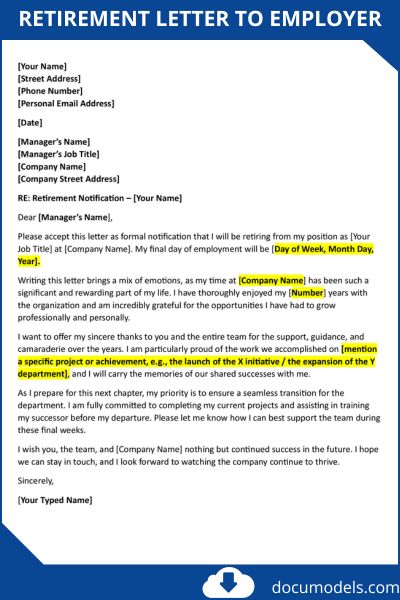
Retirement Letter to Employer (Sample)Sample retirement letter to employer
[Your Name]
[Street Address]
[Phone Number]
[Personal Email Address]
[Date]
[Manager’s Name]
[Manager’s Job Title]
[Company Name]
[Company Street Address]
RE: Retirement Notification – [Your Name]
Dear [Manager’s Name],
Please accept this letter as formal notification that I will be retiring from my position as [Your Job Title] at [Company Name]. My final day of employment will be [Day of Week, Month Day, Year].
Writing this letter brings a mix of emotions, as my time at [Company Name] has been such a significant and rewarding part of my life. I have thoroughly enjoyed my [Number] years with the organization and am incredibly grateful for the opportunities I have had to grow professionally and personally.
I want to offer my sincere thanks to you and the entire team for the support, guidance, and camaraderie over the years. I am particularly proud of the work we accomplished on [mention a specific project or achievement, e.g., the launch of the X initiative / the expansion of the Y department], and I will carry the memories of our shared successes with me.
As I prepare for this next chapter, my priority is to ensure a seamless transition for the department. I am fully committed to completing my current projects and assisting in training my successor before my departure. Please let me know how I can best support the team during these final weeks.
I wish you, the team, and [Company Name] nothing but continued success in the future. I hope we can stay in touch, and I look forward to watching the company continue to thrive.
Sincerely,
[Your Typed Name]
Retirement Letter Sample to Notify Your Employer
[Your Full Name]
[Department, if applicable]
[Your Email Address]
[Phone Number]
[Date]
[Supervisor’s Name or “Human Resources Manager”]
[Their Job Title]
[Company Name]
[Company Address]
Dear [Supervisor’s Name or “Human Resources Manager”],
I am writing to formally notify you of my decision to retire from my position as [Your Job Title] at [Company Name], effective [Retirement Date, e.g., June 30, 2026]. After [number of years, e.g., 25 years] of dedicated service, I am excited to transition into this next phase of my life.
I want to express my deepest gratitude for the opportunities, support, and professional growth I’ve experienced here. Collaborating with such an outstanding team on initiatives like [briefly mention 1-2 key achievements or projects, e.g., “the 2023 expansion project”] has been profoundly rewarding and has shaped my career in meaningful ways.
To ensure a smooth handover, I am committed to assisting during my notice period. This includes documenting key processes, training a successor, and addressing any outstanding tasks. Please let me know the best way to proceed with these efforts.
I look forward to discussing the details of my retirement benefits, final payroll, and any required exit procedures. Thank you once again for an exceptional journey—I will always cherish my time at [Company Name].
Sincerely,
[Your Full Name]
[Your Signature, if printed]
What Is a Retirement Letter to Employer?
A retirement letter is a formal document you provide to your employer to announce your intention to leave the workforce and end your employment with the company.
Unlike a standard resignation letter, a retirement letter specifically states that you are concluding your career, not just moving to another job.
This letter serves several important functions:
- Official Notification: It provides a formal, written record of your departure date for HR and administrative purposes.
- Professional Courtesy: It gives your employer ample time to plan for your departure, including finding and training a replacement.
- Benefits and Pension: It initiates the process for your company to prepare your final pay, pension, retirement benefits, and any other entitlements.
- Preserves Relationships: It allows you to express gratitude and maintain positive relationships with your colleagues and the company as you leave.
When and How to Notify Your Employer
Timing your retirement announcement is essential to avoid disrupting operations while giving yourself time to prepare. The “when” depends on your industry, role, and company policy, but here’s a general framework.
Ideal Timeline for Notification
- Standard Notice Period: Most professionals give 2-4 weeks’ notice, but for retirement, aim for 3-6 months if possible. This allows ample time for succession planning.
- Senior or Specialized Roles: If you’re in executive leadership or a niche position (e.g., IT specialist or teacher), notify 6-12 months in advance to facilitate a smooth handover.
- Check Your Contract: Review your employment agreement for any required notice periods. Some companies mandate 30-90 days.
- Personal Factors: Consider your health, financial readiness, and retirement plans. If you’re eligible for full benefits at a certain age (e.g., 65 for Medicare in the U.S.), align your date accordingly.
How to Notify Your Employer
1. Verbal Discussion First: Before submitting the letter, have a private conversation with your supervisor. This builds rapport and allows for questions. Schedule a meeting via email: “I’d like to discuss my future plans with the company.”
2. Submit the Written Letter: Follow up with the formal letter via email (with a PDF attachment) or printed copy. Use company letterhead if available.
3. Choose the Delivery Method:
- In-Person: Hand it to your boss during or after the verbal discussion.
- Email: CC HR and use a professional subject line like “Formal Notice of Retirement.”
- Certified Mail: Rare, but useful if there’s tension or legal concerns.
4. Follow Company Protocol: Some organizations have HR forms or portals for retirement notifications. Inquire discreetly if needed.
Pro Tip: Avoid announcing during busy seasons (e.g., end-of-year for accountants) to minimize impact.
Core Elements of a Retirement Letter
A well-structured retirement letter is clear, concise, and professional. It should contain several key components to ensure all necessary information is conveyed effectively.
Here are the essential elements to include:
- Clear Statement of Intent: The very first paragraph should state your intention to retire and your final day of employment. Be direct and unambiguous.
- Your Last Day of Work: Provide a specific date for your last day. For example, “My last day of employment will be Friday, March 28, 2026.”
- Expression of Gratitude: Thank your employer for the opportunities you have been given. You can mention specific experiences, skills you have gained, or positive memories from your time with the company.
- Offer to Assist with the Transition: State your willingness to help ensure a smooth handover. This could involve training your replacement, documenting your job duties, or completing pending projects.
- Positive Closing: End the letter on a warm and forward-looking note, wishing the company and your colleagues future success.
- Your Signature: A formal letter requires your handwritten signature above your typed name.
How to Write a Retirement Letter Step-by-Step
Writing your retirement letter does not need to be complicated. Follow these steps to craft a professional and thoughtful document.
Step 1: Start with a Formal Salutation
Begin your letter with a professional greeting addressed to your direct manager.
- Example: “Dear [Manager’s Name],”
Step 2: State Your Intention and Effective Date
In the first paragraph, get straight to the point. Announce your retirement and state your last day of work clearly.
- Example: “Please accept this letter as formal notification of my intention to retire from my position as [Your Job Title] at [Company Name]. My final day of employment will be [Your Last Day].”
Step 3: Express Gratitude
Use the second paragraph to thank the company for your time there. This is a chance to reflect positively on your career.
- Example: I want to express my sincere gratitude for the opportunity to have worked here for the past [Number] years. I have thoroughly enjoyed my time at [Company Name] and am proud of the contributions we have made together. I am especially thankful for the support and guidance you have provided throughout my career.
Step 4: Offer to Help with the Transition
Show your commitment to a smooth handover in the next paragraph. This demonstrates your professionalism and goodwill.
- Example: I am dedicated to ensuring a seamless transition upon my departure. I am more than willing to assist in training my replacement and documenting my responsibilities to ensure that my projects continue without interruption. Please let me know how I can best support this process over the coming weeks.
Step 5: Add a Positive Closing
Conclude your letter with well wishes for the future of the company and your colleagues.
- Example: “I wish you and [Company Name] continued success, and I look forward to hearing about your future accomplishments. I will cherish the relationships I have built here.”
Step 6: End with a Professional Sign-off
Finish with a professional closing and your signature.
- Example:
“Sincerely,”
[Your Handwritten Signature]
[Your Typed Name]
Post-Submission Considerations and Next Steps
Once you have submitted your letter, your work is not quite done. The transition period is just as important as the initial notification.
During the Transition Period
- Stay Engaged: Continue to perform your duties with the same level of professionalism and commitment you always have. Avoid “checking out” mentally before your last day.
- Document Everything: Create detailed documentation of your daily tasks, ongoing projects, key contacts, and login credentials. This will be an essential resource for your successor.
- Train Your Replacement: If your replacement is hired before you leave, invest time in training them. Share your knowledge and introduce them to key stakeholders.
- Organize Your Files: Clean up your digital and physical files to make them easy for your successor to navigate.
Finalizing Your Departure
- Discuss Benefits with HR: Schedule a meeting with the HR department to discuss the details of your retirement package. This includes your pension, 401(k) or other retirement plans, final paycheck, and any unused vacation payout.
- Health Insurance: Clarify what happens to your health insurance. You may be eligible for COBRA or a company-sponsored retiree health plan.
- Say Your Goodbyes: Take time to say goodbye to your colleagues. You might exchange personal contact information with those you wish to stay in touch with.
- Return Company Property: On your last day, be sure to return all company property, including your laptop, phone, keys, and ID badge.
Format model to edit
Related Articles: