
Establishing proof of residency is a crucial step for various administrative and legal processes, such as applying for a driver’s license, enrolling in school, or verifying your address for immigration purposes.
A proof of residency letter serves as a formal document that confirms your current address and can be issued by a landlord, employer, or another credible source. This letter typically includes essential details such as your full name, address, and the duration of your stay at that address, along with the contact information of the person or entity verifying your residence.
Crafting an effective proof of residency letter can seem daunting, but with the right guidance, you can ensure it meets all necessary requirements.
In this post, we will provide you with a comprehensive overview of what a proof of residency letter should include, tips on how to write one, and common mistakes to avoid. Additionally, we will share various examples to help you understand how to structure and format your letter correctly.
What is a Proof of Residency Letter?
A Proof of Residency Letter, also known as an Affidavit of Residence, is an official document that confirms an individual’s address. This letter is usually requested by institutions like schools, banks, government agencies, or employers to verify where someone lives.
It acts as evidence of residency and is typically used when other forms of proof, such as utility bills or lease agreements, are not available.
Why is a Proof of Residency Letter Needed?
There are various scenarios where this document might be required, such as:
- Enrolling a child in school (schools often need proof you live within the district).
- Opening a bank account and needing to verify your permanent address.
- Applying for government services like a driver’s license or voter registration.
- Renting an apartment when the landlord wants additional documentation.
- Verifying residence for insurance purposes or legal matters.
Who Can Write a Proof of Residency Letter?
Not just anyone can issue a valid Proof of Residency Letter. The person or entity writing the letter must have a direct connection to the individual and enough knowledge to verify their address.
Here are some common examples of who can write this type of letter:
1. Landlords or Property Managers
- Often, tenants request Proof of Residency Letters from landlords to confirm their current address.
- These individuals can verify that you rent or reside at a specific address based on tenancy agreements.
2. Employers
- If your place of employment requires you to live in a certain area, your employer might issue this letter to confirm your local residence.
3. Parents or Guardians
- For minors or dependent individuals who cannot prove residency on their own, a parent or guardian can write and sign the letter.
4. Government or Community Representatives
- Social workers, notaries, or community leaders can issue these types of letters, especially for people with informal living arrangements.
5. Utility Service Providers
- Some proof of residency processes accept letters or endorsements from utility companies. A utility bill attached to a handwritten or digitally authorized letter works in these cases.
General Structure
A well-written Proof of Residency Letter usually follows this format:
- Header: Includes the writer’s contact information and the date.
- Salutation (optional): A polite introduction to the letter recipient, if known.
- Body: Outlines the purpose of the letter, including the writer’s relationship to the individual and confirmation of the address.
- Closing Statement: Assurance of the letter’s accuracy and intent, often with a request to contact the writer for further confirmation.
- Signature: The writer’s signature and printed name seal its authenticity.
How to Write a Proof of Residency Letter
Below is a step-by-step guide on how to write a proof of residency letter.
1. Understand the Requirements
Before you begin writing, it’s crucial to understand what information is required in the letter. Different institutions may have specific requirements, so make sure to gather all necessary details.
2. Gather Supporting Documents
Collect any documents that can serve as evidence of your residency. These may include:
- Utility bills (electricity, water, gas)
- Lease agreements
- Bank statements
- Government correspondence
3. Write the Header
Start by including your name, address, and contact information at the top of the letter. Below your information, include the date.
4. Address the Letter
Address the letter to the relevant authority or institution. If you don’t have a specific name, use a general title such as “To Whom It May Concern.”
5. State the Purpose
Clearly state the purpose of the letter in the opening paragraph.
For example: “I am writing this letter to confirm that [Your Name] resides at [Your Address].”
6. Provide Residency Details
In the body of the letter, include the following details:
- The full address of the residence
- The duration of residency (e.g., “I have been living at this address since January 2023.”)
- Any additional information that may be relevant (e.g., names of other residents)
7. Include a Statement of Truth
Include a statement affirming the truthfulness of the information provided.
For example: “I hereby certify that the above information is true and accurate to the best of my knowledge.”
8. Sign the Letter
Sign the letter and print your name below your signature. If required, have the letter notarized.
Proof of Residency Letter Template
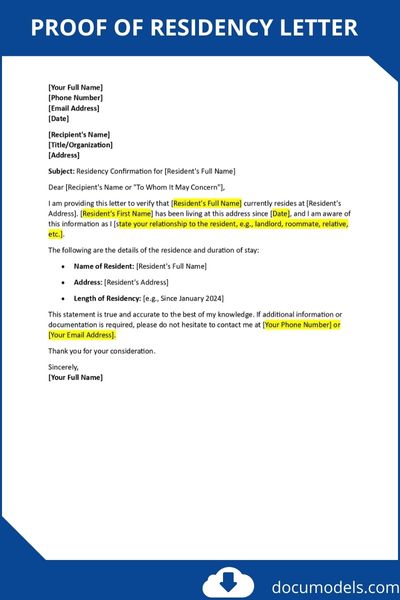
General Example
[Your Full Name]
[Phone Number]
[Email Address]
[Date]
[Recipient’s Name]
[Title/Organization]
[Address]
Subject: Residency Confirmation for [Resident’s Full Name]
Dear [Recipient’s Name or “To Whom It May Concern”],
I am providing this letter to verify that [Resident’s Full Name] currently resides at [Resident’s Address]. [Resident’s First Name] has been living at this address since [Date], and I am aware of this information as I [state your relationship to the resident, e.g., landlord, roommate, relative, etc.].
The following are the details of the residence and duration of stay:
- Name of Resident: [Resident’s Full Name]
- Address: [Resident’s Address]
- Length of Residency: [e.g., Since January 2024]
This statement is true and accurate to the best of my knowledge. If additional information or documentation is required, please do not hesitate to contact me at [Your Phone Number] or [Your Email Address].
Thank you for your consideration.
Sincerely,
[Your Full Name]
[Your Signature if submitting a printed copy]
Proof of residency letter from family member sample
[Your Full Name]
[Phone Number]
[Your Email Address]
[Date]
[Recipient’s Name or Organization]
[Recipient’s Address]
Subject: Proof of Residency for [Individual’s Full Name]
Dear [Recipient’s Name or Sir/Madam],
I am writing to confirm that [Individual’s Full Name], whose date of birth is [Date of Birth], resides at my address, which is [Your Address]. [He/She/They] has been living at this residence since [Start Date of Residency] and continues to reside here as of today’s date.
[Individual’s Full Name] is my [Relationship to Individual, e.g., son/daughter/niece/nephew/etc.], and I can confirm that [he/she/they] uses this address as their primary and permanent residence.
Should you require any further information or clarification, please feel free to contact me at [Your Phone Number] or [Your Email Address].
Thank you for your attention to this matter.
Sincerely,
[Your Full Name]
Proof of residency letter for school
[Your Full Name]
[Phone Number]
[Email Address]
[Date]
[School Name]
[School Address]
Subject: Proof of Residency for [Student’s Full Name]
Dear [School Administrator’s Name or Sir/Madam],
I am writing to confirm that [Student’s Full Name], whose date of birth is [Date of Birth], resides at my address, which is [Your Address]. [He/She/They] has been living at this residence since [Start Date of Residency] and continues to reside here as of today’s date.
[Student’s Full Name] is my [Relationship to Student, e.g., son/daughter/ward], and our residence is within the district boundaries of [District/School Name]. This letter serves as confirmation of [his/her/their] primary and permanent residence for enrollment purposes at your school.
If you need further information or clarification, please do not hesitate to contact me at [Your Phone Number] or [Your Email Address].
Thank you for your time and attention to this matter.
Sincerely,
[Your Full Name]
Notarization and Legal Considerations
Why is Notarization Important?
Notarizing a Proof of Residency letter adds an extra layer of authenticity. A notary public acts as an impartial witness to the signing of the letter, ensuring the legitimacy of the document. Many organizations, including government bodies, require notarized letters to prevent fraud.
Steps to Notarize a Proof of Residency Letter:
- Complete the Letter but don’t sign it yet.
- Visit a notary public (found at banks, libraries, UPS stores, or online notary services).
- Sign in the Presence of the Notary to validate the document.
- The notary will stamp and seal the document as official.
Legal Considerations
While writing or using a Proof of Residency letter, there are a few key legal aspects to keep in mind:
- Do Not Falsify Information
Providing false information on this document can lead to serious legal consequences, including fines or imprisonment. - Understand Acceptance Criteria
Each organization may have its own rules about what constitutes valid proof of residency. Always verify the specific requirements before submitting. - Keep Copies of Supporting Documents
If the letter is not enough, you might need additional records like utility bills, lease agreements, or government-issued IDs.
Supporting Documents Commonly Used Alongside:
- Utility bills or lease agreements.
- Bank statements showing the address.
- Driver’s license or state ID card.
- School enrollment or employment letters.
Format model to edit
Related Articles: