
When unexpected situations arise, ensuring the safety and well-being of your child or dependent becomes a top priority.
A Temporary Guardianship Agreement is a practical and legal solution that allows parents or legal guardians to grant temporary care responsibilities to a trusted individual, such as a close relative or family friend.
This agreement provides peace of mind by clearly outlining the guardian’s rights and duties during a specified period, whether it’s due to travel, medical needs, or other circumstances requiring short-term care.
Understanding how to create a comprehensive Temporary Guardianship Agreement can save you from potential complications and ensure that your loved one is cared for properly.
In this post, we’ll explore the key elements of a Temporary Guardianship Agreement, why it’s important, and how it can protect everyone involved. Plus, we’ll share easy-to-use templates that you can customize and print instantly to fit your unique situation.
Free Temporary Guardianship Agreement Template
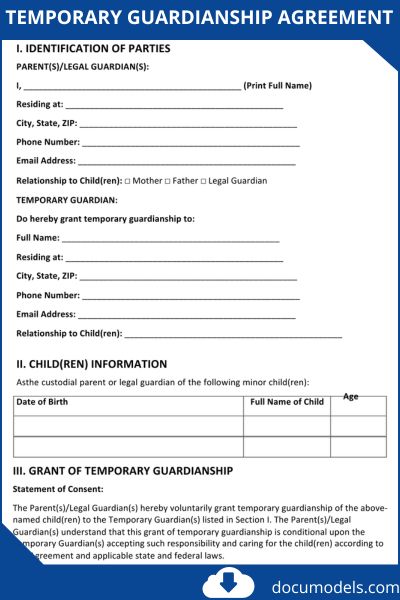
Understanding the nuances of temporary guardianship is essential for parents and guardians alike, as it can significantly impact a child’s safety and stability.
Temporary Guardianship Agreement (Template)Temporary Guardianship Agreement Template
What Is a Temporary Guardianship Agreement?
A temporary guardianship agreement is a legal document that grants another adult (the “guardian”) the authority to care for your child for a limited time.
Unlike permanent guardianship, which often involves a court order and the termination of parental rights, a temporary agreement is a more flexible arrangement made between parents and a chosen guardian.
This document empowers the temporary guardian to make important decisions for the child, such as those related to education, healthcare, and daily well-being. It provides legal proof that the person caring for your child has the authority to do so, which is essential for interacting with schools, doctors, and other institutions.
Situations Requiring Temporary Guardianship
Parents may need to establish temporary guardianship for various reasons. The arrangement is designed for short-term situations where a parent is unable to fulfill their parental duties.
Common scenarios include:
- Military Deployment: A parent in the armed forces is deployed overseas or for an extended domestic assignment.
- Medical Reasons: A parent is facing a serious illness, undergoing surgery with a long recovery period, or entering a rehabilitation program.
- Work or Travel: A job requires extensive travel, or a parent must be away from home for a prolonged period.
- Educational Needs: In some cases, to allow the child to attend school in a different district or during parental absence.
- Family Emergencies: A parent needs to care for another sick family member in a different location.
In each case, the goal is to provide a stable and safe environment for the child until the parent can resume their responsibilities.
Key Components of a Temporary Guardianship Agreement
A well-drafted agreement acts as a roadmap for all parties involved. It should be clear, comprehensive, and tailored to the specific needs of the child.
Essential elements include:
- Identification of Parties: Full names, addresses, and relationships of the parent(s), child(ren), and proposed guardian(s). If multiple guardians are named, list them in order of preference.
- Duration and Triggering Events: Specify the start and end dates, or events that activate and terminate the guardianship (e.g., “upon the parent’s return from deployment”).
- Scope of Authority: Detail the guardian’s powers, such as consenting to medical treatment, enrolling in school, or managing finances. Be explicit about limitations, like no authority to consent to adoption.
- Reason for Guardianship: A brief explanation of why the arrangement is needed, which helps in legal validation.
- Visitation and Communication Plans: Outline how parents will stay involved, including visitation rights or regular updates.
- Contingency Plans: What happens if the guardian becomes unavailable or if unexpected issues arise.
- Signatures and Notarization: Spaces for all parties to sign, often requiring witnesses or a notary.
How to Write a Temporary Guardianship Agreement
Creating a legally sound agreement is essential. While you can find templates online, it’s often wise to have the final document reviewed by a family law attorney.
Here is a step-by-step guide to writing the agreement:
- Title the Document: Clearly label the document at the top, for example, “Temporary Guardianship Agreement.”
- State the Basics: Begin with a paragraph identifying the parents, child, and the appointed guardian by their full legal names and addresses.
- Define the Term: Clearly state the start and end dates of the guardianship period.
- List the Guardian’s Powers: Use a numbered or bulleted list to detail the powers you are granting. Cover healthcare, education, and daily care.
- Include Financial Arrangements (Optional): If you are providing funds for the child’s care, detail how the guardian will access and use them. This is not always required but can prevent misunderstandings.
- Add a Revocation Clause: Include a statement explaining that you, the parent, have the right to revoke the guardianship at any time.
- Create Signature Lines: The agreement must be signed and dated by the parent(s) and the temporary guardian.
Legal Requirements and Formalities
To ensure your temporary guardianship agreement is legally recognized, you must follow certain formalities. These can differ from one state to another, so it’s a good idea to check your local laws.
- Written Document: The agreement must be in writing. An oral agreement is not legally enforceable.
- Signatures: All parties—the parents and the temporary guardian—must sign the document. If both parents have legal custody, both should sign.
- Notarization: Many states require the agreement to be signed in the presence of a notary public. A notary verifies the identities of the signers and witnesses them signing the document, adding a layer of legal validity.
- Witnesses: Some states may also require one or two witnesses to sign the agreement. Witnesses should be adults who are not named in the document.
While court approval is not usually necessary for a temporary guardianship agreement created by a parent, filing a copy with the local family court can provide an extra measure of security.
Parental Rights, Consent, and Revocation
Granting temporary guardianship does not mean you are giving up your parental rights. This is a key distinction between temporary and permanent guardianship.
Parental Rights
The parent remains the child’s legal guardian and retains the right to make major decisions affecting the child’s life, unless that responsibility has been expressly granted to the temporary guardian.
The right to maintain contact and visitation is also preserved, and these terms may be clearly defined within the agreement itself.
Consent
The agreement is based on consent. As the parent, you willingly grant authority to the chosen guardian. The guardian must also consent to taking on the responsibilities. The document serves as proof of this mutual consent.
Revocation
Because you retain your parental rights, you can revoke the temporary guardianship at any time. The process is typically straightforward. You should provide a written notice of revocation to the temporary guardian.
The agreement should include a clause that explains this right. Once you revoke the agreement, the guardian’s legal authority ends, and you resume full responsibility for your child.
Temporary Guardianship Agreement FAQs
The maximum length depends on state law. Many states allow a few months up to about a year, sometimes with the option to renew or seek court‑ordered guardianship if it needs to continue longer. Parents often choose a period that matches a specific event (deployment, medical treatment, work assignment) and state the start and end dates clearly in the document.
Often, if all legal parents agree and the arrangement is truly short‑term, a properly drafted and notarized document is enough for schools and medical providers. Some states, however, require a court order for longer periods, contested situations, or when there are existing custody orders.
Parents generally remain the child’s legal parents, retaining overall custody and the ability to make major decisions unless a court has limited those rights. The temporary guardian exercises day‑to‑day authority during the agreed period, but parents usually can revoke the arrangement and resume direct care, subject to any existing court orders that say otherwise.
Usually, any competent adult over 18 who can provide safe, stable care, has no disqualifying criminal history, and can meet the child’s needs. States often prefer relatives or close family friends, but eligibility and background-check requirements vary by state.
Yes, that is typically one of the main purposes. The agreement can authorize the guardian to consent to routine and emergency medical or dental care, access records, enroll the child in school, communicate with teachers, and sign forms such as field‑trip permissions.
Most agreements can be ended at any time by the parent(s) through a signed written revocation delivered to the guardian, schools, and healthcare providers. The agreement should also contain an automatic end date or condition, such as the parent’s return from deployment.
Format model to edit
Related Articles: