
Addressing employee misconduct is a challenging but necessary part of management. When verbal warnings are not enough, a formal Letter of Reprimand becomes an essential tool.
This official document formally records a breach of company policy, poor performance, or unacceptable behavior.
It serves as a clear statement that an employee’s actions have been noted and that improvement is required. More than just a disciplinary measure, a well-written letter protects the organization legally while giving the employee a clear path to correct their actions.
Understanding the correct structure, tone, and content is crucial for creating a letter that is both effective and fair. It must be direct, professional, and unambiguous to avoid confusion and potential disputes.
In this post, we’ll explore how to craft a well-structured Letter of Reprimand, highlight key components to include, and share practical tips to maximize its impact.
Letter of reprimand examples
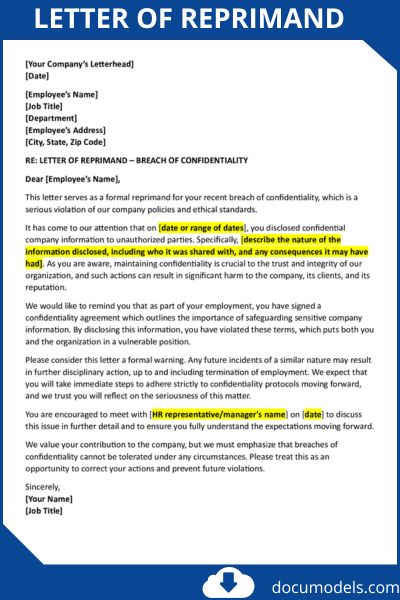
A letter of reprimand serves as a formal tool for addressing unacceptable behavior or performance issues among employees.
Letter of Reprimand (Sample)Example letter of reprimand for breach of confidentiality
[Your Company’s Letterhead]
[Date]
[Employee’s Name]
[Job Title]
[Department]
[Employee’s Address]
[City, State, Zip Code]
RE: LETTER OF REPRIMAND – BREACH OF CONFIDENTIALITY
Dear [Employee’s Name],
This letter serves as a formal reprimand for your recent breach of confidentiality, which is a serious violation of our company policies and ethical standards.
It has come to our attention that on [date or range of dates], you disclosed confidential company information to unauthorized parties. Specifically, [describe the nature of the information disclosed, including who it was shared with, and any consequences it may have had]. As you are aware, maintaining confidentiality is crucial to the trust and integrity of our organization, and such actions can result in significant harm to the company, its clients, and its reputation.
We would like to remind you that as part of your employment, you have signed a confidentiality agreement which outlines the importance of safeguarding sensitive company information. By disclosing this information, you have violated these terms, which puts both you and the organization in a vulnerable position.
Please consider this letter a formal warning. Any future incidents of a similar nature may result in further disciplinary action, up to and including termination of employment. We expect that you will take immediate steps to adhere strictly to confidentiality protocols moving forward, and we trust you will reflect on the seriousness of this matter.
You are encouraged to meet with [HR representative/manager’s name] on [date] to discuss this issue in further detail and to ensure you fully understand the expectations moving forward.
We value your contribution to the company, but we must emphasize that breaches of confidentiality cannot be tolerated under any circumstances. Please treat this as an opportunity to correct your actions and prevent future violations.
Sincerely,
[Your Name]
[Job Title]
Sample letter of reprimand for unprofessional conduct
[Company Name]
[Company Address]
[City, State, Zip Code]
[Phone Number]
[Email Address]
[Date]
[Employee’s Name]
[Employee’s Position]
[Address]
Re: Formal Reprimand for Unprofessional Conduct
Dear [Employee’s Name],
This letter serves as a formal reprimand for your unprofessional conduct on [Date(s) of Incident(s)]. As discussed in our previous conversations, we expect all employees of [Company Name] to adhere to our company’s code of conduct, maintaining a standard of professionalism and respect in all workplace interactions.
On [specific date(s)], you engaged in behavior that violated [specific policy, rule, or expectation, e.g., “our workplace harassment policy,” “appropriate communication standards,” or “company dress code”]. Specifically, [describe the behavior or incident in detail, including any actions, words, or situations that were unprofessional, such as inappropriate language, disrespectful behavior, or failure to adhere to company standards].
Such behavior is not acceptable at [Company Name] and does not reflect the professional standards we aim to maintain in our workplace. We have discussed this issue with you on [previous dates of informal discussions or warnings], but despite our previous conversations, the behavior has continued. Please be advised that any further instances of unprofessional conduct may lead to more severe disciplinary action, up to and including termination of employment.
We encourage you to take this reprimand seriously and reflect on the impact of your actions on the team and the overall work environment. [Offer any recommendations for improvement, such as “We suggest you attend a training session on workplace conduct” or “We encourage you to seek guidance from HR if you need support in maintaining professional behavior.”]
Please sign and return the enclosed copy of this letter, acknowledging that you have received and reviewed it. If you have any questions or would like to discuss this matter further, do not hesitate to contact me.
We trust that this reprimand will serve as a reminder of our expectations and encourage you to make the necessary adjustments to your behavior moving forward.
Sincerely,
[Your Name]
[Your Title]
[Company Name]
Acknowledgment of Receipt
I, [Employee’s Name], acknowledge receipt of this letter of reprimand and understand its contents.
Employee’s Signature: ___________________________
Date: ___________________________
Purpose of a Letter of Reprimand
The primary goal of a letter of reprimand is to correct undesirable behavior or performance while protecting the organization legally and operationally.
Here’s why they’re used:
- Document Issues: It creates a paper trail, which is crucial for HR records. If the problem escalates, this letter can justify further actions like demotion or firing.
- Encourage Improvement: By clearly outlining the problem and expectations, it gives the employee a chance to fix things before more drastic measures.
- Maintain Fairness and Consistency: It ensures all employees are held to the same standards, reducing claims of favoritism or discrimination.
- Protect the Employer: In legal disputes (e.g., wrongful termination lawsuits), it shows the employer attempted to resolve issues reasonably.
- Promote a Positive Work Culture: Addressing problems promptly prevents minor issues from becoming major disruptions, fostering accountability.
Common Reasons for Issuing a Reprimand
Not every mistake warrants a formal letter. Minor errors are usually handled through coaching. However, recurring issues or serious policy breaches require formal documentation.
Common triggers include:
- Attendance Issues: Chronic tardiness, unexcused absences, or abusing sick leave policies.
- Performance Deficiencies: Consistently missing deadlines, failing to meet quotas, or producing work that is below the agreed-upon standard despite previous coaching.
- Insubordination: Refusal to follow direct orders from a supervisor or showing disrespect toward management.
- Policy Violations: Breaches of safety protocols, misuse of company property, or violating the code of conduct (e.g., harassment or bullying).
- Negligence: Carelessness that results in financial loss, safety hazards, or damage to the company’s reputation.
Structure of a Letter of Reprimand
A well-structured letter ensures clarity and professionalism. It typically follows a standard business letter format.
Here’s a breakdown:
- Header: Include the company’s letterhead, date, employee’s name, position, and department.
- Salutation: Address the employee formally (e.g., “Dear [Employee’s Name],”).
- Introduction/Statement of Purpose: State that this is a formal reprimand and briefly describe the issue.
- Body/Details of the Incident: Provide specifics—what happened, when, where, and how it violated policy. Include evidence or witnesses.
- Impact Section: Explain how the behavior affects the team, company, or clients.
- Expectations for Improvement: Outline required changes, timelines, and support (e.g., training).
- Consequences: Warn of further actions if no improvement occurs.
- Closing: Offer a chance for response, sign off professionally (e.g., “Sincerely, [Your Name and Title]”).
- Attachments: Reference any supporting documents.
How to Write a Letter of Reprimand: A Step-by-Step Guide
Writing this letter requires a balance of firmness and professionalism. Follow these steps to draft an effective document.
Step 1: Gather Your Facts
Before writing a single word, review your notes. Do you have the exact dates of previous verbal warnings? do you have evidence of the poor performance? Relying on memory (“You’re always late”) is dangerous. Relying on data (“You were late on March 3rd, 10th, and 12th”) is professional.
Step 2: Use Clear, Objective Language
Avoid emotional language. Words like “lazy,” “careless,” or “bad attitude” are subjective and defensive. Instead, describe the behavior.
- Subjective: “You were disrespectful in the meeting.”
- Objective: “During the Tuesday meeting, you interrupted the client three times and raised your voice when corrected.”
Step 3: Connect to Policy
Whenever possible, cite the specific company policy or handbook section that has been violated. This grounds the reprimand in established rules rather than personal opinion.
Step 4: Define the “Cure”
Tell the employee exactly what success looks like. If they need to arrive by 9:00 AM, state that. If they need to submit reports with zero errors, state that. Vague instructions like “do better” set employees up to fail.
Step 5: Draft the Consequences Clause
You must be transparent about the next steps. Standard phrasing often includes: “Failure to improve this behavior immediately and sustainably may result in further disciplinary action, up to and including termination of employment.”
Follow-Up After Issuing a Letter of Reprimand
Issuing the letter isn’t the end—follow-up ensures progress:
- Schedule Check-Ins: Meet weekly or monthly to discuss improvements.
- Monitor Performance: Track metrics objectively.
- Provide Support: Offer training or counseling if promised.
- Document Outcomes: Note positive changes or further issues in follow-up memos.
- Escalate if Needed: If no improvement, proceed to next disciplinary steps.
- Recognize Success: If resolved, acknowledge it to rebuild morale.
A timeline example:
- Day 1: Issue letter and initial meeting.
- Week 2: First follow-up review.
- Month 1: Formal evaluation of progress.
Tips for Writing Effective Letters of Reprimand
To ensure your letter achieves its goals without causing unnecessary legal exposure, keep these tips in mind:
- Be Timely: Do not wait weeks after an incident to write the letter. Delays suggest the behavior wasn’t actually that serious.
- Focus on Behavior, Not Character: Attack the problem, not the person. This helps maintain a professional relationship.
- Keep it Private: Confidentiality is key. Discussing the reprimand with other employees destroys trust and can create a hostile work environment.
- Proofread Carefully: A document filled with typos undermines your authority. Ensure names, dates, and policy references are 100% accurate.
- Consult HR: Before issuing any formal written warning, always have Human Resources review the draft. They ensure consistent application of policy across the company.
Format model to edit
Related Articles: