
Walking away from a job is never an easy decision, but sometimes life throws situations your way that demand immediate action. An immediate resignation letter is a formal document used to inform your employer that you won’t be able to continue working, effective right away.
Unlike a standard resignation, this type of letter skips the traditional two-week notice period and is typically used during urgent or unforeseen circumstances.
Maybe you’ve been offered a once-in-a-lifetime opportunity that starts tomorrow, or a personal emergency requires your undivided attention. Whatever the reason, delivering your resignation professionally—even on short notice—is crucial for maintaining your reputation and leaving on good terms.
If you’re unsure how to structure one or what to say, don’t worry. We’re here to guide you every step of the way. Read on to discover tips and letter examples that will guide you in crafting a letter that ensures a graceful and professional departure.
Immediate Resignation Letter Samples
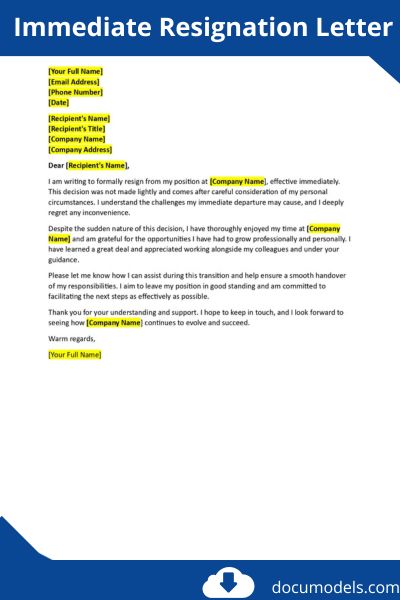
Submitting a clear and professional Immediate Resignation Letter is essential to maintain your reputation and close this chapter respectfully
Immediate Resignation Letter (Word)Immediate resignation letter template
[Your Full Name]
[Email Address]
[Phone Number]
[Date]
[Recipient’s Name]
[Recipient’s Title]
[Company Name]
[Company Address]
Dear [Recipient’s Name],
I am writing to formally resign from my position at [Company Name], effective immediately. This decision was not made lightly and comes after careful consideration of my personal circumstances. I understand the challenges my immediate departure may cause, and I deeply regret any inconvenience.
Despite the sudden nature of this decision, I have thoroughly enjoyed my time at [Company Name] and am grateful for the opportunities I have had to grow professionally and personally. I have learned a great deal and appreciated working alongside my colleagues and under your guidance.
Please let me know how I can assist during this transition and help ensure a smooth handover of my responsibilities. I aim to leave my position in good standing and am committed to facilitating the next steps as effectively as possible.
Thank you for your understanding and support. I hope to keep in touch, and I look forward to seeing how [Company Name] continues to evolve and succeed.
Warm regards,
[Your Full Name]
Immediate resignation letter for personal reasons
[Your Full Name]
[Email Address]
[Phone Number]
[Date]
[Recipient’s Full Name]
[Their Professional Title]
[Company/Organization Name]
[Company Address]
Dear [Recipient’s Full Name],
I am writing to formally announce my resignation from my position at [Company/Organization Name], effective immediately.
This decision has not been easy and it comes after careful consideration of my personal circumstances. Due to unforeseen personal reasons, I am unable to continue my duties and responsibilities in a manner that meets both my standards and those of [Company/Organization Name].
I am deeply grateful for the opportunities for professional and personal development that you have provided me during my time here. I have enjoyed working for the company and appreciate the support provided me during my tenure with the company.
If there are any ways I can assist during this transition, please let me know. I hope to make the process as smooth as possible and ensure a seamless handover of my responsibilities.
Thank you for your understanding.
Yours sincerely,
[Your Signature (if sending a hard copy)]
[Your Typed Name]
Immediate resignation letter due to a toxic work environment
[Your Name]
[Email Address]
[Phone Number]
[Date]
[Recipient’s Name]
[Recipient’s Title]
[Company’s Name]
[Company’s Address]
Dear [Recipient’s Name],
I am writing to formally resign from my position as [Your Position] at [Company’s Name], effective immediately.
Unfortunately, due to the increasingly toxic work environment, I feel that continuing in my current role is no longer tenable. Despite my efforts to address these issues, the situation has not improved, and it has significantly affected my well-being and ability to perform my duties effectively.
I appreciate the opportunities for professional growth and development that I have received during my tenure at [Company’s Name]. However, my health and well-being must take precedence, and I believe this decision is in my best interest.
Please consider this letter as my formal resignation and my last working day will be [today’s date]. I am willing to assist in the transition process and ensure that all my responsibilities are handed over smoothly.
Thank you for your understanding.
Sincerely,
[Your Name]
When Is It Necessary to Resign Without Notice?
There are several scenarios where resigning without notice might be justified:
- Health Issues: If you face severe health problems that prevent you from continuing your work duties.
- Family Emergencies: Urgent family matters that require your immediate and undivided attention.
- Unsafe Work Environment: Situations where the workplace conditions are hazardous or unethical.
- Harassment or Discrimination: If you are experiencing harassment or discrimination that makes the work environment intolerable.
- New Job Offer: Occasionally, a new job opportunity may require you to start immediately.
Impact on Professional Relationship
Departing without observing the customary notice period might strain professional relationships, as it can leave the employer with a sudden vacancy that needs to be filled.
- Employer’s Readiness: An immediate resignation challenges an employer’s ability to quickly adapt and find a replacement, potentially disrupting ongoing projects and team dynamics.
- Future References: Although the decision to resign immediately might be necessary, it can influence the employee’s professional references and the likelihood of future re-employment with the same organization.
- Communication and Transition: Offering to assist with the transition or documenting work processes can help mitigate the impact on professional relationships. Clear and respectful communication of the reasons for resignation is essential.
Legal Considerations
Legal considerations surrounding Immediate Resignation should be carefully evaluated. Key aspects include:
- Employment Contracts: An employee should review their contract terms to understand any implications or potential penalties for resigning without notice.
- Company Policies: Adherence to company-specific resignation procedures should be considered, even when resigning immediately.
- Local Employment Laws: These laws can vary significantly and may provide certain protections or impose specific requirements on both the employee and employer.
- Documentation: Providing a written notice is vital, as it formally records the intent to resign and the reasons when necessary.
Steps to Take When Resigning Without Notice
- Evaluate the Situation: Assess whether immediate resignation is the only viable option.
- Communicate with Your Employer: If possible, have a direct conversation with your employer or HR to explain your situation.
- Prepare Your Resignation Letter: Write a concise and professional resignation letter.
- Return Company Property: Ensure you return any company property such as laptops, keys, or documents.
- Offer Assistance: If feasible, offer to help with the transition remotely or by providing documentation.
How To Write an Immediate Resignation Letter
Follow these steps to create a clear, professional, and respectful immediate resignation letter.
1. Start with a Professional Format
Presentation matters when writing any formal letter. An immediate resignation letter should follow standard business formatting to appear professional and respectful.
Here’s what to include:
- Your Contact Information: Name, phone number, and email (aligned to the left).
- Date: The day you’re writing the letter.
- Employer’s Information: Name, title, company address.
- Salutation: Use “Dear [Manager’s Name].”
Here’s a quick example of how your header might look:
[Your Name]
[Phone Number]
[Your Email Address]
[Date]
[Manager’s Name]
[Company Name]
[Company Address]
Dear [Manager’s Name],
2. State Your Intent Clearly
Begin your letter by getting straight to the point. Clearly articulate that you are resigning and specify that your resignation is effective immediately. This sets the tone and leaves no room for ambiguity.
Example:
“I am writing to formally resign from my position as [Your Job Title] at [Company Name], effective immediately.”
3. Provide a Brief Explanation
While offering an explanation isn’t mandatory, providing a brief, honest reason for your decision shows respect and professionalism. Keep it concise and avoid overly personal details or complaints.
Examples of concise explanations:
- “Due to unforeseen personal circumstances, I am unable to continue in my role.”
- “I have accepted an opportunity that requires my immediate availability.”
- “Health concerns require my full attention at this time.”
4. Express Gratitude
Maintaining a positive tone is vital, even if you’re leaving under challenging circumstances. Take a moment to thank your employer for the opportunities and experiences you’ve had while working at the company. Gratitude adds a professional touch and keeps the door open for future connections.
Example:
“I want to take this opportunity to thank you and the team for the support and opportunities I have received during my time at [Company Name]. I am genuinely grateful for the chance to grow both personally and professionally.”
5. Offer Assistance
Even though you’re leaving immediately, offering to help with the transition shows professionalism and consideration. Be realistic about what you can reasonably assist with during your departure.
Ways to offer assistance:
- Completing a final handover document.
- Answering questions remotely (if appropriate).
- Sharing important passwords, files, or task statuses.
Example:
“I am willing to assist in any way possible to ensure a smooth transition. Please feel free to reach out if there’s any information I can provide to help during this process.”
6. Close on a Positive Note
End the letter with a polite and professional closing that reinforces your appreciation and goodwill. Sign off using a formal, respectful closing phrase and your full name.
Example of a closing paragraph:
“Once again, I appreciate all the support and guidance I’ve received during my time at [Company Name]. I wish you and the team continued success in the future. Please don’t hesitate to contact me if you need further assistance.”
Closing phrases to consider:
- “Sincerely, [Your Full Name]”
- “Best regards, [Your Full Name]”
- “With gratitude, [Your Full Name]”
Final Tips for Writing
- Be Honest: If appropriate, explain your reason for leaving, but keep it professional and tactful.
- Keep It Brief: Aim for a one-page letter; there’s no need to go into too much detail.
- Review Before Sending: Double-check for grammar and spelling errors to ensure a polished and professional tone.
- Plan for Feedback: Be ready for a conversation about your resignation and answer any questions professionally.
- Send It Appropriately: Ideally, hand-deliver the letter or email it directly to your manager or HR, depending on your company’s protocol.
Frequently Asked Questions
Reasons include personal emergencies, illness, unsafe or hostile work environments, harassment, ethical concerns, or urgent job opportunities with immediate start dates.
You might lose a reference, damage professional relationships, or forfeit severance benefits. It’s important to handle the resignation professionally to minimize negative outcomes.
You don’t have to give detailed reasons unless you feel comfortable. It’s acceptable to keep your explanation brief and professional.
Typically, an employer cannot refuse your resignation. However, it’s important to check your employment contract for obligations like notice periods or penalties.
Maintain a polite tone in your letter, offer to help with the transition if possible, and thank your employer for the experiences gained during your time there.
Address your resignation letter to your direct supervisor or manager, ensuring you use a professional tone throughout
Format model to edit
Related Articles: