
Crafting a winning SEO proposal is the critical first step in turning a promising lead into a long-term client. Far more than a simple price list, a strong proposal builds trust and sets the foundation for a successful partnership.
It demonstrates your understanding of the client’s unique business goals and outlines a clear path to achieving them. A well-structured document translates complex SEO strategies into a compelling business case, giving potential clients the confidence to invest in your services.
In this article, we will explore the key components of a successful SEO proposal, highlight the elements that make it stand out, and provide a customizable template to help you get started.
Whether you’re new to SEO or a seasoned professional, mastering the art of the proposal can significantly enhance your chances of closing deals and growing your business.
SEO Proposal Templates
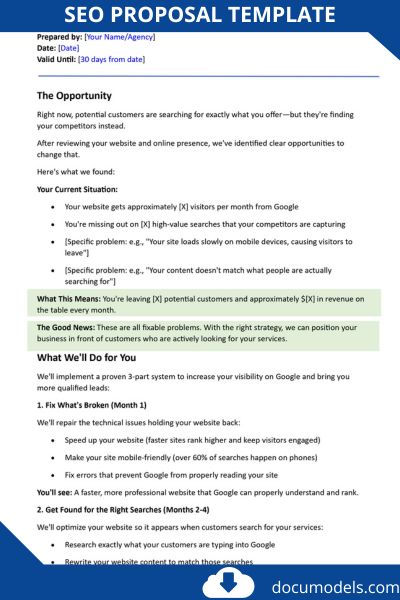
An effective proposal not only outlines your services but also demonstrates your understanding of the client’s needs and goals.
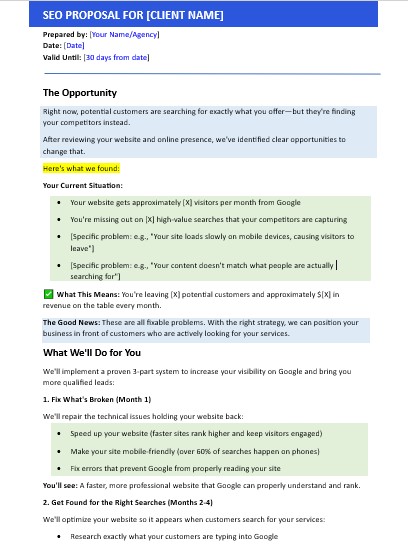
Download seo proposalSample of SEO proposal
What Is an SEO Proposal?
At its core, an SEO proposal is a formal document that proposes SEO services to a potential client. It details the strategies, timelines, costs, and expected outcomes for optimizing their website.
Key Characteristics of an SEO Proposal
- Professional and Structured: It’s not just an email—it’s a polished document, often in PDF or presentation format (e.g., Google Slides or PowerPoint).
- Data-Driven: Includes audits, competitor analysis, and metrics to back up your recommendations.
- Client-Centric: Focuses on the client’s goals, pain points, and how SEO will solve them.
- Actionable: Outlines specific steps, not vague promises.
For beginners, imagine it like a job application: You highlight your skills (SEO expertise), experience (case studies), and what you’ll deliver (improved rankings).
Purpose and Importance of an SEO Proposal
The primary purpose of an SEO proposal is to convince a potential client that your services are worth investing in. It serves as a sales tool, a contract outline, and a project blueprint all in one.
Why Is It Important?
- Builds Trust: By showing thorough research (e.g., a site audit), you prove you’re not just selling hype.
- Sets Clear Expectations: Prevents misunderstandings about deliverables, timelines, and costs.
- Differentiates You from Competitors: A standout proposal with visuals and data can win over clients who receive multiple pitches.
- Drives Business Growth: For agencies, winning proposals means more revenue; for clients, it means better online presence.
In importance terms, consider this: SEO can increase organic traffic by 100-200% in the first year for many sites, but without a solid proposal, clients won’t see the value. It’s crucial in a market where businesses spend an average of $1,000-$10,000 monthly on SEO services.
| Benefit | Description | Example Impact |
| Client Acquisition | Helps close deals by addressing objections upfront. | Convert 30% more leads into paying clients. |
| Risk Mitigation | Outlines terms to avoid scope creep. | Reduces project disputes by 50%. |
| Strategic Planning | Provides a roadmap for SEO campaigns. | Achieves 20-50% traffic growth in 6 months. |
Basic Elements of an SEO Proposal
A strong SEO proposal includes several core components. For first-timers, think of these as the building blocks—miss one, and your proposal might crumble.
Essential Sections
- Cover Page and Introduction: Includes your logo, client details, and a personalized greeting. Introduce your agency and the proposal’s purpose.
- Client’s Current Situation: A website audit summary, highlighting issues like slow load times, poor mobile optimization, or weak backlinks.
- Goals and Objectives: Align with the client’s business goals, e.g., “Increase organic traffic by 50% in 6 months.”
- Proposed Strategy: Break down services like keyword research, on-page SEO, content creation, link building, and technical fixes.
- Timeline and Milestones: A phased plan, e.g., Month 1: Audit and Research; Month 2-3: Implementation.
- Pricing and Payment Terms: Transparent costs, perhaps tiered packages (Basic, Standard, Premium).
- Case Studies or Testimonials: Proof of past success to build credibility.
- Next Steps and Call to Action: How to proceed, like scheduling a call.
- Terms and Conditions: Legal details, including guarantees (or lack thereof, since SEO isn’t guaranteed).
How to Create a Successful SEO Proposal
Follow these steps to build a proposal that is both strategic and persuasive.
Step 1: Research the Prospect Thoroughly
Before writing a single word, you must understand the client’s business. Your proposal cannot be a generic template; it must be a custom solution.
- Understand Their Business: What do they sell? Who are their customers? What is their unique value proposition?
- Identify Their Business Goals: Are they trying to generate more leads, increase e-commerce sales, or build brand awareness? This is the most important question to answer.
- Analyze Their Competitors: Who ranks for their target keywords? What are those competitors doing well, and where are their weaknesses?
Step 2: Run a Lightweight SEO Audit
A mini-audit provides the data you need to justify your strategy. You don’t need to do a full-scale, multi-day audit for a proposal, but you should investigate a few key areas:
- On-Page SEO: Check for issues with title tags, meta descriptions, header usage, and keyword optimization on key pages.
- Technical SEO: Use a tool like Google’s PageSpeed Insights to check site speed. Look for obvious indexing issues (e.g., using a site:domain.com search) and check the robots.txt file.
- Off-Page SEO: Analyze their backlink profile using a tool like Ahrefs or Semrush. How many referring domains do they have? Is the quality good or spammy?
- Content Gaps: Identify valuable keywords they are not ranking for but their competitors are.
Step 3: Align SEO Objectives with Business Outcomes
This is where many proposals fail. A client doesn’t buy “backlinks” or “keyword optimization”; they buy more revenue and more customers. You must connect your SEO activities to their bottom line.
Example:
- Instead of: “We will build 10 high-quality backlinks per month.”
- Try: “To increase your authority and rankings for ‘commercial plumbing services,’ we will acquire high-quality backlinks from industry publications. This will drive more qualified traffic to your service pages, resulting in an estimated 15% increase in lead form submissions over six months.”
Step 4: Build a Realistic Roadmap
An effective roadmap manages expectations and shows a clear plan of action. A good approach is to structure it around quick wins and long-term goals.
Example Timeline Snippet:
Month 1 (Foundation & Quick Wins):
- Technical SEO audit and implementation of critical fixes (e.g., site speed, indexation).
- On-page optimization of top 5 service pages.
- Setup of analytics and rank tracking.
Months 2-3 (Content & Authority Building):
- Publish 2 new blog posts targeting mid-funnel keywords.
- Begin foundational link-building outreach.
- Optimize Google Business Profile for local search.
Months 4-6 (Scaling & Expansion):
- Expand content strategy to address top-of-funnel queries.
- Scale targeted link acquisition.
- Analyze performance data and refine strategy.
Step 5: Define Your Measurement Plan
Show the client how you will track progress and demonstrate ROI.
Key Performance Indicators (KPIs): Choose metrics that matter.
- Good KPI: Organic traffic, keyword rankings for commercial terms, conversion rate from organic search, number of qualified leads.
- Bad KPI: Impressions, bounce rate (without context), keyword rankings for vanity terms.
Baselines: Record the current metrics before you start so you can show improvement.
Reporting Cadence: Specify how often you will report. A monthly report and a quarterly strategy review is a common and effective cadence.
Step 6: Price Your Services Strategically
Choose a pricing model that aligns with the scope of work and the value you provide. Be transparent and confident in your pricing.
Common SEO Pricing Models
| Model | Description | Pros | Cons |
| Retainer | A fixed fee paid monthly for ongoing SEO services. | Predictable revenue for you, consistent budget for the client. | Scope creep can be an issue if not clearly defined. |
| Project-Based | A flat fee for a one-time project (e.g., a technical audit or a site migration). | Clear scope and timeline. | No ongoing revenue unless it leads to a retainer. |
| Hourly | The client pays an hourly rate for your time. | Flexible and simple to track. | Clients may focus on hours instead of results; income is not scalable. |
| Performance | Payment is based on achieving specific KPIs (e.g., a bonus for ranking #1). | Directly ties your pay to results. | High risk; many ranking factors are outside your control. |
Step 7: Address Common Objections
Anticipate potential concerns and address them proactively in your proposal.
- “It’s too expensive.” Frame your pricing in terms of value and potential ROI, not cost. Compare the investment to the potential revenue gain.
- “How long until we see results?” Set realistic expectations in your timeline. Explain that SEO is a long-term strategy but that you’ll track leading indicators (like ranking improvements) from the start.
- “Can you guarantee a #1 ranking?” No. Explain that no one can guarantee rankings, as Google’s algorithm is a black box. Instead, guarantee your process, expertise, and commitment to their goals.
Customization Tips and Best Practices
To make your SEO proposal stand out, tailor it to each client while following proven best practices. This personalization boosts engagement and conversion rates.
Key Customization Tips
- Align with Industry and Goals: For an e-commerce client, emphasize conversion tracking; for a local business, focus on Google My Business optimization. Reference their specific metrics from the audit.
- Personalize the Narrative: Use the client’s name, challenges, and success stories from similar industries. For example, “Like we did for Client X in retail, we’ll target high-intent keywords for your site”.
- Adapt Length and Depth: Shorten for quick audits (3-5 pages); expand for enterprise projects with appendices for full audits.
- Incorporate Client Feedback: If they’ve shared preferences (e.g., via email), weave them in, like prioritizing content over links.
Best Practices
- Use Visuals Strategically: Add infographics for timelines or pie charts for budget breakdowns to simplify complex info without overwhelming text. Avoid clutter—limit to 2-3 per proposal.
- Minimize Jargon and Focus on ROI: Explain acronyms on first use (e.g., ROI: Return on Investment). Quantify benefits: “SEO can deliver 14.6% annual ROI on average”.
- Include Proof of Expertise: Add anonymized case studies, testimonials, or awards. For instance, “We increased organic traffic by 200% for a similar client in 6 months”.
- Ensure Mobile-Friendliness and Interactivity: If digital, make it clickable with embedded forms for signatures.
- Follow Up Promptly: Send within 24-48 hours of the pitch call, and track opens if using tools like Flodesk.
- Legal Considerations: Include terms on confidentiality, revisions, and termination to protect both parties.
Format model to edit
Related Articles: