
Receiving a job offer is an exciting milestone in your career journey. It represents recognition of your skills, experience, and potential contribution to a new team.
But before you officially step into your new role, there’s an important step that many candidates overlook: writing a thank-you letter for the job offer.
This simple yet powerful gesture not only shows your gratitude but also reinforces your professionalism, enthusiasm, and commitment to the opportunity.
A well-crafted thank-you letter goes beyond basic courtesy. It can strengthen your relationship with your future employer, highlight your genuine interest in the position, and set a positive tone for your first days at work.
To help you get it right, we’ve put together a guide on how to write the perfect response. Explore our job offer thank-you letter templates to make a lasting impact.
Job Offer Thank You Letter Templates and Examples
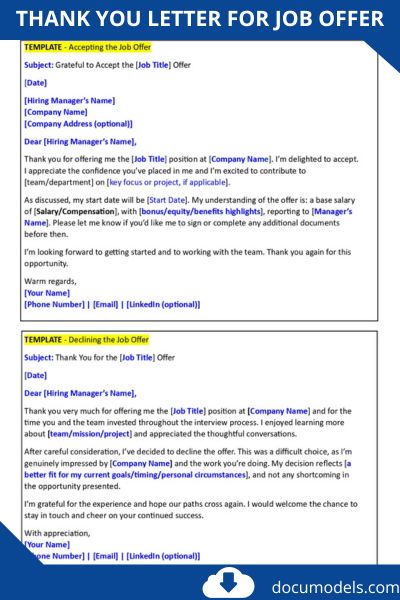
This simple gesture can leave a lasting impression on your future employer, setting the tone for a positive relationship from the very start.
Download Job Offer Thank You LetterTemplate 1: Accepting the Job Offer
Subject: Grateful to Accept the [Job Title] Offer
[Date]
[Hiring Manager’s Name]
[Company Name]
[Company Address (optional)]
Dear [Hiring Manager’s Name],
Thank you for offering me the [Job Title] position at [Company Name]. I’m delighted to accept. I appreciate the confidence you’ve placed in me and I’m excited to contribute to [team/department] on [key focus or project, if applicable].
As discussed, my start date will be [Start Date]. My understanding of the offer is: a base salary of [Salary/Compensation], with [bonus/equity/benefits highlights], reporting to [Manager’s Name]. Please let me know if you’d like me to sign or complete any additional documents before then.
I’m looking forward to getting started and to working with the team. Thank you again for this opportunity.
Warm regards,
[Your Name]
[Phone Number] | [Email] | [LinkedIn (optional)]
Template 2: Requesting Time to Consider
Subject: Thank You for the [Job Title] Offer — Request for Short Decision Window
[Date]
Dear [Hiring Manager’s Name],
Thank you for extending the offer for the [Job Title] role at [Company Name]. I’m honored by your confidence and truly excited about the opportunity to contribute to [team/initiative].
To make the most thoughtful decision, I’d like a brief period to review the details and align timing with current commitments. Would it be possible to confirm my decision by [Proposed Date—e.g., “Tuesday, September 2”]? If a different timeline is necessary, I’m happy to accommodate and will prioritize accordingly.
In the meantime, if you can share any additional materials that would help my evaluation—such as a benefits summary, onboarding plan, or details about [specific question]—I’d appreciate it.
Thank you again for the offer and for your understanding. I’m very enthusiastic about the role and will be back in touch by [Proposed Date].
Sincerely,
[Your Name]
[Phone Number] | [Email] | [LinkedIn (optional)]
Template 3: Declining the Job Offer
Subject: Thank You for the [Job Title] Offer
[Date]
Dear [Hiring Manager’s Name],
Thank you very much for offering me the [Job Title] position at [Company Name] and for the time you and the team invested throughout the interview process. I enjoyed learning more about [team/mission/project] and appreciated the thoughtful conversations.
After careful consideration, I’ve decided to decline the offer. This was a difficult choice, as I’m genuinely impressed by [Company Name] and the work you’re doing. My decision reflects [a better fit for my current goals/timing/personal circumstances], and not any shortcoming in the opportunity presented.
I’m grateful for the experience and hope our paths cross again. I would welcome the chance to stay in touch and cheer on your continued success.
With appreciation,
[Your Name]
[Phone Number] | [Email] | [LinkedIn (optional)]
Why Send a Thank You Letter for a Job Offer?
Sending a thank you letter isn’t just good manners; it’s a strategic move that can influence your professional relationship.
Here’s why it’s essential, especially if you’re new to the job market:
- Demonstrates Professionalism and Gratitude: Employers invest time and resources in the hiring process. A thank you letter shows you value their effort, reinforcing your image as a courteous and thoughtful candidate.
- Reaffirms Your Interest: It keeps the conversation going and reminds the hiring manager of your enthusiasm, which can be crucial if they’re considering multiple candidates or if the offer is contingent.
- Provides an Opportunity to Clarify or Negotiate: If the offer details (like salary, benefits, or start date) need discussion, this letter is the perfect place to politely raise questions without seeming ungrateful.
- Builds Long-Term Relationships: Even if you decline, a gracious thank you can keep doors open for future opportunities. Networking is key in careers, and positive interactions matter.
- Sets You Apart: In a survey by CareerBuilder, 22% of hiring managers said they are less likely to hire candidates who don’t send thank you notes after interviews—imagine the impact post-offer!
If you skip it: You risk appearing disinterested or unprofessional, potentially leading to the offer being rescinded or extended to someone else.
Accepting or Declining the Job Offer
Your thank you letter often doubles as your response to the offer. Decide promptly—most employers expect a reply within 1-3 business days.
Here’s a detailed breakdown for first-timers:
Accepting the Offer
If the role aligns with your goals, accept enthusiastically but professionally.
- Review the Offer Thoroughly: Check salary, benefits (health insurance, PTO, retirement plans), job title, responsibilities, start date, and any contingencies (e.g., background checks).
- Express Acceptance Clearly: State your acceptance upfront in the letter to avoid ambiguity.
- Confirm Next Steps: Ask about onboarding, paperwork, or any immediate actions.
- Negotiate if Needed: If terms aren’t ideal, propose changes politely (e.g., “I am excited to accept, but would it be possible to adjust the start date to [date]?”).
Declining the Offer
Declining gracefully is crucial—burn no bridges!
- Be Honest but Positive: You don’t need to detail reasons (e.g., better offer elsewhere), but a brief, positive note like “After careful consideration, I’ve decided to pursue another opportunity that aligns more closely with my current goals” suffices.
- Thank Them Profusely: Highlight what you appreciated about the process or company.
- Keep It Brief: No need for lengthy explanations; respect their time.
- Offer to Stay in Touch: Suggest connecting on LinkedIn for future networking.
Tip for Beginners: If undecided, request an extension politely: “Thank you for the offer. Could I have until [date] to respond?” This buys time without offending.
| Scenario | Key Action | Potential Outcome |
| Accepting | State acceptance early; confirm details. | Faster onboarding; positive start to employment. |
| Declining | Express thanks; keep positive. | Preserved network; possible future opportunities. |
| Negotiating | Propose changes diplomatically. | Improved terms; shows assertiveness. |
Key Components of a Job Offer Thank You Letter
A well-structured letter ensures clarity and impact. For those new to this, think of it as a simple email with these essential parts:
1. Subject Line: Clear and concise, e.g., “Thank You for the [Job Title] Offer at [Company Name]”.
2. Greeting: Personalized, like “Dear [Hiring Manager’s Name],” or “Hello [Team/Department],” if names are unknown.
3. Opening Paragraph (Gratitude and Acknowledgment): Thank them for the offer and express excitement. Reference the position and date of the offer.
4. Body Paragraph(s):
- Reaffirm interest or state decision (accept/decline).
- Clarify any questions or negotiate terms.
- Highlight why you’re a great fit (briefly, to reinforce value).
5. Closing Paragraph: Reiterate thanks, provide contact info, and end positively.
6. Sign-Off: Professional, e.g., “Best regards,” followed by your full name, phone, and LinkedIn/profile link.
How to Write a Job Offer Thank You Letter
Crafting the perfect thank you letter doesn’t have to be complicated. Follow these steps to create a clear, professional, and impactful message.
Step 1: Choose the Right Format (Email vs. Mail)
In today’s professional world, email is the standard and most efficient way to send a thank you letter for a job offer. It’s fast, ensures immediate delivery, and allows the hiring manager to respond quickly.
A handwritten note sent via traditional mail can be a nice touch, but it should be sent in addition to an email, not instead of it. For the sake of timeliness, always start with an email.
Step 2: Craft a Clear Subject Line
Your subject line should be direct and easy to understand. The hiring manager is likely very busy, so make it simple for them to see what your email is about.
Examples of effective subject lines:
- Job Offer – [Your Name]
- Thank You – [Job Title] Offer
- [Your Name] – Job Offer Acceptance
- Following Up: [Job Title] Offer
Step 3: Use a Professional Salutation
Address the letter to the person who extended the offer, typically the hiring manager or recruiter. Use a formal and respectful greeting.
Examples:
- Dear Mr. Smith,
- Dear Ms. Jones,
- Dear [Hiring Manager’s Name],
Step 4: Express Your Gratitude
Begin the letter by thanking them for the job offer. Be specific about the position you were offered. This should be the very first sentence of your letter.
Example:
“Thank you so much for offering me the position of Marketing Manager at [Company Name].”
Step 5: Reiterate Your Enthusiasm
Briefly restate your excitement for the role and the company. This reinforces that you are a good fit and genuinely interested in the opportunity.
Example:
“I truly enjoyed learning more about the role and your team during the interview process, and I am very excited about the opportunity to contribute to your company’s success.”
Step 6: Address the Offer and Next Steps
This is where your letter might vary depending on your situation.
You have a few options:
- Accepting the Offer: If you are ready to accept, state it clearly. You can mention the agreed-upon salary and start date to confirm the terms.
- Requesting Time to Decide: It’s completely acceptable to ask for time to review the offer. State how much time you need (e.g., “by the end of the week” or a specific date).
- Opening Negotiations: If you want to discuss the terms, you can use the letter to set up a time for a conversation.
Example for accepting:
“I am delighted to formally accept the offer. I look forward to starting on [Start Date] and am excited to join the team.”
Example for requesting time:
“As the offer includes many details, I would like to take a few days to review it thoroughly. I will be in touch with my final decision by [Date].”
Step 7: Close Professionally
End your letter with a professional closing.
Examples:
- Sincerely,
- Best regards,
- Respectfully,
Follow the closing with your full name and contact information.
Format model to edit
Related Articles: