
Selecting the ideal candidate is only the beginning of a successful hiring process. The job offer letter marks a critical next step: it is the formal bridge between candidate selection and onboarding.
More than simply outlining salary and start date, this document serves to welcome new hires, clarify essential terms, and legally formalize the employment agreement.
A well-structured offer letter establishes a foundation of professionalism and trust, ensuring transparency and minimizing misunderstandings from the outset.
It also communicates your organization’s commitment to a positive working relationship, reassuring new team members of their value. For organizations aiming to attract and retain top talent, the right offer letter can set the tone for long-term success.
In this article, we will guide you through the key elements of an employment offer letter, highlighting its significance and common pitfalls to avoid. Additionally, we will provide a practical job offer letter example to illustrate the ideal format and content.
Employment offer letter templates
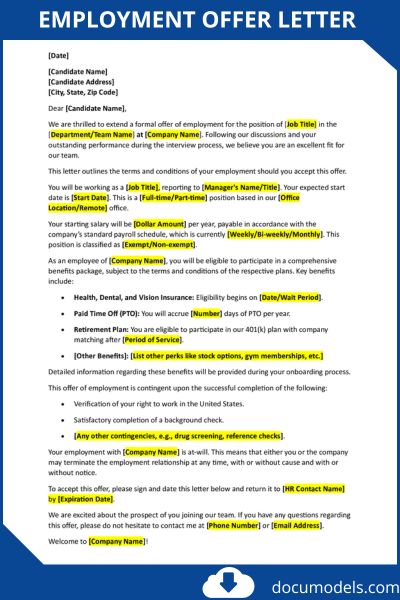
This essential document not only outlines the terms of employment but also reflects the company’s culture and professionalism.
Job Offer letter (template)Job Offer letter template
[Date]
[Candidate Name]
[Candidate Address]
[City, State, Zip Code]
Dear [Candidate Name],
We are thrilled to extend a formal offer of employment for the position of [Job Title] in the [Department/Team Name] at [Company Name]. Following our discussions and your outstanding performance during the interview process, we believe you are an excellent fit for our team.
This letter outlines the terms and conditions of your employment should you accept this offer.
You will be working as a [Job Title], reporting to [Manager’s Name/Title]. Your expected start date is [Start Date]. This is a [Full-time/Part-time] position based in our [Office Location/Remote] office.
Your starting salary will be [Dollar Amount] per year, payable in accordance with the company’s standard payroll schedule, which is currently [Weekly/Bi-weekly/Monthly]. This position is classified as [Exempt/Non-exempt].
As an employee of [Company Name], you will be eligible to participate in a comprehensive benefits package, subject to the terms and conditions of the respective plans. Key benefits include:
- Health, Dental, and Vision Insurance: Eligibility begins on [Date/Wait Period].
- Paid Time Off (PTO): You will accrue [Number] days of PTO per year.
- Retirement Plan: You are eligible to participate in our 401(k) plan with company matching after [Period of Service].
- [Other Benefits]: [List other perks like stock options, gym memberships, etc.]
Detailed information regarding these benefits will be provided during your onboarding process.
This offer of employment is contingent upon the successful completion of the following:
- Verification of your right to work in the United States.
- Satisfactory completion of a background check.
- [Any other contingencies, e.g., drug screening, reference checks].
Your employment with [Company Name] is at-will. This means that either you or the company may terminate the employment relationship at any time, with or without cause and with or without notice.
To accept this offer, please sign and date this letter below and return it to [HR Contact Name] by [Expiration Date].
We are excited about the prospect of you joining our team. If you have any questions regarding this offer, please do not hesitate to contact me at [Phone Number] or [Email Address].
Welcome to [Company Name]!
Sincerely,
(Signature)
[Your Name]
[Your Job Title]
[Company Name]
—————————————————————————————————–
Acceptance
I, [Candidate Name], accept the offer of employment as [Job Title] at [Company Name] as described in this letter.
Signature: __________________________________________________
Date: ______________________________________________________
Template 2: Job Offer letter for apartment
[Company Name]
[Company Address]
[City, State, ZIP Code]
[Email Address] | [Phone Number]
[Date]
[Candidate’s Full Name]
[Candidate’s Address]
[City, State, ZIP Code]
Dear [Candidate’s Full Name],
We are pleased to extend a formal offer of employment for the position of Apartment Manager at [Company Name/Property Name], located at [Property Address]. We were impressed by your experience in property management, tenant relations, and maintenance oversight during the interview process, and we believe you will be a valuable addition to our team.
This is a full-time position reporting to [Supervisor’s Name/Title, e.g., Regional Property Manager]. Your anticipated start date is [Start Date, e.g., Monday, January 15, 2026], with standard working hours of [e.g., 40 hours per week, Monday through Friday, 9:00 AM to 5:00 PM, with on-call availability].
Compensation and Benefits:
- Base annual salary: [Amount, e.g., $55,000], paid [e.g., bi-weekly].
- Performance bonus: Eligible for up to [e.g., 10%] of base salary based on property performance metrics.
- Benefits: Comprehensive health, dental, and vision insurance (company pays [e.g., 80%] of premiums); 401(k) with [e.g., 4%] employer match; paid time off (15 days vacation, 10 sick days, 7 paid holidays); and a company-provided vehicle for property-related duties.
This offer is contingent upon successful completion of a background check, reference verification, and proof of eligibility to work in [Country/State]. Employment is at-will, meaning either party may terminate the relationship at any time, with or without cause or notice.
To accept this offer, please sign and date the bottom of this letter and return it to us by [Deadline, e.g., December 25, 2025] via email to [HR Contact Email] or mail. If you have any questions, contact [HR Contact Name] at [Phone Number]. We look forward to welcoming you to the team!
Sincerely,
[Your Full Name]
[Your Title, e.g., Human Resources Director]
[Company Name]
[Phone Number] | [Email Address]
Acceptance:
I accept the offer of employment as outlined above.
Signature: _______________________________ Date: _______________
Printed Name: [Candidate’s Full Name]
What Is an Employment Offer Letter?
An employment offer letter is a formal document extended by an employer to a job candidate, outlining the terms and conditions of employment.
Unlike a verbal offer, this letter provides a tangible record that protects both parties by clarifying expectations and reducing misunderstandings.
Think of it as a contract precursor, it’s not always legally binding (depending on jurisdiction and wording), but it sets the stage for the formal employment agreement.
For first-timers, note that offer letters are common in professional roles but may vary by industry; for example, tech companies often include equity details, while retail might focus on hourly wages.
Key differences from related documents:
- Employment Contract: More detailed and legally enforceable, often including non-compete clauses.
- Letter of Intent: Less formal, used in early negotiations.
- At-Will Employment Statement: Often included in offer letters, indicating employment can end at any time.
When to Use an Employment Offer Letter
You should use a formal offer letter every time you intend to hire someone or significantly change an employee’s status. It provides a paper trail and ensures both parties are on the same page.
Here are the most common scenarios:
- New Hires: The most obvious use case. Whether it is a full-time executive or a part-time assistant, they need a letter.
- Internal Promotions: If an existing employee gets a new title and salary, a new offer letter supersedes their old one.
- Change in Status: Moving someone from part-time to full-time (or vice versa) requires new documentation regarding benefits and hours.
- Temporary to Permanent: If a contractor is becoming a full-time employee, an offer letter formalizes this transition.
Pro Tip: Always deliver the offer verbally first. Sending a letter cold without a phone call can feel impersonal. Call the candidate to share the good news, then follow up immediately with the letter.
Essential Elements of an Employment Offer Letter
A vague offer letter is a recipe for negotiation headaches later. To be comprehensive and clear, your letter must include specific components.
Here is a checklist of the “must-haves”:
1. Job Details
- Job Title: The official name of the role.
- Department: Where they fit in the organization.
- Reporting Structure: The name or title of their direct supervisor.
- Work Location: Is this remote, hybrid, or in a specific office?
2. Timeline
- Start Date: The exact day and time they are expected to report for work.
- Schedule: Expected work hours (e.g., 9:00 AM to 5:00 PM) and days of the week.
3. Compensation
- Salary/Wage: State the annualized salary for exempt employees or the hourly rate for non-exempt employees.
- Payment Schedule: How often will they get paid? (e.g., bi-weekly, monthly).
- Bonuses: If applicable, outline the structure for sign-on bonuses, commissions, or performance bonuses.
4. Benefits Overview
You do not need to paste the whole policy handbook here, but you should summarize the perks:
- Health, dental, and vision insurance eligibility.
- 401(k) matching.
- Paid time off (PTO) and sick leave policies.
- Stock options or equity grants.
5. Legal Statements
- At-Will Statement: Crucial for US employers. Explicitly state that the employment is at-will and can be terminated by either party at any time.
- Privacy/Confidentiality: A brief mention that they may need to sign a Non-Disclosure Agreement (NDA).
6. Expiration Date
Create a sense of urgency. Include a deadline by which the candidate must sign and return the letter (usually 2 to 5 business days).
How to Write an Employment Offer Letter
Writing your first offer letter can feel daunting, but following a step-by-step process makes it straightforward. Aim for a concise, positive tone—keep it to 1-2 pages. Use professional language, avoid jargon, and proofread for errors.
Step-by-Step Guide
- Prepare the Template: Start with a customizable template. Include placeholders for variable details like salary.
- Personalize the Introduction: Begin with “We are pleased to offer you the position of [Job Title] at [Company Name].” Express enthusiasm to build rapport.
- Detail the Offer: Use bullet points or paragraphs to cover job title, start date, reporting structure, and compensation. For example: “Your annual base salary will be $75,000, paid bi-weekly.”
- Outline Benefits and Perks: List them clearly, e.g.: Health, dental, and vision insurance starting after 30 days, 15 days of paid time off annually, 401(k) matching up to 5%.
- Include Contingencies: State any conditions, like “This offer is contingent upon successful completion of a background check.”
- Add Legal Clauses: If applicable, include at-will employment or confidentiality agreements.
- Provide Acceptance Details: Specify a response deadline (e.g., 7 days) and how to accept (e.g., sign and email back).
- Close Professionally: End with “We look forward to welcoming you to the team!” and sign off.
- Review and Send: Have legal or HR review it, then send via email or certified mail.
Sample Snippet:
Dear [Candidate’s Name],
We are excited to extend a formal offer for the role of Marketing Coordinator at XYZ Corp. Your skills and experience make you a perfect fit for our team.
Best Practices and Tips for Creating Job Offer Letters
To make your offer letters stand out and increase acceptance rates, incorporate these best practices. They’re especially useful for beginners to avoid common pitfalls.
- Keep It Positive and Engaging: Use welcoming language to excite the candidate. Avoid negative phrasing like “failure to accept will result in…”
- Be Transparent and Accurate: Double-check all details—errors in salary can erode trust. Disclose any probationary periods upfront.
- Customize for the Candidate: Reference specific interview discussions, like “As discussed, this role includes flexible remote work options.”
- Comply with Laws: Research regulations (e.g., EEOC guidelines in the U.S. for non-discrimination). For global hires, consider currency conversions and local holidays.
- Use Digital Tools: Templates from platforms like Google Docs or HR software save time. Consider using electronic signatures for greater efficiency.
- Follow Up: If no response by the deadline, send a polite reminder.
Format model to edit
Related Articles: