
When you move to a new home or office, one of the most important tasks is notifying friends, family, clients, and service providers about your change of address.
A well-written change of address letter ensures that all your important mail and communications reach you without interruption.
Whether you’re relocating locally or to a different city, this formal notification helps prevent missed bills, packages, or essential documents.
Crafting a clear and concise letter not only informs your contacts but also maintains professionalism, especially in business settings. Many people find it challenging to know what details to include or how to phrase their message effectively. That’s why having a reliable template or example letter can make the process simple and stress-free.
In this post, we will explore the key elements of a change of address letter and share practical examples you can customize for your own situation.
Change of Address Letter Templates and Examples
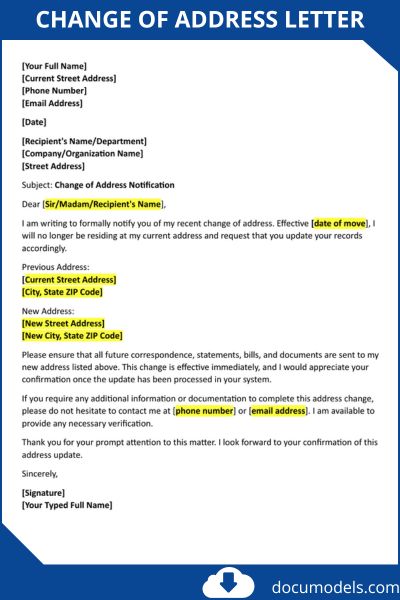
This letter is essential for avoiding missed communications, bills, or important documents.
Change of Address Letter (Sample)Sample change of address letter
[Your Full Name]
[Current Street Address]
[Phone Number]
[Email Address]
[Date]
[Recipient’s Name/Department]
[Company/Organization Name]
[Street Address]
Subject: Change of Address Notification
Dear [Sir/Madam/Recipient’s Name],
I am writing to formally notify you of my recent change of address. Effective [date of move], I will no longer be residing at my current address and request that you update your records accordingly.
Previous Address:
[Current Street Address]
[City, State ZIP Code]
New Address:
[New Street Address]
[New City, State ZIP Code]
Please ensure that all future correspondence, statements, bills, and documents are sent to my new address listed above. This change is effective immediately, and I would appreciate your confirmation once the update has been processed in your system.
If you require any additional information or documentation to complete this address change, please do not hesitate to contact me at [phone number] or [email address]. I am available to provide any necessary verification.
Thank you for your prompt attention to this matter. I look forward to your confirmation of this address update.
Sincerely,[Signature]
[Your Typed Full Name]
Business change of address letter example
STERLING & ASSOCIATES CONSULTING GROUP
1847 Parkview Boulevard, Suite 320
Boston, MA 02108
Phone: (617) 555-0142 | Email: info@sterlingassociates.com
December 30, 2025
Dear Valued Client,
RE: NOTICE OF BUSINESS ADDRESS CHANGE
We are pleased to inform you that Sterling & Associates Consulting Group will be relocating to a new office space to better serve your needs and accommodate our growing team.
Effective Date: January 20, 2026
New Address:
Sterling & Associates Consulting Group
4500 Innovation Drive, 8th Floor
Boston, MA 02115
Our phone numbers, email addresses, and website will remain unchanged during this transition. All scheduled appointments and ongoing projects will proceed as planned without interruption to our services.
This move reflects our commitment to providing you with enhanced facilities and improved accessibility. Our new location offers ample parking, is conveniently situated near public transportation, and features state-of-the-art meeting rooms for client consultations.
Please update your records with our new address effective January 20, 2026. Should you have any questions or concerns regarding this relocation, please contact our office manager, Patricia Mendez, at (617) 555-0142 or pmendez@sterlingassociates.com.
We look forward to welcoming you to our new office and continuing to provide you with exceptional service.
Sincerely,
Michael J. Sterling
Chief Executive Officer
Sterling & Associates Consulting Group
Why a Change of in Address Letter Is Important
Failing to update your address can lead to significant problems. Here’s why sending a timely notification is so important:
- Continuity of Services: Utility companies, banks, and subscription services need your current address to continue providing their services without interruption.
- Financial Security: Banks, credit card companies, and investment firms send sensitive documents, including statements, new cards, and tax forms. An incorrect address puts your financial information at risk of being lost or intercepted.
- Legal and Government Compliance: Government agencies like the IRS, Social Security Administration, and the DMV require your current address for official correspondence, tax information, and identification purposes. Failing to update it can result in missed legal notices or non-compliance.
- Personal Connections: It ensures friends and family can stay in touch, send greeting cards, and update their personal address books.
- Receiving Goods and Subscriptions: If you subscribe to magazines or regularly order products online, updating your address guarantees your items arrive at your new home.
When and Whom to Send a Change of Address Letter To
Timing is key. Ideally, you should start sending out notifications two to four weeks before your move. This gives organizations enough time to process the change. Some entities, like the post office, allow you to set a future date for mail forwarding to begin.
Create a checklist to keep track of everyone you need to notify. Your list should be divided into several categories:
Government Agencies
- Postal Service: File an official change of address with the United States Postal Service (USPS) to have your mail forwarded.
- Internal Revenue Service (IRS): Update your address to ensure you receive tax refunds and notices.
- Social Security Administration (SSA): If you receive benefits, this is a critical update.
- Department of Motor Vehicles (DMV): Your driver’s license, vehicle registration, and title must reflect your current address.
- Voter Registration Office: Update your registration to vote in local elections.
Financial Institutions
- Banks and credit unions
- Credit card companies
- Loan providers (auto, student, mortgage)
- Investment and retirement account administrators
- Accountants or financial advisors
People and Services
- Employers: For payroll, tax forms (W-2), and other official communication.
- Utility Companies: Electricity, gas, water, internet, and cable providers.
- Insurance Providers: Health, auto, life, and home or renters’ insurance.
- Healthcare Providers: Doctors, dentists, and specialists.
- Subscriptions and Memberships: Magazines, newspapers, streaming services, and subscription boxes.
- Online Shopping Sites: Update your shipping and billing information on platforms like Amazon.
- Friends and Family: Let your personal network know where to find you.
Key Elements to Include in a Change of Address Letter
Whether you’re sending a formal letter or a quick email, certain pieces of information are essential for a smooth update.
- Your Full Name: Include the full names of everyone in the household covered by the notice.
- Old Address: State your complete previous address, including the street, city, state, and ZIP code.
- New Address: Clearly provide your complete new address.
- Effective Date: Specify the date the change of address should take effect. This is usually your moving date.
- Account or Policy Numbers: For businesses and service providers, include any relevant account, policy, or customer ID numbers to help them locate your file quickly.
- Contact Information: Provide a phone number or email address in case the recipient has any questions.
Types of Change of Address Letters
Change of address letters vary by context. Here are the main types:
- Personal Change of Address Letter: For individuals notifying friends, family, or personal services. Often informal but still structured.
- Business Change of Address Letter: For companies relocating offices. Includes company letterhead, impacts on operations, and reassurances to clients.
- Temporary Change of Address Letter: For short-term moves, like vacations or renovations. Specifies start and end dates.
- Permanent Change of Address Letter: The standard type for long-term relocations.
- Official/Government Change of Address: Formal forms required by agencies like USPS or IRS, often with specific templates.
Choose based on your situation; for example, businesses might need a press release-style version for wider distribution.
How to Write a Change of Address Letter
Follow these simple steps to draft an effective notification.
- Identify the Recipient: Determine if you need a formal letter or an informal announcement.
- Gather Necessary Information: Collect all the key elements, such as your old and new addresses, effective date, and any relevant account numbers.
- Choose a Format: Decide whether to send a physical letter, an email, or use an online form. Many companies now offer a way to update your address directly through your online account profile.
- Draft the Letter: Start with a clear subject line. State the purpose of the letter in the first sentence. Clearly list your old and new addresses to avoid confusion.
- Proofread: Double-check all the information for accuracy, especially addresses and account numbers. A simple typo can derail the entire process.
- Send It: Mail your letter, send your email, or submit the online form at least two weeks before you move.
Best Practices for Change of Address Notifications
To ensure a seamless transition, keep these final tips in mind:
- Start with the Post Office: Your first step should always be to notify the USPS. This creates a safety net, as they will forward mail sent to your old address for up to 12 months.
- Use Online Portals: Whenever possible, use a company’s official website to update your address. It’s often the fastest and most secure method.
- Keep Records: Maintain a checklist of who you have notified and when. This helps you track your progress and follow up if necessary.
- Follow Up: A few weeks after your move, review your mail and bank statements to confirm that companies are using your new address. If you notice mail still going to your old address, contact that company directly.
- Inform Senders of Forwarded Mail: When you receive a piece of forwarded mail, take a moment to contact the sender directly to update their records. The USPS forwarding service is temporary.
Format model to edit
Related Articles: