
Before you sign a legally binding contract, how do you make sure everyone is on the same page? This is where a Memorandum of Understanding (MoU) comes into play. Think of it as a formal handshake on paper.
An MoU outlines the broad strokes of an agreement between two or more parties, establishing a framework of cooperation and shared intentions.
It’s not typically a legally enforceable document, but it’s a crucial first step in formalizing a relationship, whether for a business partnership, a joint venture, or a collaborative project.
Understanding what to include — from scope and deliverables to confidentiality and dispute resolution — is key to creating an effective document that aligns with your organization’s goals.
In this article, we will explore the essential components of an MOU, highlighting its significance in fostering effective communication and cooperation. We’ll provide practical examples and templates to guide you in drafting your own MOU.
Templates for Memorandums of Understanding (MOUs)
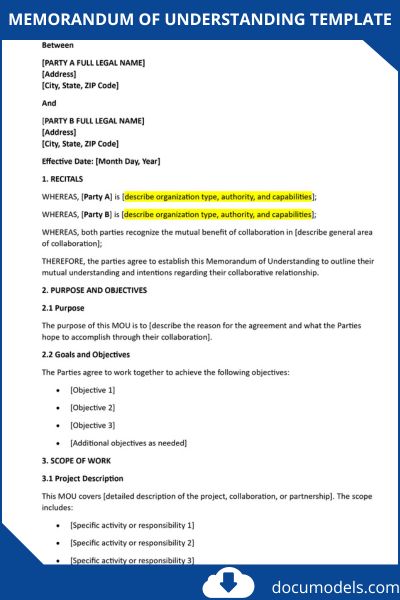
MOUs create a framework for collaboration, ensuring clarity and mutual understanding before moving forward with more binding contracts.
Memorandum of understanding (MOU)Sample memorandum of understanding
What Is a Memorandum of Understanding (MOU)?
A Memorandum of Understanding (MOU) is a written document that captures the preliminary agreement between two or more parties on a shared objective or project. It is typically non-binding, meaning it doesn’t carry the same legal weight as a contract, but it demonstrates a serious intent to collaborate.
MOUs are often used to establish a framework for future negotiations or actions without committing to enforceable obligations right away.
Key Characteristics of an MOU
- Non-Binding Nature: Most MOUs are not intended to be legally enforceable. They express goodwill and outline broad terms, but they lack the specificity or penalties found in contracts.
- Flexibility: MOUs can be bilateral (between two parties) or multilateral (involving multiple parties), allowing for adaptability in various scenarios.
- Purpose-Driven: They focus on mutual goals, roles, and expectations, serving as a roadmap for collaboration rather than a final deal.
- Comparison to Similar Documents: An MOU differs from a Memorandum of Agreement (MOA), which is more detailed and often binding on specific commitments. MOUs are broader and less formal.
For example, governments might use an MOU to signal intent for trade discussions, while businesses could employ one during merger talks to align on high-level strategies.
Quick Comparison: MOU vs. Contract
| Feature | MOU | Contract |
| Legal status | Generally non-binding | Legally enforceable |
| Typical length | 2–6 pages | Variable, often 10+ pages |
| Detail level | Broad terms and intent | Specific duties, consideration and remedies |
| Use case | Early negotiations, alliances | Finalized business transactions |
When to Use a Memorandum of Understanding
MOUs are ideal in situations where parties want to formalize their intent to collaborate without immediately entering a binding contract. They provide a low-risk way to explore partnerships and set expectations early on.
Here’s when an MOU is particularly useful:
Common Scenarios
- Early-Stage Negotiations: Use an MOU when discussions are preliminary, such as in business mergers, acquisitions, or joint ventures, to outline goals before drafting a full contract.
- Partnerships and Collaborations: Non-profits, educational institutions, or companies forming alliances (e.g., research projects or marketing campaigns) benefit from MOUs to define roles without legal commitments.
- International or Governmental Agreements: Often used in diplomacy, trade, or inter-agency cooperation where flexibility is needed due to changing circumstances.
- Resource Sharing: When organizations plan to share resources, technology, or expertise, an MOU can clarify intentions without immediate financial or legal ties.
- Before Formal Contracts: If a project requires multiple steps, an MOU acts as a stepping stone, allowing parties to test compatibility before committing.
Note: Avoid using an MOU when immediate enforceability is required, such as in high-stakes financial deals—opt for a contract instead. Remember, while non-binding, a poorly drafted MOU could lead to misunderstandings or even legal disputes if interpreted as binding.
Essential Elements of a Memorandum of Understanding
A well-structured MOU includes key components to ensure clarity and alignment. These elements make the document comprehensive yet straightforward.
Below is a breakdown:
Core Components
- Identification of Parties: Clearly list all involved parties, including their full names, addresses, and representatives. This sets the “who” of the agreement.
- Purpose and Objectives: State the reason for the MOU, including shared goals and what the collaboration aims to achieve. Be specific to avoid ambiguity.
- Scope and Responsibilities: Outline what each party will contribute, such as resources, timelines, or actions. This includes roles, duties, and any limitations.
- Duration and Timeline: Specify the start date, end date (if applicable), and any milestones. Include provisions for renewal or termination.
- Confidentiality and Non-Disclosure: If sensitive information is involved, include clauses to protect it.
- Financial Considerations: Detail any funding, costs, or resource allocations, even if non-binding.
- Dispute Resolution: Describe how disagreements will be handled, such as through mediation.
- Signatures and Dates: End with spaces for authorized signatures to formalize intent.
How to Write a Memorandum of Understanding
Drafting an MOU doesn’t require legal expertise, but it should be clear, concise, and reviewed by all parties. Follow this step-by-step guide to create one from scratch:
Step-by-Step Process
- Research and Plan: Gather input from all parties on goals, roles, and expectations. Decide if the MOU will be non-binding or include any enforceable elements (consult a lawyer if needed).
- Draft the Introduction: Begin with a title (e.g., “Memorandum of Understanding Between [Party A] and [Party B]”), followed by the date and party identifications.
- Outline the Purpose: Write a section detailing the “why” behind the collaboration, using clear language.
- Detail the Terms: Use bullet points or numbered lists for responsibilities, scope, timelines, and any other elements from the previous section.
- Include Definitions: If technical terms are used, add a definitions section to avoid confusion (e.g., define acronyms or specific jargon).
- Add Boilerplate Clauses: Incorporate standard sections like confidentiality, amendments, and governing law.
- Review and Revise: Share drafts with all parties for feedback. Ensure the language is neutral and unambiguous.
- Sign and Distribute: Have authorized representatives sign, date, and exchange copies. Store digitally for reference.
Frequently Asked Questions (FAQ)
Generally, an MOU is not legally binding unless specified otherwise. It indicates a willingness to work together, but it doesn’t enforce legal responsibilities.
Unlike contracts, which are legally enforceable, an MOU outlines goals and intentions without binding legal commitments. A contract involves specific obligations, rights, and legal consequences if breached.
An MOU is used when parties want to formalize their agreement or collaboration intentions without entering into a legally binding contract. It’s ideal for preliminary negotiations or partnerships.
An MOU is typically signed by authorized representatives of each party, confirming mutual understanding. While not legally required, signatures validate the agreement and the parties’ intentions.
Yes, an MOU can be terminated if the parties agree to end the collaboration or partnership. However, any commitments made within the MOU may require resolution or compensation, depending on its terms.
An MOU should include the objectives of the collaboration, roles and responsibilities of each party, duration of the agreement, confidentiality clauses (if necessary), and conditions for termination or renewal.
Format model to edit
Related Articles: