
Announcing a price change can feel like walking a tightrope. You need to protect your profit margins, but you also want to keep your customers happy and loyal. It’s a delicate balance, and getting it wrong can damage hard-earned trust.
The key to success lies in how you communicate the change. A well-crafted price increase letter can make all the difference between retaining a customer and losing them for good.
This is where clear, empathetic, and professional communication becomes essential. Handling this conversation effectively shows your customers that you value their business and understand their perspective.
In this post, we’ll explore how to write a professional and empathetic price increase letter that maintains strong customer relationships while supporting your business growth. You’ll discover key elements to include, tone and structure tips, and real-world examples that can guide your own message.
Sample Price Increase Letter Templates
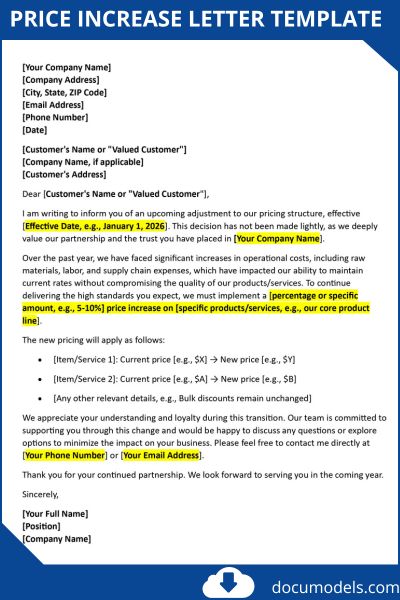
Crafting this letter effectively can make a significant difference in how customers perceive the increase and their continued relationship with the brand.
Download Price Increase LetterPrice increase letter template
[Your Company Name]
[Company Address]
[City, State, ZIP Code]
[Email Address]
[Phone Number]
[Date]
[Customer’s Name or “Valued Customer”]
[Company Name, if applicable]
[Customer’s Address]
Dear [Customer’s Name or “Valued Customer“],
I am writing to inform you of an upcoming adjustment to our pricing structure, effective [Effective Date, e.g., January 1, 2026]. This decision has not been made lightly, as we deeply value our partnership and the trust you have placed in [Your Company Name].
Over the past year, we have faced significant increases in operational costs, including raw materials, labor, and supply chain expenses, which have impacted our ability to maintain current rates without compromising the quality of our products/services. To continue delivering the high standards you expect, we must implement a [percentage or specific amount, e.g., 5-10%] price increase on [specific products/services, e.g., our core product line].
The new pricing will apply as follows:
- [Item/Service 1]: Current price [e.g., $X] → New price [e.g., $Y]
- [Item/Service 2]: Current price [e.g., $A] → New price [e.g., $B]
- [Any other relevant details, e.g., Bulk discounts remain unchanged]
We appreciate your understanding and loyalty during this transition. Our team is committed to supporting you through this change and would be happy to discuss any questions or explore options to minimize the impact on your business. Please feel free to contact me directly at [Your Phone Number] or [Your Email Address].
Thank you for your continued partnership. We look forward to serving you in the coming year.
Sincerely,
[Your Full Name]
[Position]
[Company Name]
Template 2: Price increase letter to customers
Subject: Important Update: Upcoming Price Adjustment
Dear [Customer Name],
We hope this message finds you well. At [Your Company Name], we’re committed to providing the highest quality [products/services] and the level of support you’ve come to expect from us.
Over the past [time period], we’ve seen significant increases in the costs of [materials, shipping, labor, etc.]. We have absorbed these increases for as long as possible, but to continue delivering the value and reliability you deserve, we must make a modest price adjustment.
Effective [date], the price of [product/service name] will increase by [percentage or amount].
This decision was not made lightly. We’ve carefully reviewed our costs and operations to ensure this change is both fair and necessary.
The adjustment allows us to:
- Maintain our quality standards
- Continue innovating and improving our offerings
- Provide you with the same dedicated service and support
We truly value your loyalty and understanding. If you have any questions or would like to discuss how this change affects your account, please don’t hesitate to reach out to our team at [contact email or phone number].
Thank you for your continued trust in [Your Company Name]. We’re grateful for your partnership and look forward to serving you in the years ahead.
Warm regards,
[Your Name]
[Title]
[Company Name]
Sample price increase letter
ABC Supplies Inc.
123 Business Avenue
Anytown, USA 12345
Phone: (555) 123-4567
Email: info@abcsupplies.com
[Date]
Dear [Customer Name],
We appreciate your continued partnership with ABC Supplies Inc. and value the trust you place in us as your reliable provider of office and industrial supplies. It is with careful consideration that we are writing to inform you of an upcoming adjustment to our pricing structure, effective December 1, 2025.
Over the past year, we have faced significant increases in operational costs, including raw materials, transportation, and labor expenses, driven by broader inflationary pressures in the supply chain. Despite our best efforts to absorb these rising costs through operational efficiencies and supplier negotiations, we must implement a modest price adjustment of 7% across our product catalog to maintain the high quality and service levels you expect from us.
This change will apply to all orders placed on or after December 1, 2025. We have attached a detailed pricing update for your reference, highlighting any specific impacts to your most frequently ordered items. Our team remains committed to supporting your business needs and is available to discuss this transition or explore ways to optimize your orders for cost savings.
Thank you once again for your loyalty and understanding. We look forward to continuing our successful collaboration and serving you in the years ahead.
Sincerely,
[Your Name]
[Your Position]
ABC Supplies Inc.
Phone: (555) 123-4567
Email: [Your Email]
What Is a Price Increase Letter?
A price increase letter is a formal written communication from a business to its customers, informing them of upcoming changes to product or service pricing. It’s more than just an announcement—it’s a strategic message that explains the reasons behind the increase, reassures customers of continued value, and aims to maintain positive relationships.
Unlike casual emails or social media posts, this letter is typically structured, polite, and professional. It helps mitigate potential backlash by providing context, such as inflation or enhanced features, and often includes details like the effective date and new pricing structure.
For example, a SaaS company might send a letter explaining a 10% hike due to added AI integrations, emphasizing how it benefits users.
When to Use a Price Increase Letter
Timing and context are crucial when deciding to issue a price increase letter. Use it in scenarios where transparency builds trust rather than erodes it.
Here are key situations:
- Rising Operational Costs: When expenses like raw materials, labor, or shipping increase significantly (e.g., due to supply chain disruptions or inflation).
- Market Adjustments: To align with industry standards or competitors’ pricing, especially if your offerings have improved.
- Value Enhancements: After introducing new features, better quality, or expanded services that justify a higher price.
- Contractual or Subscription Renewals: Ideal for annual reviews in B2B relationships or subscription models.
- Economic Factors: In response to broader economic shifts, like currency fluctuations or regulatory changes.
Key Components of an Effective Price Increase Letter
An effective price increase letter should be concise, empathetic, and informative. Structure it to address customer concerns while highlighting benefits.
Essential elements include:
- Header and Contact Information: Include your company’s letterhead, date, and recipient’s details for a professional touch.
- Salutation: Personalized if possible (e.g., “Dear Valued Customer” or “Dear [Name]”).
- Introduction: Acknowledge the relationship and express appreciation.
- Announcement of the Increase: Clearly state the new prices, percentage change, and effective date.
- Explanation: Provide honest reasons without excuses—focus on facts like “increased material costs by 15%.”
- Value Proposition: Reiterate benefits or improvements to justify the change.
- Call to Action: Encourage questions or offer alternatives (e.g., loyalty discounts).
- Closing: End positively with contact info and a sign-off.
How to Write a Price Increase Letter (Step-by-Step)
Writing an effective price increase letter involves a mix of transparency, timing, and tact. Follow these steps to craft a communication that protects your revenue and your customer relationships.
Step 1: Plan Your Announcement in Advance
Timing is everything. Don’t surprise your customers with a price hike that takes effect tomorrow. A sudden change feels unfair and can damage trust.
- Give Ample Notice: Provide at least 30-60 days of notice before the new prices take effect. For contract-based services or long-term clients, 90 days might be more appropriate. This gives them time to adjust their budgets.
- Choose the Right Time: Avoid announcing increases during holidays or traditionally slow business periods for your clients. A mid-month or mid-quarter announcement often works well.
- Prepare Your Team: Ensure your sales, support, and billing teams are fully aware of the price change before your customers are. They should be equipped to answer questions consistently and professionally.
Step 2: Start with a Direct and Clear Subject Line
Your customers are busy. Your email subject line should be straightforward and impossible to misinterpret. Avoid vague or “clickbait” titles that might seem deceptive.
Good Subject Line Examples:
- Important Update on Our Pricing
- Changes to Our Service Pricing Effective [Date]
- Upcoming Price Adjustment for [Your Product/Service]
Bad Subject Line Examples:
- An Exciting Announcement!
- A Quick Question
- Don’t Miss This Update
Step 3: Open with a Personal and Appreciative Tone
Begin your letter by addressing the customer directly and thanking them for their business. This sets a positive tone and reminds them that you value the relationship. Starting with gratitude shows that this isn’t just a transactional communication; it’s a message to a valued partner.
Example Opening:
“Dear [Customer Name],
We want to start by saying thank you for being a loyal customer. We have truly valued our partnership with you over the last [Number] years and appreciate the trust you place in us.”
Step 4: State the Price Increase Clearly
After the warm opening, get straight to the point. Announce the price increase clearly and concisely in the first or second paragraph. Don’t bury this information deep in the letter. State the old price, the new price, and the exact date the change will take effect.
Example:
“To continue providing the high level of service you expect, we are making an adjustment to our prices. Effective [Date], the price of our [Product/Service Name] plan will increase from [Old Price] to [New Price].”
Step 5: Explain the “Why” with Transparency
This is the most critical part of your letter. Customers are more likely to accept a price increase if they understand the reason behind it. Be honest and transparent, but focus on how the change benefits them.
Common valid reasons for a price increase include:
- Product Improvements: You’ve added new features or enhanced the product’s capabilities.
- Increased Operating Costs: The costs for materials, labor, or overhead have risen.
- Expanded Service: You’ve invested in better customer support, faster infrastructure, or a larger team to serve them better.
- Market Value: Your prices are being adjusted to align with the current market value of your offerings.
Example:
“This change will allow us to invest further in the [Product/Service Name] platform. Over the next year, we are excited to roll out [mention a specific new feature or improvement], enhance our customer support response times, and continue upgrading our infrastructure to ensure 99.9% uptime. This price adjustment helps us make these improvements while delivering the quality you rely on.”
Step 6: Reinforce Your Value Proposition
After explaining the “why,” remind the customer of the value you provide. Briefly touch on the key benefits they get from your product or service. This reframes the conversation from cost to value and reminds them what they stand to lose if they leave.
Example:
“We remain committed to helping you achieve [Customer’s Goal, e.g., ‘streamline your marketing efforts’ or ‘manage your projects more efficiently’]. With [Your Product/Service], you can continue to benefit from [Key Feature 1], [Key Feature 2], and our dedicated support.”
Step 7: Provide Clear Next Steps and Contact Information
Tell your customers exactly what they need to do, if anything. For subscription services, you might state that the new price will be reflected on their next billing cycle automatically. Provide a clear point of contact for anyone who has questions.
Example:
“No action is required on your part. This new pricing will be automatically reflected on your next invoice after [Date].
If you have any questions about this change or your account, please don’t hesitate to reply to this email or contact our support team at [Email/Phone Number]. We are here to help.”
Step 8: Close Professionally
End the letter on a positive and appreciative note. Thank the customer again for their understanding and continued business.
Example Closing:
“We are grateful for your business and look forward to continuing to serve you.
Sincerely,
The [Your Company Name] Team”
Delivery Methods for Price Increase Notifications
Choosing the right delivery method ensures your message reaches customers effectively and compliantly (e.g., adhering to data privacy laws like GDPR).
Options include:
- Email: Fast and trackable; ideal for digital-first businesses. Use personalized subject lines like “Important Update on Your Subscription Pricing.”
- Physical Mail: For formal B2B contracts or older demographics; adds a professional weight.
- In-App or Portal Notifications: For SaaS or online services; allows for interactive elements like FAQs.
- SMS or Phone Calls: For urgent, small-scale increases; combine with follow-up emails.
- Website Announcements: Supplement with a blog post or banner for broader reach.
Pros and Cons Table:
| Method | Pros | Cons |
| Cost-effective, easy to personalize | May go to spam; low open rates | |
| Physical Mail | Tangible and formal | Expensive, slower delivery |
| In-App | Immediate, integrated | Limited to active users |
| SMS | High open rates | Character limits; intrusive |
Best Practices for Communicating a Price Increase
To minimize negative reactions and retain customers, follow these proven strategies:
- Timing is Key: Announce during off-peak seasons; avoid holidays.
- Segment Your Audience: Customize messages—offer grandfathering for long-term clients.
- Provide Alternatives: Suggest bundles, discounts, or downgrades to soften the blow.
- Monitor Feedback: Track responses and adjust future communications.
- Legal Compliance: Ensure the letter aligns with contracts and consumer protection laws.
- Follow Up: Send reminders closer to the effective date and thank customers post-implementation.
- Measure Impact: Use metrics like churn rate or NPS scores to evaluate effectiveness.
Format model to edit
Related Articles: