
How do you get your team to think and act like owners? A well-structured profit sharing agreement can be a powerful tool to make it happen.
This type of plan distributes a portion of company profits to employees, aligning everyone’s incentives toward a common goal of growth and success.
For startups, agencies, and professional firms, it’s a game-changer for attracting and retaining top talent while fostering a culture of transparency and shared purpose.
A strong agreement clearly defines participants, profit formulas, vesting schedules, and governance.
Getting it right requires careful planning around key elements, from calculating the profit pool to managing cash flow and tax compliance. We’ll break down everything you need to know to build an effective plan for your business.
To see how these concepts work in the real world, explore the practical examples and downloadable profit sharing agreement templates we’ve included below.
Profit sharing agreement templates
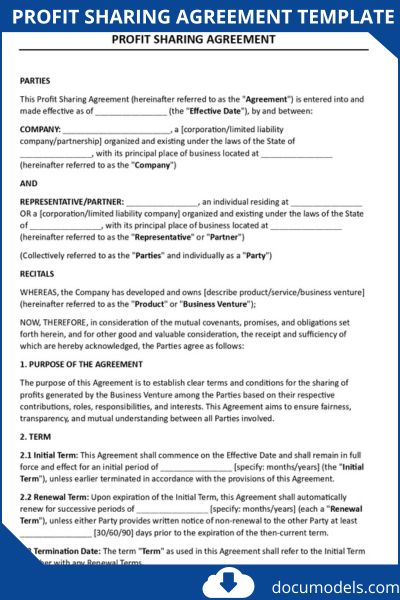
These agreements outline how profits will be distributed among partners, employees, or investors, ensuring that everyone benefits from the success of a venture.
Profit sharing agreement (Word)Sample Profit sharing agreement
What Is a Profit Sharing Agreement?
A profit sharing agreement is a legally binding contract between two or more parties that outlines how profits from a business, project, or venture will be distributed. Unlike traditional salary or equity arrangements, it focuses specifically on sharing a portion of the net profits—after expenses, taxes, and other deductions have been accounted for.
Key Characteristics
- Voluntary and Customizable: These agreements are typically negotiated and tailored to the specific situation, rather than being a one-size-fits-all template.
- Performance-Based: Distributions are often tied to the overall success of the business, making it a motivational tool.
- Not the Same as Revenue Sharing: Profit sharing deals with net profits (revenue minus costs), while revenue sharing might split gross income without considering expenses.
- Common in Various Structures: It can be part of employment contracts, partnership agreements, or standalone documents.
When Do You Need a Profit Sharing Agreement?
You need a profit sharing agreement whenever multiple parties are collaborating on a profit-generating activity and want to formalize how earnings will be distributed. It’s particularly crucial in scenarios where informal arrangements could lead to misunderstandings or legal conflicts.
Consider drafting one if:
- You’re entering a partnership without equal ownership.
- Employees or contractors are contributing to revenue growth and deserve a share of the rewards.
- A joint project involves investors who expect returns based on performance.
- Business expansion requires incentivizing key stakeholders without diluting equity.
Timing is key—create the agreement before profits start flowing to avoid disputes. For example, if two entrepreneurs launch a tech startup, they should document profit splits early to prevent arguments during scaling.
Profit Sharing Agreement Use Cases
Profit sharing agreements are versatile and apply across industries. Here are some common scenarios, illustrated with real-world examples:
1. Partnerships and Joint Ventures: Two companies team up for a project, like a real estate development where profits are split based on investment levels. For instance, one partner provides capital (60% share) while the other handles operations (40% share).
2. Employee Incentive Programs: Corporations like tech giants use profit sharing to boost morale. Employees might receive 10% of annual profits as bonuses, encouraging loyalty and performance.
3. Investment Deals: Angel investors in startups often negotiate profit shares until the business reaches profitability, ensuring returns without immediate equity dilution.
4. Freelance or Contractor Collaborations: A marketing agency and a freelance designer might agree to split profits from a client campaign, with the designer getting 30% for creative input.
5. Family Businesses: Siblings inheriting a company could use an agreement to divide profits fairly, accounting for varying involvement levels.
| Use Case | Typical Parties Involved | Profit Split Example |
| Startup Partnership | Founders/Investors | 50/50 after expenses |
| Employee Bonuses | Company/Staff | 5-15% of net profits pool |
| Joint Product Launch | Two Businesses | Based on contribution (e.g., 70/30) |
| Real Estate Flip | Investors/Developers | Proportional to capital invested |
Core Components of a Profit Sharing Agreement
A well-drafted profit sharing agreement includes several essential elements to ensure clarity and enforceability. Below, we outline the core components, structured for easy reference.
1. Parties Involved
Identify all participants, including their roles, contact details, and legal entities (e.g., individuals, LLCs). This section prevents ambiguity about who benefits.
2. Definition of Profits
Clearly define what constitutes “profits.” This typically means net income after subtracting:
- Operating expenses
- Taxes
- Reserves for future investments
Include formulas, such as: Profit Share = (Net Profit × Agreed Percentage).
3. Distribution Terms
Specify how and when profits are distributed:
- Frequency: Quarterly, annually, or upon project completion.
- Method: Bank transfers, checks, or reinvestment options.
- Thresholds: Minimum profit levels before sharing begins (e.g., no distribution below $10,000).
4. Duration and Termination
Outline the agreement’s lifespan, renewal terms, and exit clauses. For example, it might end if a party withdraws or upon reaching a profit milestone.
5. Dispute Resolution
Include mechanisms like mediation or arbitration to handle conflicts, reducing the need for court involvement.
6. Confidentiality and Non-Compete Clauses
Protect sensitive business information and prevent parties from competing unfairly.
Here’s a simple checklist for drafting:
- List all parties and roles
- Define profit calculation method
- Set distribution schedule
- Include termination conditions
- Add signatures and dates
Note: These components form the backbone, but customize them based on your specific needs.
Legal Considerations and Compliance
Navigating the legal side of profit sharing agreements is vital to avoid pitfalls. Always consult a lawyer to tailor the document to your jurisdiction, as laws vary.
Key legal aspects include:
- Compliance with Tax Laws: Profits shared are taxable income. In the US, for example, they’re reported on IRS Form 1099 for non-employees or as part of W-2 for staff. Ensure the agreement accounts for withholding taxes.
- Securities Regulations: If the agreement resembles an investment, it might fall under SEC rules. Avoid unregistered securities to prevent penalties.
- Employment Laws: For employee plans, comply with ERISA (Employee Retirement Income Security Act) if it’s a qualified plan, ensuring non-discrimination.
- Contract Validity: The agreement must have mutual consent, consideration (something of value exchanged), and legal purpose. Include clauses for amendments and governing law (e.g., state-specific).
Potential risks:
- Ambiguity Leading to Disputes: Vague terms can result in lawsuits; use precise language.
- Non-Compliance Penalties: Failing to report shared profits could lead to fines or audits.
- International Considerations: For cross-border deals, factor in foreign tax treaties and currency exchange rules.
Frequently Asked Questions (FAQ)
These agreements allocate profits based on predefined criteria such as capital investment, expertise, or effort. The distribution method can be equal or proportional, depending on what the parties agree upon. They also address how losses are shared and outline dispute resolution procedures.
Yes, when properly drafted and executed, profit-sharing agreements are legally enforceable. To ensure validity, it’s advisable to have the agreement reviewed by a legal professional. This helps prevent issues like misrepresentation or failure to disclose material information.
No. Parties can agree to any commercially reasonable split. But terms must comply with federal and state laws (e.g., antitrust, securities if interests are sold, tax rules, and employment laws if used for employees). Get legal counsel for state-specific issues.
Partners/members generally receive pass-through allocations reported on K-1 and pay tax regardless of distributions. Employees in profit sharing plans follow retirement-plan rules; nonqualified bonuses are W-2 income. Define tax withholdings and estimated tax support in the agreement.
Common schedules are quarterly or annually after closing the books, audits, and reserve allocations. Agreements should specify timelines, methods (cash vs. reinvestment), thresholds, and clawback/true-up provisions for restatements or errors.
It depends on the plan. Employees may take vested amounts upon leaving, often rolling them into another retirement account. Vesting schedules might require a certain tenure for full ownership; unvested portions could be forfeited.
Use precise definitions, GAAP references, audit rights, approval thresholds, and change-control. Include negotiation, mediation, then arbitration or court venue. Keep contemporaneous financial reporting and access to records per the agreement.
Format model to edit
Related Articles: