
In the workplace, effective communication is crucial, and sometimes that means addressing issues directly to ensure they are resolved satisfactorily. A grievance letter serves as an essential tool in expressing concerns, dissatisfaction, or unfair treatment experienced at work.
Whether it’s a matter related to workplace harassment, discrimination, or any violation of company policies, a well-crafted grievance letter can help set the stage for a fair resolution.
Understanding how to structure and articulate your thoughts clearly in such a letter can significantly impact how your issue is perceived and acted upon by management or HR.
This article will guide you through the key components of a well-written complaint letter, providing practical tips and letter examples to help you articulate your concerns clearly and professionally.
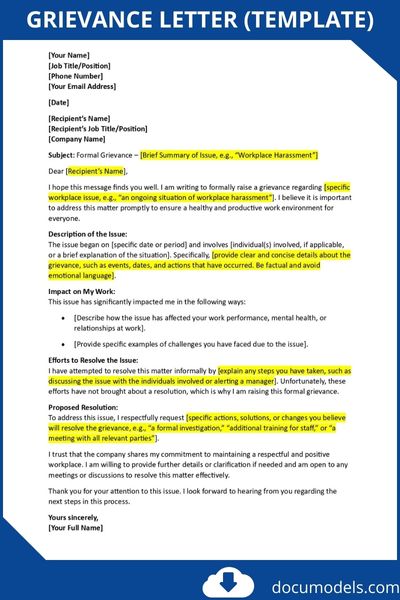
This formal letter acts as a tool for employees to express their dissatisfaction, request solutions, and move toward a resolution within their organization.
Grievance letter (example)What Is a Grievance Letter?
A grievance letter is a formal document written by an employee to their employer to raise a complaint or concern regarding workplace issues. This could include anything from unfair treatment, harassment, discrimination, or any breach of your employment rights. Its purpose is to give the employer a clear understanding of the issue so they can investigate and resolve it.
Unlike informal complaints, grievance letters create an official record of the issue, which can be crucial if the matter escalates to legal proceedings. Think of it as your way of ensuring a structured process to handle your concern.
Examples of Situations Requiring a Grievance Letter:
- Discrimination based on race, gender, ethnicity, or disability.
- Harassment from colleagues or management.
- Pay disputes, such as unpaid overtime or incorrect salary.
- Unfair treatment, like favoritism or bias.
- Unsafe working conditions or violations of workplace safety standards.
What Should the Grievance Letter Contain?
Crafting a grievance letter requires clarity, structure, and professional language. To ensure it is effective, there are specific elements your letter must include. Below is a breakdown of what to cover:
1. Basic Details
Start your letter with basic information:
- Your name, job title, and employee ID (if applicable).
- The date you are writing the letter.
- Clearly state that it’s a grievance letter in the subject line.
Example:
Subject Line: Formal Grievance Regarding Workplace Harassment
2. An Explanation of the Problem
Provide a clear, detailed description of the issue. Stick to the facts and avoid emotional language to maintain professionalism.
Include:
- What happened and when it happened.
- Who was involved (use names, if possible).
- Any relevant context or background information.
For example, “On October 3rd, during the morning shift, I was subjected to repeated offensive remarks about my ethnicity by a coworker, which I found deeply distressing.”
3. Supporting Evidence
Strengthen your grievance by providing evidence where possible, such as:
- Emails or written communication.
- Witness statements from coworkers who were present.
- Photographs, time logs, or other documents.
4. Details of the Impact
Explain how the issue has affected you, your performance, or your well-being. This could include:
- Emotional distress.
- Physical harm (in cases like unsafe work environments).
- Difficulty completing work tasks.
5. Desired Outcome
Specify what resolution you are seeking.
This could include:
- An apology or acknowledgment of the issue.
- Action to address the behavior or problem (e.g., improved policies or procedures).
- Compensation, if applicable.
Be polite but firm in your request.
For example:
“I would like an official investigation into this matter and appropriate disciplinary action against the individual involved.”
Who to Send the Grievance Letter To
Deciding whom to address your grievance letter to is just as important as writing the letter itself. Sending it to the correct person ensures your complaint is directed to someone who can take action.
1. Your Immediate Supervisor or Manager
Start by addressing the letter to your direct supervisor. They are usually the first point of contact for handling such issues. However, if the grievance is about your manager, you’ll need to escalate it.
2. Human Resources (HR)
If the issue involves serious misconduct (e.g., harassment or discrimination) or if your manager is part of the problem, send your letter directly to the HR department. They are trained to handle sensitive issues and ensure policies are followed.
3. Senior Management
For unresolved grievances or extreme circumstances where HR has failed to act, you may need to escalate the matter further. Address your letter to higher-level personnel, such as the head of HR or a company director.
If internal processes fail to resolve your grievance, you may have legal options. This could involve labor tribunals or regulatory bodies, depending on the nature of the issue and the laws in your country.
Example Contact Pathway:
- Step 1: Direct Manager →
- Step 2: HR Department →
- Step 3: Senior Management →
- Step 4: Legal Authorities
How to write a grievance letter
This guide will walk you through the process step-by-step, ensuring that your letter is clear, concise, and effective.
1. Start with Preparation
Before you begin writing:
- Review your company’s grievance process: This can usually be found in the employee handbook.
- Gather evidence: Collect emails, memos, witness statements, or any other relevant documents that support your case.
- Understand your rights: Familiarize yourself with relevant workplace laws or policies related to your issue.
2. Structure Your Letter
A well-structured letter is easier to read and more likely to be taken seriously.
Use the following format:
- Introduction
- Details of the Grievance
- Impact on You
- Desired Outcome
- Conclusion
3. Start with a Clear Heading
Include the words “Formal Grievance” in the heading of your letter to ensure that it is immediately recognized as a formal complaint.
4. Write a Brief Introduction
In the introduction, provide a brief history of your employment, including your start date and job role. This sets the context for your grievance.
5. Detail the Grievance
Clearly describe the issue you are facing. Include specific details such as dates, times, locations, and individuals involved. The more precise you are, the easier it will be for your employer to investigate the matter.
6. Explain the Impact
Explain how the grievance has affected you. This could include emotional distress, impact on your work performance, or any other relevant consequences.
7. State Your Desired Outcome
Clearly state what you would like to happen as a result of your grievance. This could be an apology, a change in company policy, or any other reasonable remedy.
8. Conclude the Letter
In your conclusion, reiterate your desire for a resolution and thank the recipient for their time and consideration.
Grievance letter examples
[Your Name]
[Job Title/Position]
[Phone Number]
[Your Email Address]
[Date]
[Recipient’s Name]
[Recipient’s Job Title/Position]
[Company Name]
Subject: Formal Grievance – [Brief Summary of Issue, e.g., “Workplace Harassment”]
Dear [Recipient’s Name],
I am writing to formally raise a grievance regarding [specific workplace issue, e.g., “an ongoing situation of workplace harassment”]. I believe it is important to address this matter promptly to ensure a healthy and productive work environment for everyone.
Description of the Issue:
The issue began on [specific date or period] and involves [individual(s) involved, if applicable, or a brief explanation of the situation]. Specifically, [provide clear and concise details about the grievance, such as events, dates, and actions that have occurred. Be factual and avoid emotional language].
Impact on My Work:
This issue has significantly impacted me in the following ways:
- [Describe how the issue has affected your work performance, mental health, or relationships at work].
- [Provide specific examples of challenges you have faced due to the issue].
Efforts to Resolve the Issue:
I have attempted to resolve this matter informally by [explain any steps you have taken, such as discussing the issue with the individuals involved or alerting a manager]. Unfortunately, these efforts have not brought about a resolution, which is why I am raising this formal grievance.
Proposed Resolution:
To address this issue, I respectfully request [specific actions, solutions, or changes you believe will resolve the grievance, e.g., “a formal investigation,” “additional training for staff,” or “a meeting with all relevant parties”].
I trust that the company shares my commitment to maintaining a respectful and positive workplace. I am willing to provide further details or clarification if needed and am open to any meetings or discussions to resolve this matter effectively.
Thank you for your attention to this issue. I look forward to hearing from you regarding the next steps in this process. Yours sincerely,
[Your Full Name]
Grievance letter for unfair treatment (Example)
[Your Name]
[Email Address]
[Phone Number]
[Date]
[Recipient’s Name/Title]
[Company Name]
[Company Address]
[City, State, ZIP Code]
Subject: Formal Grievance Regarding Unfair Treatment
Dear [Recipient’s Name/Title],
I am writing to formally raise a grievance concerning the unfair treatment I have experienced at [Company Name]. I believe that I have been subjected to unfair treatment, which has significantly affected my work environment and well-being.
The incidents of unfair treatment include the following:
- [Specific Incident 1]: On [date], [describe the incident in detail, including any witnesses if applicable].
- [Specific Incident 2]: On [date], [describe the incident in detail, including any witnesses if applicable].
- [Specific Incident 3]: On [date], [describe the incident in detail, including any witnesses if applicable].
These incidents have led me to feel [describe how the unfair treatment has affected you, e.g., stressed, demotivated, anxious]. I believe these actions are in violation of [company policy/employee handbook/labor laws], specifically [mention any relevant sections or laws].
A thorough investigation into these matters is requested, with appropriate actions taken to address the concerns raised. Further information or clarification can be provided as needed, and the opportunity to discuss this matter in person would be appreciated.
I trust that this grievance will be handled with the seriousness and confidentiality it deserves. I look forward to your prompt response and resolution of this issue.
Thank you for your attention to this matter.
Sincerely,
[Your Name]
Tips for Writing an Effective Grievance Letter
Follow these tips to ensure your grievance letter is persuasive and professional:
- Remain factual and objective: Avoid emotional language or making accusations. Stick to the facts.
- Be clear and concise: While it’s important to include detail, keep your writing clear and to the point.
- Use bullet points: If you’re listing incidents or evidence, bullet points can make the information easier to read.
- Proofread your letter: Check for any spelling or grammar errors that may weaken your credibility.
- Follow company procedures: Many organizations have specific grievance policies. Be sure to follow the outlined steps, including deadlines.
Format model to edit
Related Articles: