
Mistakes are an inevitable part of professional life, no matter how experienced or diligent we may be.
Whether it’s missing a deadline, sending the wrong information to a client, or making a simple oversight, errors can happen to anyone in the workplace. What truly sets professionals apart is not the absence of mistakes, but how they handle them.
Addressing your errors promptly and sincerely demonstrates integrity, accountability, and respect for your colleagues and organization. One of the most effective ways to do this is by writing a thoughtful apology letter.
A well-crafted apology letter not only acknowledges the mistake but also helps rebuild trust, maintain positive working relationships, and shows your commitment to improvement.
In this post, we’ll explore why apology letters are so important in the workplace, what key elements they should include. We will offer sample letters to illustrate the structure and tone needed to convey sincerity and professionalism.
Template and Samples of Apology Letter for Mistake at Work
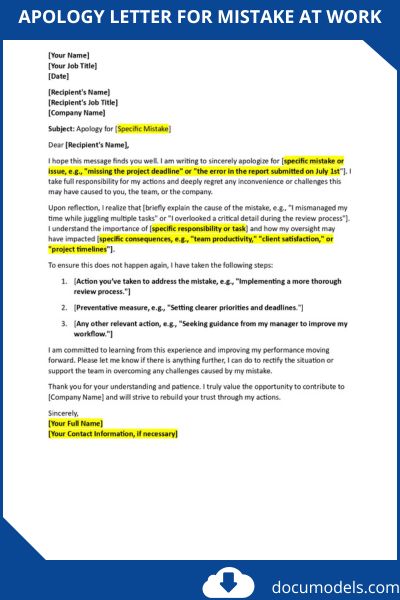
A well-crafted apology letter can prevent misunderstandings from escalating, foster a culture of transparency, and showcase your professionalism and commitment to continuous improvement.
Apology Letter for Mistake (Word)Sample apology letter for mistake at work
[Your Name]
[Your Job Title]
[Date]
[Recipient’s Name]
[Recipient’s Job Title]
[Company Name]
Subject: Apology for [Specific Mistake]
Dear [Recipient’s Name],
I hope this message finds you well. This letter serves as a sincere apology for [specific mistake or issue, e.g., “missing the project deadline” or “the error in the report submitted on July 1st“]. Full responsibility is taken for my actions, and I deeply regret any inconvenience or challenges this may have caused to you, the team, or the company.
Upon reflection, it is clear that [briefly explain the cause of the mistake, e.g., “time mismanagement while juggling multiple tasks” or “overlooking a critical detail during the review process”] contributed to the situation. Understanding the importance of [specific responsibility or task], it is evident how this oversight may have impacted [specific consequences, e.g., “team productivity,” “client satisfaction,” or “project timelines“].
To ensure this does not happen again, the following steps have been taken:
- [Action you’ve taken to address the mistake, e.g., “Implementing a more thorough review process.”]
- [Preventative measure, e.g., “Setting clearer priorities and deadlines.”]
- [Any other relevant action, e.g., “Seeking guidance from my manager to improve my workflow.”]
A commitment is made to learning from this experience and improving performance moving forward. Please let me know if there is anything further that can be done to rectify the situation or support the team in overcoming any challenges caused by my mistake.
Thank you for your understanding and patience. The opportunity to contribute to [Company Name] is truly valued, and efforts will be focused on rebuilding your trust through actions.
Sincerely,
[Your Full Name]
[Your Contact Information, if necessary]
Sample 2: Sending incorrect information to a client
[Date]
[Client’s Name]
[Client’s Job Title/Company Name]
Subject: Apology for Providing Incorrect Information
Dear [Client’s Name],
I hope this message finds you well. This letter serves as a sincere apology for the error in the information provided to you on [specific date or occasion]. It is deeply regrettable that the details shared regarding [specific topic, e.g., “pricing,” “product specifications,” or “delivery timelines”] were incorrect, potentially causing confusion or inconvenience.
Upon realizing the mistake, I immediately [explain what you did to address the issue, e.g., “reviewed the correct information and verified its accuracy”]. I have attached the accurate details for your reference and assurance. Please rest assured that I have taken steps to ensure this information is now correct and up to date.
I understand how important it is to provide accurate and reliable information, and I take full responsibility for this oversight. To prevent such errors in the future, I have [specific actions you’ve taken, e.g., “implemented a more thorough review process before sharing information with clients” or “set up an additional verification step in our communication workflow“].
Please let me know if there is anything further, I can do to rectify this situation or assist you in any way. Your trust and satisfaction are of utmost importance to me, and I am committed to ensuring that this does not happen again.
Thank you for your understanding and patience. I truly value our partnership and look forward to continuing to serve you with the highest level of professionalism and accuracy.
Sincerely,
[Your Full Name]
[Your Job Title]
Why Apology Letters Matter in the Workplace
Apology letters are more than just a formality; they are a critical tool for maintaining trust, professionalism, and accountability.
Here’s why they are essential:
- Restores Trust: A sincere apology demonstrates accountability, helping to rebuild trust with colleagues, supervisors, or clients affected by the mistake.
- Shows Professionalism: Acknowledging errors formally signals maturity and a commitment to professional growth.
- Mitigates Conflict: A well-crafted apology can de-escalate tensions and prevent misunderstandings from escalating.
- Encourages Learning: Addressing mistakes openly fosters a culture of learning and improvement within teams.
- Protects Reputation: A proactive apology can prevent negative perceptions and show that you value relationships over ego.
The Cost of Not Apologizing
Failing to apologize can lead to:
- Damaged relationships with colleagues or clients.
- Loss of credibility or trust.
- Escalation of minor issues into major conflicts.
- Negative impact on team morale or productivity.
Key Elements of an Effective Apology Letter
An effective apology letter is sincere, concise, and action-oriented. Below are the essential components to include:
1. Clear Acknowledgment of the Mistake
- Clearly state what went wrong without vague language.
- Avoid deflecting blame or making excuses.
Example: “I recognize that I missed the deadline for submitting the project report, which delayed the team’s progress.”
2. Sincere Expression of Regret
- Use empathetic language to show genuine remorse.
- Address the impact on others (e.g., inconvenience, stress).
Example: “I deeply regret any inconvenience this caused the team and understand the frustration it may have created.”
3. Taking Full Responsibility
- Own the mistake without shifting blame to others or external factors.
Example: “This error was due to my oversight in prioritizing tasks, and I take full responsibility.”
4. Explanation (If Appropriate)
- Briefly explain the cause of the mistake, but only if it adds clarity and doesn’t sound like an excuse.
Example: “The error occurred because I misunderstood the client’s requirements during our initial meeting.”
5. Plan for Resolution
- Outline specific steps to correct the mistake or mitigate its impact.
Example: “I have already revised the report and ensured it meets the client’s specifications, submitting it this morning.”
6. Commitment to Prevent Future Mistakes
- Share how you will avoid similar errors moving forward.
Example: “To prevent this in the future, I’ve implemented a checklist to verify project requirements before proceeding.”
7. Professional Closing
- Offer to discuss further or answer questions.
- End with a polite and professional tone.
Example: “Please let me know how I can further address this issue. Thank you for your understanding.”
Sample Apology Letter Structure
| Section | Purpose | Example Phrase |
| Greeting | Address the recipient respectfully | “Dear [Recipient’s Name],” |
| Acknowledgment | State the mistake clearly | “I’m writing to address my error in…” |
| Apology | Express regret sincerely | “I sincerely apologize for…” |
| Responsibility | Own the mistake | “This was entirely my oversight…” |
| Resolution | Outline corrective actions | “I have taken the following steps…” |
| Prevention | Share preventive measures | “To ensure this doesn’t happen again…” |
| Closing | Invite further discussion | “Please feel free to reach out…” |
Common Situations Requiring an Apology Letter at Work
Apology letters are appropriate in various workplace scenarios. Below are some common situations where they are necessary:
1. Missed Deadlines
Example: Failing to submit a report on time, delaying a project.
Impact: Slows team progress, frustrates stakeholders.
Solution: Acknowledge the delay, explain briefly, and provide the deliverable promptly.
2. Miscommunication with Clients or Colleagues
Example: Sending incorrect information to a client or misunderstanding a colleague’s instructions.
Impact: Erodes trust or causes confusion.
Solution: Clarify the mistake and provide accurate information immediately.
3. Quality Issues in Work
Example: Delivering a report with errors or incomplete data.
Impact: Undermines credibility and requires rework.
Solution: Revise the work and implement quality checks for future tasks.
4. Unprofessional Behavior
Example: Speaking inappropriately during a meeting or failing to follow protocol.
Impact: Damages team morale or professional relationships.
Solution: Apologize sincerely and commit to better conduct.
5. Failure to Follow Instructions
Example: Ignoring a supervisor’s specific directions for a task.
Impact: Wastes time and resources.
Solution: Acknowledge the oversight and align with expectations moving forward.
Best Practices for Making Amends and Preventing Future Mistakes
Beyond writing the letter, taking proactive steps to make amends and prevent recurrence is crucial.
Here are best practices:
Making Amends
- Act Quickly: Address the mistake as soon as possible to show accountability.
- Personalize the Apology: Tailor the letter to the recipient and situation for authenticity.
- Follow Through: Ensure any promised actions (e.g., fixing an error) are completed promptly.
- Offer to Meet: Propose a discussion to address concerns or clarify expectations.
- Learn from Feedback: If the recipient provides feedback, use it to improve.
Preventing Future Mistakes
1. Implement Systems:
- Use project management tools (e.g., Trello, Asana) to track deadlines.
- Create checklists for complex tasks to ensure accuracy.
2. Improve Communication:
- Confirm instructions with colleagues or clients to avoid misunderstandings.
- Use clear, concise language in emails and reports.
3. Seek Training:
- Request training or mentorship to address skill gaps.
- Stay updated on industry best practices.
4. Reflect and Review:
- Conduct regular self-assessments to identify areas for improvement.
- Review past mistakes to understand their root causes.
5. Foster a Supportive Culture:
- Encourage open communication within teams to address errors early.
- Share lessons learned to help others avoid similar mistakes.
Format model to edit
Related Articles: