
When it comes to managing rental properties, one of the most important documents a landlord may need is an eviction notice.
Whether it’s due to non-payment of rent, lease violations, or the end of a lease term, an eviction notice serves as the formal communication that initiates the process of asking a tenant to vacate the property.
Crafting this notice correctly is crucial, as it must comply with legal requirements and clearly outline the reasons and deadlines for eviction.
Using a well-structured eviction notice template can save landlords time, reduce misunderstandings, and help ensure the process moves smoothly and professionally.
In this post, we’ll explore what makes an effective eviction notice template, key elements to include, and provide practical examples that landlords can customize for their specific situations.
Sample Eviction Notice Templates
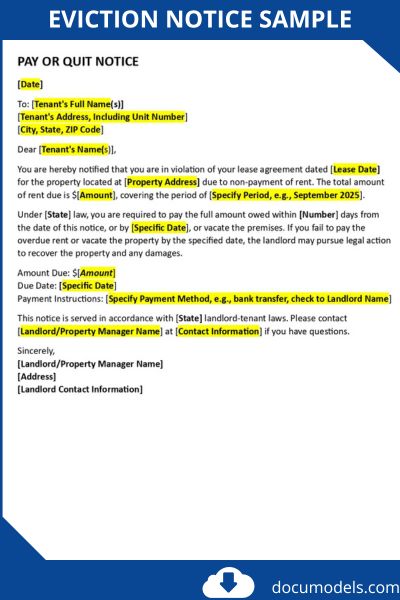
Using a well-structured eviction notice template can save time, reduce misunderstandings, and ensure that everyone involved remains informed at every step.
Eviction notice template (Word)Pay or Quit Notice Template
[Date]
To: [Tenant’s Full Name(s)]
[Tenant’s Address, Including Unit Number]
[City, State, ZIP Code]
Dear [Tenant’s Name(s)],
You are hereby notified that you are in violation of your lease agreement dated [Lease Date] for the property located at [Property Address] due to non-payment of rent. The total amount of rent due is $[Amount], covering the period of [Specify Period, e.g., September 2025].
Under [State] law, you are required to pay the full amount owed within [Number] days from the date of this notice, or by [Specific Date], or vacate the premises. If you fail to pay the overdue rent or vacate the property by the specified date, the landlord may pursue legal action to recover the property and any damages.
Amount Due: $[Amount]
Due Date: [Specific Date]
Payment Instructions: [Specify Payment Method, e.g., bank transfer, check to Landlord Name]
This notice is served in accordance with [State] landlord-tenant laws. Please contact [Landlord/Property Manager Name] at [Contact Information] if you have questions.
Sincerely,
[Landlord/Property Manager Name]
[Address]
[Landlord Contact Information]
Cure or Quit Notice Template
[Date]
To: [Tenant’s Full Name(s)]
[Tenant’s Address, Including Unit Number]
[City, State, ZIP Code]
Dear [Tenant’s Name(s)],
You are hereby notified that you are in violation of the lease agreement dated [Lease Date] for the property located at [Property Address]. The specific violation is: [Describe Violation, e.g., Keeping an unauthorized pet in violation of Section X of the lease].
Under [State] law, you are required to remedy the violation within [Number] days from the date of this notice, or by [Specific Date], or vacate the premises. To remedy this violation, you must: [Specify Required Action, e.g., Remove the unauthorized pet from the property].
If you fail to correct the violation or vacate the property by the specified date, the landlord may pursue legal action to recover the property and any damages.
This notice is served in accordance with [State] landlord-tenant laws. Please contact [Landlord/Property Manager Name] at [Contact Information] if you have questions.
Sincerely,
[Landlord/Property Manager Name]
[Address]
[Landlord Contact Information]
Unconditional Quit Notice Template
[Date]
To: [Tenant’s Full Name(s)]
[Tenant’s Address, Including Unit Number]
[City, State, ZIP Code]
Dear [Tenant’s Name(s)],
You are hereby notified that your tenancy of the property located at [Property Address] is terminated effective immediately due to the following severe violation(s) of the lease agreement dated [Lease Date]: [Describe Violation, e.g., Engaging in illegal activity, specifically drug-related activities, on the premises].
Under [State] law, you are required to vacate the premises within [Number] days from the date of this notice, or by [Specific Date]. There is no opportunity to remedy this violation. Failure to vacate by the specified date will result in legal action to recover the property and any damages.
This notice is served in accordance with [State] landlord-tenant laws. Please contact [Landlord/Property Manager Name] at [Contact Information] if you have questions.
Sincerely,
[Landlord/Property Manager Name]
[Address]
[Landlord Contact Information]
Notice to Vacate Template
[Date]
To: [Tenant’s Full Name(s)]
[Tenant’s Address, Including Unit Number]
[City, State, ZIP Code]
Dear [Tenant’s Name(s)],
You are hereby notified that your tenancy of the property located at [Property Address] under the lease agreement dated [Lease Date] (or month-to-month tenancy) will terminate on [Specific Date]. You are required to vacate the premises and surrender possession of the property by [Number] days from the date of this notice, or by [Specific Date], in accordance with [State] law.
This notice is issued for the following reason: [Specify Reason, e.g., Landlord’s decision to terminate month-to-month tenancy or non-renewal of fixed-term lease]. Failure to vacate by the specified date may result in legal action to recover the property and any damages.
Please ensure the property is left in good condition, as outlined in the lease agreement. Contact [Landlord/Property Manager Name] at [Contact Information] to arrange a final inspection or if you have questions.
Sincerely,
[Landlord/Property Manager Name]
[Address]
[Landlord Contact Information]
What Is an Eviction Notice?
An eviction notice, also known as a notice to quit, is a written document issued by a landlord or property manager to a tenant. It serves as a formal notification that the tenant has violated the terms of the lease agreement or that the landlord wishes to end the tenancy for a specific reason.
The notice typically provides the tenant with a set period to either correct the violation or vacate the property before further legal action, such as an eviction lawsuit, is pursued.
Eviction notices are governed by state and local laws, which dictate the format, delivery method, and timelines. They are the first step in the eviction process and are designed to give tenants an opportunity to resolve issues or prepare to leave the property.
Why Are Eviction Notices Important?
- Legal Requirement: Most jurisdictions require landlords to serve an eviction notice before filing for eviction in court.
- Clarity: They provide tenants with clear reasons for the eviction and a chance to remedy the situation (if applicable).
- Documentation: Notices create a paper trail, which is critical if the case escalates to court.
- Tenant Rights: They ensure tenants are informed of their rights and the landlord’s intentions.
Common Reasons for Serving an Eviction Notice
Landlords issue eviction notices for various reasons, typically related to lease violations or the termination of tenancy.
Below are the most common reasons:
1. Non-Payment of Rent
- The tenant fails to pay rent on time or within the grace period specified in the lease.
Example: A tenant misses rent for two consecutive months.
2. Lease Violations
- The tenant breaches terms of the lease, such as keeping unauthorized pets, subletting without permission, or causing property damage.
Example: A tenant hosts loud parties in violation of a “no excessive noise” clause.
3. Illegal Activity
- The tenant engages in illegal activities on the property, such as drug use or criminal behavior.
Example: Evidence of illegal drug sales occurring in the rental unit.
4. End of Lease Term
- The landlord chooses not to renew a fixed-term lease or wishes to terminate a month-to-month tenancy.
Example: A landlord decides to sell the property and needs the tenant to vacate.
5. Health or Safety Violations
- The tenant’s actions (or inaction) create unsafe or unsanitary conditions.
Example: Hoarding that leads to fire hazards or pest infestations.
6. Holdover Tenancy
- The tenant remains in the property after the lease expires without the landlord’s consent.
Example: A tenant stays after a fixed-term lease ends without signing a new lease.
Key Elements to Include in an Eviction Notice
An eviction notice must be clear, precise, and compliant with state laws to be legally enforceable.
Below are the key elements that should be included:
- Landlord and Tenant Information
Full names and contact details of the landlord (or property manager) and tenant(s).
Example: “John Smith, Landlord” and “Jane Doe, Tenant.”
- Property Address
The complete address of the rental property, including unit number if applicable.
- Reason for the Notice
A clear explanation of why the notice is being issued (e.g., non-payment of rent, lease violation).
Example: “This notice is issued due to non-payment of rent for September and October 2025.”
- Date of Issuance
The date the notice is issued to establish the timeline for compliance.
- Compliance Deadline
The number of days the tenant has to remedy the violation or vacate, as required by state law.
Example: “You have 7 days from the date of this notice to pay the overdue rent or vacate the premises.”
- Legal Consequences
A statement indicating that failure to comply may result in an eviction lawsuit.
Example: “Failure to comply with this notice will result in legal action to recover the property.”
- Landlord’s Signature
The landlord or property manager’s signature to authenticate the document.
- Delivery Method
A note on how the notice was delivered (e.g., hand-delivered, certified mail, posted on the property).
Example Eviction Notice Structure
| Section | Example Content |
| Landlord Information | John Smith, 123 Main St., Springfield, IL |
| Tenant Information | Jane Doe, 456 Oak St., Apt. 3, Springfield, IL |
| Reason for Notice | Non-payment of rent totaling $1,500 for September and October 2025 |
| Compliance Deadline | Pay the overdue amount or vacate by October 15, 2025 |
| Legal Consequences | Failure to comply will result in an eviction lawsuit filed in Springfield County Court |
| Date and Signature | Issued on October 1, 2025, [Landlord’s Signature] |
Types of Eviction Notices
Eviction notices vary depending on the reason for eviction and the state’s legal requirements. Below are the most common types:
1. Pay or Quit Notice
- Issued for non-payment of rent.
- Gives the tenant a set period (e.g., 3–7 days) to pay the overdue rent or vacate.
- Example: A 5-day pay or quit notice in California for unpaid rent.
2. Cure or Quit Notice
- Issued for lease violations (e.g., unauthorized pets, excessive noise).
- Allows the tenant to correct the violation within a specified time or leave.
- Example: A 10-day cure or quit notice for keeping a pet in violation of the lease.
3. Unconditional Quit Notice
- Requires the tenant to vacate immediately without the option to remedy the violation.
- Used for severe violations, such as illegal activities or repeated lease breaches.
- Example: A notice to vacate due to drug-related activity on the property.
4. Notice to Vacate
- Used to terminate a month-to-month tenancy or end a fixed-term lease.
- Typically provides 30–60 days’ notice, depending on state law.
- Example: A 30-day notice to vacate for a month-to-month tenant in Texas.
5. Holdover Tenant Notice
- Issued when a tenant remains in the property after the lease expires.
- Often treated as a notice to vacate with a specific deadline.
- Example: A 7-day notice to vacate for a holdover tenant in New York.
Comparison of Eviction Notice Types
| Notice Type | Purpose | Typical Timeframe | Remedy Option |
| Pay or Quit | Non-payment of rent | 3–7 days | Yes |
| Cure or Quit | Lease violations | 3–30 days | Yes |
| Unconditional Quit | Severe violations (e.g., illegal activity) | Immediate–14 days | No |
| Notice to Vacate | End of tenancy | 30–60 days | No |
| Holdover Tenant Notice | Tenant stays past lease term | 7–30 days | No |
State-Specific Eviction Notice Requirements
Eviction laws vary significantly by state, and failing to comply with local regulations can render an eviction notice invalid. Below is an overview of key considerations and examples of state-specific requirements:
General Considerations
- Notice Periods: The time given to tenants to comply or vacate varies (e.g., 3 days for non-payment in California, 7 days in Texas).
- Delivery Methods: States may require hand-delivery, certified mail, or posting the notice on the property.
- Content Requirements: Some states mandate specific language or forms for notices.
- Grace Periods: Certain states allow grace periods for late rent before a notice can be issued.
Examples of State-Specific Requirements
1. California
- Non-Payment of Rent: 3-day pay or quit notice.
- Lease Violations: 3-day cure or quit notice.
- Month-to-Month Termination: 60-day notice for tenants who have lived in the property for over a year.
- Delivery: Must be hand-delivered, mailed, or posted and mailed.
2. New York
- Non-Payment of Rent: 14-day pay or quit notice.
- Holdover Tenancy: 30-day notice for month-to-month tenants.
- Illegal Activity: Immediate unconditional quit notice in some cases.
- Delivery: Personal delivery or certified mail; posting is allowed only if other methods fail.
3. Texas
- Non-Payment of Rent: 3-day pay or quit notice (unless the lease specifies a longer period).
- Lease Violations: 3-day cure or quit notice.
- Month-to-Month Termination: 30-day notice.
- Delivery: Hand-delivery, certified mail, or posting on the inside of the main entry door.
4. Florida
- Non-Payment of Rent: 3-day pay or quit notice (excludes weekends and holidays).
- Lease Violations: 7-day cure or quit notice.
- Month-to-Month Termination: 15-day notice.
- Delivery: Hand-delivery or posting on the property.
State-Specific Eviction Notice Periods (Sample)
| State | Non-Payment Notice | Lease Violation Notice | Month-to-Month Termination |
| California | 3 days | 3 days | 60 days (if >1 year tenancy) |
| New York | 14 days | 30 days | 30 days |
| Texas | 3 days | 3 days | 30 days |
| Florida | 3 days | 7 days | 15 days |
Frequently Asked Questions
An eviction notice is a formal written document from a landlord informing a tenant of a lease violation or the landlord’s intent to terminate the tenancy, requiring the tenant to either fix the issue or move out within a specified timeframe.
Notice periods vary by state but typically range from 3-5 days for lease violations to 30-60 days for no-fault or general terminations.
Yes, tenants can contest evictions by checking for errors in the notice, responding timely, and seeking legal counsel or rental assistance if available.
Non-payment of rent, lease violations, property damage, illegal activities, or the landlord’s decision not to renew the lease (no-fault eviction).
It means the tenant has a chance to fix the violation (“cure”) within the notice period or move out (“quit”) to avoid eviction.
Yes, eviction procedures, notice requirements, and tenant protections vary significantly by state and local laws.
Review the notice for accuracy, understand your rights, respond if required, seek legal advice, and explore rental assistance programs if needed.
Format model to edit
Related Articles: