
Dealing with debt collectors can be stressful and confusing, especially when you’re unsure whether a debt actually belongs to you. That’s where a debt verification letter comes in—a powerful tool that helps you protect your rights and ensure you’re not being held responsible for debts you don’t owe.
Under the Fair Debt Collection Practices Act (FDCPA), you have the right to request verification of any debt a collector claims you owe.
Sending a debt verification letter not only puts the burden of proof on the collector, but it also gives you valuable time to review the details and dispute any inaccuracies.
Understanding how to write an effective debt verification letter can make a significant difference in your financial journey, preventing potential mistakes on your credit report and shielding you from fraudulent or mistaken collections.
This article will explore the significance of a debt verification letter, detailing its purpose and the key elements to include. We’ll provide you with sample letters to help you draft them, ensuring you can confidently assert your rights.
Debt Verification Letter Templates
By sending a debt verification letter, you’re not only protecting yourself from potential fraudulent claims, but also ensuring that debt collectors follow the law and provide accurate information.
Debt verification letter WordSample Debt Verification Letter
[Your Name]
[Your Address]
[City, State, ZIP Code]
[Date]
[Creditor/Collection Agency Name]
[Address]
[City, State, ZIP Code]
Subject: Request for Debt Verification
Dear [Creditor/Collection Agency Name],
I am writing to formally request verification of the debt referenced in your recent communication, as is my right under the Fair Debt Collection Practices Act (FDCPA). Please provide the following information regarding the alleged debt:
- The name and address of the original creditor.
- The amount of the debt, including a breakdown of any fees, interest, or other charges.
- Proof that I am legally obligated to pay this debt.
- A copy of any agreement or contract that created this obligation.
Additionally, I request that you cease all collection activities, including reporting this debt to credit reporting agencies, until you have provided the requested verification.
Please note that this letter is not an acknowledgment of the debt, nor is it a refusal to pay. I am simply exercising my rights to ensure the accuracy and validity of the information provided.
I look forward to your prompt response. Please send all correspondence to the address listed above.
Thank you for your attention to this matter.
Sincerely,
[Your Full Name]
[Optional: Your Contact Information]
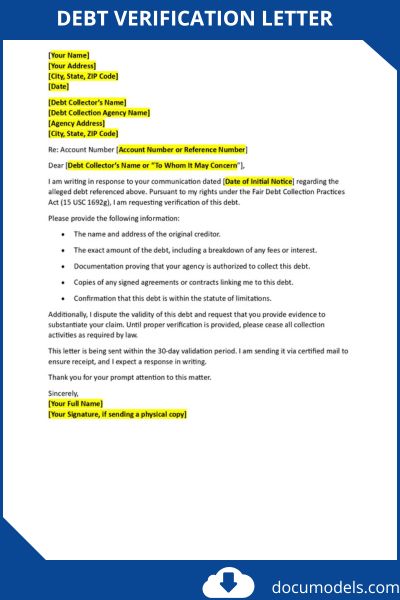
Sample 2 Debt Verification Letter
[Your Name]
[Your Address]
[City, State, ZIP Code]
[Date]
[Debt Collector’s Name]
[Debt Collection Agency Name]
[Agency Address]
[City, State, ZIP Code]
Re: Account Number [Account Number or Reference Number]
Dear [Debt Collector’s Name or “To Whom It May Concern”],
I am writing in response to your communication dated [Date of Initial Notice] regarding the alleged debt referenced above. Pursuant to my rights under the Fair Debt Collection Practices Act (15 USC 1692g), I am requesting verification of this debt.
Please provide the following information:
- The name and address of the original creditor.
- The exact amount of the debt, including a breakdown of any fees or interest.
- Documentation proving that your agency is authorized to collect this debt.
- Copies of any signed agreements or contracts linking me to this debt.
- Confirmation that this debt is within the statute of limitations.
Additionally, I dispute the validity of this debt and request that you provide evidence to substantiate your claim. Until proper verification is provided, please cease all collection activities as required by law.
This letter is being sent within the 30-day validation period. I am sending it via certified mail to ensure receipt, and I expect a response in writing.
Thank you for your prompt attention to this matter.
Sincerely,
[Your Full Name]
[Your Signature, if sending a physical copy]
Example Debt Verification Letter (filled with data)
John Doe
123 Maple Street
Springfield, IL 62701
555-123-4567
johndoe@email.com
July 7, 2025
ABC Collections, Inc.
789 Elm Avenue, Suite 300
Chicago, IL 60601
Subject: Request for Debt Verification
Account Number: 1234567890
Dear ABC Collections,
I am writing in response to your recent communication regarding an alleged debt under the account number listed above. I request that you please provide verification of this debt in accordance with my rights under the Fair Debt Collection Practices Act (FDCPA), Section 809. Specifically, I request that you provide the following information:
- The amount of the alleged debt.
- The name of the original creditor.
- A copy of the original agreement or a statement showing the details of the debt.
- Proof of your authority to collect on this debt, including any chain of assignment from the original creditor to your agency.
- A detailed payment history if available, including any charges, interest, or fees that have been added to the debt.
Please provide this documentation within 30 days of receiving this letter. Until I receive the requested information, I request that no further collection activity be pursued, and that this account be marked as disputed in your records.
Additionally, please note that if this debt is not validated, I expect any negative reporting related to this account to be removed from my credit report.
I look forward to your prompt response.
Sincerely,
John Doe
What Is a Debt Verification Letter?
A debt verification letter is a written request sent by a debt collector in response to your inquiry about an alleged debt. Its purpose is straightforward: to confirm details about the debt in question, including the amount owed, the original creditor, and your obligation to pay.
Debt verification is typically initiated after you’ve been contacted by a collection agency, giving you the opportunity to ensure the debt is accurate and belongs to you before taking any action.
When Should You Request a Debt Verification Letter?
You should request a debt verification letter if:
- You do not recognize the debt collector or the account.
- The debt appears to be inaccurate or outdated.
- You want to ensure the debt collector complies with legal obligations under the FDCPA.
Requesting this letter is your legal right as a consumer, protecting you from paying debt that may be fraudulent or in error.
Example Scenario:
Imagine you receive a phone call from a company claiming you owe $1,500 on a credit card from 2015. If you’re unsure about whether this account is legitimate, you can request a debt verification letter to confirm the validity of the claim.
Verification vs. Validation Letters
While the terms verification and validation are often used interchangeably, they refer to distinct processes under the FDCPA:
Debt Verification
- Initiated by the consumer: You request verification by sending a debt verification letter to the collector.
- Purpose: To confirm the debt’s validity, including details like the amount, creditor, and the collector’s authority.
- Timing: You must send the letter within 30 days of receiving the initial notice from the debt collector.
Debt Validation
Initiated by the debt collector: The FDCPA requires collectors to send you a written validation notice within five days of their first contact.
Content of the validation notice:
- The amount of the debt.
- The name of the original creditor.
- A statement informing you of your right to dispute the debt within 30 days.
- Instructions on how to request verification.
Purpose: Informs you of the debt and your rights, setting the stage for you to request verification if needed.
Key Differences
| Aspect | Verification | Validation |
| Who initiates? | Consumer (you) | Debt collector |
| When? | Within 30 days of receiving validation notice | Within 5 days of initial contact |
| Purpose | To confirm debt details and legitimacy | To notify you of the debt and your rights |
| Form | Letter sent by you | Notice sent by the collector |
What Should a Debt Verification Letter Include?
To be effective, a debt verification letter must include specific details to clearly communicate your request and comply with FDCPA guidelines.
Below is a breakdown of the essential components:
Key Elements of a Debt Verification Letter
1. Your Contact Information:
- Full name
- Address
- Phone number (optional, but helpful for correspondence)
2. Debt Collector’s Information:
- Name of the debt collection agency
- Address of the agency
- Account number or reference number (if provided)
3. Reference to the Debt:
- Mention the debt in question, including any details provided by the collector (e.g., amount, creditor name).
4. Request for Verification:
- Clearly state that you are requesting validation of the debt under the FDCPA.
- Specify the information you want verified (see below for details).
5. Statement of Your Rights:
- Note that the letter is sent within the 30-day validation period.
- Request that collection efforts stop until verification is provided.
6. Signature and Date:
- Sign the letter (if sending a physical copy).
- Include the date to prove it was sent within the 30-day period.
Specific Information to Request
The FDCPA doesn’t explicitly define what “verification” means, but you can request detailed information to ensure transparency. Ask for:
- The amount of the debt.
- The name of the original creditor.
- Proof that the debt collector is authorized to collect the debt (e.g., a contract or agreement).
- A detailed account history, including how the debt was calculated (e.g., interest, fees).
- Any signed agreements or documents linking you to the debt.
- Confirmation that the debt is within the statute of limitations (the legal time limit for collecting a debt).
How to Write an Effective Debt Verification Letter
Crafting a compelling yet precise debt verification letter is key to ensuring your rights are upheld.
Follow these steps for an effective letter:
Step 1: Include Your Personal Information
Start by listing your contact details. Be sure to include your full name, address, and contact phone number. Avoid sharing sensitive information like your Social Security number unless absolutely necessary.
Example:
[Your Full Name]
[Street Address]
[Phone Number]
[Email Address]
[Date]
Step 2: Address the Debt Collector
Identify the debt collection agency or collector contacting you. Include their full name, address, and any identifying account numbers relevant to the debt.
Example:
[Debt Collector’s Name or Agency]
[Agency Address]
[City, State, ZIP Code]
Step 3: Use a Clear Subject Line
Clarify the purpose of the letter with a clear subject line. For example:
Subject: Debt Verification Request for Account #[Account Number]
Step 4: Write a Polite and Specific Request
State that you are requesting verification of the debt under the Fair Debt Collection Practices Act. Be explicit about what proof you require:
- The creditor’s name and address
- Proof that you owe the debt
- A detailed breakdown of the amount owed
- Evidence showing the collector has been authorized to collect the debt
Step 5: Do Not Admit Liability
It’s essential to avoid admitting fault, responsibility, or ownership of the debt in your letter. Phrasing like “I dispute the validity of this debt” keeps the burden of proof on the collector.
Step 6: Keep Copies and Send via Certified Mail
Maintain a copy of your letter and all supporting documents for your records. Always send your letter through certified mail with a return receipt request—this creates a trackable paper trail proving your request was received.
Common Mistakes to Avoid
- Ignoring Requests: Ignoring debt collector notices can escalate the situation.
- Missing Deadlines: The FDCPA typically provides a 30-day window to dispute debts in writing.
- Not Keeping Copies: Without documentation, resolving disputes or defending yourself can become harder.
- Admitting Responsibility Prematurely: Admitting to the debt without verification can have legal consequences.
Frequently Asked Questions (FAQs)
A debt verification letter is a written request to a debt collector asking them to prove that the debt is valid and belongs to you. It helps protect consumers from paying incorrect or fraudulent debts.
Send it within 30 days of first contact from a collector to ensure they must provide proof before continuing collection efforts.
They must provide details like the original creditor, amount owed, and proof you owe the debt.
If they fail to validate the debt, you can file a complaint with the Consumer Financial Protection Bureau (CFPB) and dispute the debt.
Yes, you can still request validation and dispute inaccurate debts on your credit report.
It may temporarily pause calls until they provide validation, but it does not permanently stop collection unless the debt is proven invalid.
Review the information carefully, negotiate a payment plan if needed, or dispute if inaccuracies are found.
Format model to edit
Related Articles: