
A cease and desist letter is more than just a piece of legal correspondence – it’s a powerful tool used to protect your rights.
Whether you’re an individual or a business, this formal document communicates a clear message to the recipient: stop the harmful, infringing, or unlawful activity immediately, or face potential legal action. It’s often the first step in resolving disputes without the need to head straight to court.
These letters play a crucial role in protecting intellectual property, addressing harassment, or stopping defamation, among other issues. They allow you to assert your rights professionally, helping to avoid drawn-out legal battles.
Whether it’s about copyright infringement or a contract breach, a well-drafted cease and desist letter can offer clarity and a chance to resolve conflicts amicably.
In this post, we will delve into the essential components of a cease and desist letter, discuss its legal implications, and provide you with various examples to guide you through the process.
Cease and desist letter templates
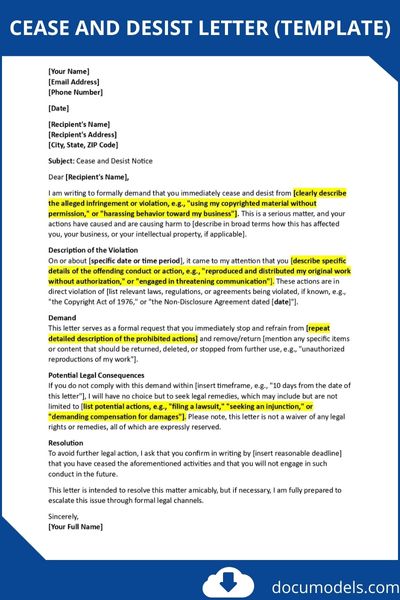
Understanding how to effectively utilize a cease and desist letter can help protect your interests without immediately resorting to costly legal battles.
Cease and Desist (Example) WordSample cease and desist letter
[Your Name]
[Email Address]
[Phone Number]
[Date]
[Recipient’s Name]
[Recipient’s Address]
[City, State, ZIP Code]
Subject: Cease and Desist Notice
Dear [Recipient’s Name],
I am writing to formally demand that you immediately cease and desist from [clearly describe the alleged infringement or violation, e.g., “using my copyrighted material without permission,” or “harassing behavior toward my business”]. This is a serious matter, and your actions have caused and are causing harm to [describe in broad terms how this has affected you, your business, or your intellectual property, if applicable].
Description of the Violation
On or about [specific date or time period], it came to my attention that you [describe specific details of the offending conduct or action, e.g., “reproduced and distributed my original work without authorization,” or “engaged in threatening communication”]. These actions are in direct violation of [list relevant laws, regulations, or agreements being violated, if known, e.g., “the Copyright Act of 1976,” or “the Non-Disclosure Agreement dated [date]”].
Demand
This letter serves as a formal request that you immediately stop and refrain from [repeat detailed description of the prohibited actions] and remove/return [mention any specific items or content that should be returned, deleted, or stopped from further use, e.g., “unauthorized reproductions of my work”].
Potential Legal Consequences
If you do not comply with this demand within [insert timeframe, e.g., “10 days from the date of this letter”], I will have no choice but to seek legal remedies, which may include but are not limited to [list potential actions, e.g., “filing a lawsuit,” “seeking an injunction,” or “demanding compensation for damages”]. Please note, this letter is not a waiver of any legal rights or remedies, all of which are expressly reserved.
Resolution
To avoid further legal action, I ask that you confirm in writing by [insert reasonable deadline] that you have ceased the aforementioned activities and that you will not engage in such conduct in the future.
This letter is intended to resolve this matter amicably, but if necessary, I am fully prepared to escalate this issue through formal legal channels.
Sincerely,
[Your Full Name]
Cease and desist letter for harassment
[Your Name]
[Your Address]
[City, State, ZIP Code]
[Email Address]
[Phone Number]
[Date]
[Recipient’s Name]
[Recipient’s Address]
[City, State, ZIP Code]
RE: Cease and Desist Harassment
Dear [Recipient’s Name],
I am writing to formally demand that you cease and desist your ongoing harassment against me. Your behavior has caused considerable distress and is both unwelcome and unacceptable. Specifically, the following actions have been noted and documented:
- [Provide a clear description of the harassment event or pattern, e.g., “Repeatedly sending threatening messages on [date(s)] via email.”]
- [Include additional incidents if applicable, e.g., “Engaging in defamatory remarks about me to others on [specific event].”]
- [Mention any other relevant behaviors, if necessary.]
These actions constitute harassment and are in violation of my personal and legal rights under [State/Local law, if applicable]. Your conduct has caused me [emotional distress/mental anguish/other relevant consequences], and this letter serves as a formal demand for you to put an end to this behavior immediately.
Effective immediately, you must:
- Stop [specific action, e.g., “sending any further communications, including emails, phone calls, or texts”].
- Refrain from [specific action, e.g., “approaching me in person or contacting those close to me regarding this matter.”].
Please be advised that if this harassment does not cease immediately, I will take legal action to protect myself and my rights. This may include filing civil or criminal charges against you, seeking restraining orders, or pursuing other remedies under applicable laws. I may also seek damages for any harm caused by your actions, including emotional distress and financial losses.
To avoid further escalation, I expect a written confirmation from you by [specific date, e.g., “10 days from receipt of this letter”] confirming that you will cease and desist from all harassing behavior. Failure to respond or comply will leave me no choice but to proceed with legal remedies.
This letter is not a waiver of any rights or remedies that I may have, all of which are expressly reserved.
I hope this matter can be resolved amicably without the need for further action.
Sincerely,
[Your Signature (if sending a physical copy)]
[Your Printed Name]
Cease and desist letter defamation
[Your Name or Business Name]
[Your Address]
[Email Address]
[Phone Number]
[Date]
[Recipient’s Name]
[Recipient’s Address]
[City, State, ZIP Code]
Subject: Cease and Desist Notification Concerning Defamation
Dear [Recipient’s Name],
I am writing to formally address and demand an immediate end to defamatory actions and statements you have made against me/my business. These actions have caused harm to my reputation, personal and/or professional standing, and may constitute violations of applicable laws.
Specifically, I refer to the following defamatory statements or actions:
- [Provide a detailed description of the defamatory statement(s)—e.g., what was said, when, where, and how it was shared or published. Include dates and examples if available.]
- [List additional specific details, such as platform of publication (e.g., social media, public forums) or individuals directly affected by the false statements.]
The above statements are false, unsubstantiated, and damaging. Such actions have caused [briefly include any measurable consequences, e.g., financial loss, reputation damage, emotional distress] and are a violation of my rights under [reference applicable defamation statute or law, if known/applicable in your jurisdiction].
Demand to Cease and Desist
I hereby demand that you immediately cease and desist from making, publishing, and/or disseminating any further false, defamatory, or damaging statements about me/my business. Specifically, I require the following actions to be taken without delay:
- Removal or retraction of all false, defamatory, or harmful statements.
- Issuing a public and written apology (if applicable).
- A commitment in writing to refrain from spreading false statements about me/my business in the future.
Potential Legal Consequences
If the demanded actions are not completed within [insert reasonable timeframe, e.g., 7, 10, or 14 days], I will have no choice but to pursue all applicable legal remedies. These remedies may include seeking monetary damages, filing a defamation lawsuit, and obtaining court-issued injunctions preventing further dissemination of false statements. Please be advised that such legal action may also render you responsible for covering legal fees and related costs.
This letter serves as formal notice and my good faith effort to resolve this matter amicably and without court intervention. Your compliance with these demands is expected and required immediately.
I recommend that you consider the seriousness of this matter and seek independent legal advice if necessary. My intent is solely to protect my reputation and prevent further harm.
Should you have questions or wish to confirm your compliance, you may contact me directly in writing at the address provided above.
Sincerely,
[Your Full Name]
[Title]
What Is a Cease and Desist Letter?
A cease and desist letter is a formal written notice sent to an individual, business, or organization. Its purpose? To demand they stop (cease) and refrain (desist) from engaging in actions or behaviors that violate your rights — whether they are legal, professional, or personal.
Why Send a Cease and Desist Letter?
Sending a cease and desist letter can serve multiple purposes, depending on your goals and the situation you’re facing.
Let’s take a closer look at why this legal tool is so useful:
1. Acts as a Warning
- The letter puts the offending party on notice. It communicates your intent to protect your legal rights. Often, that warning alone is enough to stop the wrongful behavior without further escalation.
2. Documented Evidence
- A cease and desist letter creates a written record of your complaint and your attempt to resolve the situation. If the issue progresses to court, this can serve as evidence that you acted in good faith.
3. Legal Protection
- If the other party continues their actions, the cease and desist letter strengthens your case should you decide to pursue a lawsuit.
4. Cost-Effective Solution
- Compared to immediate legal action, sending this letter is a much more affordable way to address the problem. Sometimes it resolves the issue entirely.
5. Professional Communication
- The letter formalizes your concerns. It’s a professional and constructive way to manage conflicts without resorting to verbal clashes or informal complaints.
When to Issue a Cease and Desist Letter
1. Intellectual Property Violations
When an individual or entity identifies a case of copyright infringement or trademark infringement, they may issue a cease and desist letter. It is commonly used to protect creative works, logos, and unique product identifiers when they are unlawfully replicated or used without permission.
- Copyright Infringement: Unauthorized use of copyrighted material.
- Trademark Infringement: Unauthorized use of a registered trademark or a confusingly similar mark.
2. Harassment and Personal Safety
Cease and desist letters are critical in instances of harassment or when personal safety is at risk. This includes cases of stalking or continuous unwanted contact, where the letter can demand the harasser to immediately stop such conduct.
- Harassment: Engaging in a persistent pattern of unwanted behavior.
- Stalking: Following or monitoring someone in a way that causes fear or distress.
3. Defamation, Libel, and Slander
Individuals or organizations that face false statements causing damage to their reputation can use a cease and desist letter to address defamation, libel (written defamation), or slander (spoken defamation). It demands retraction and cessation of defamatory remarks.
- Defamation: General term for false statements that harm someone’s reputation.
- Libel/Slander: Specific forms of defamation, written or spoken, respectively.
4. Debt Collection Issues
In the context of debt collection, a cease and desist letter may be sent to collectors engaging in aggressive or illegal collection practices. The letter requests an end to such activities and can specify acceptable methods of communication according to the law.
- Debt Collection: Efforts by collectors to recover debts, which must comply with legal standards.
5. Contract Disputes and Violations
A cease and desist letter is also applicable in contract disputes or violations, such as a breach of a non-compete agreement or unauthorized activities that contradict the terms of a contract.
- Breach of Contract: Failure to perform any term of a contract without a legitimate legal excuse.
- Non-Compete Agreement: A contract where one party agrees not to enter into or start a similar profession or trade in competition against another party.
How to Send a Cease and Desist Letter
Identify the Issue and Gather Evidence: Before drafting the letter, clearly identify the issue and gather any supporting evidence, such as contracts, emails, or photographs.
Consult Legal Counsel: While you can draft the letter yourself, consulting with a lawyer ensures that the letter is legally sound and effective.
Draft the Letter: Include all key components mentioned above. Be specific about the illegal activity and the legal grounds for your claim.
Send the Letter: You can send the letter via certified mail to ensure it is received. For additional proof, you may also send it electronically.
Follow Up: If the recipient does not comply by the deadline, consult your lawyer about the next steps, which may include filing a lawsuit.
Key components of the letter
- Sender Information: Name, address, and contact information of the person or entity sending the letter.
- Recipient Information: Name and address of the person or entity to whom the letter is addressed.
- Description of the Infringement: Detailed explanation of the activity that needs to be stopped.
- Legal Grounds: Basis for the claim, including any relevant laws or regulations.
- Demand to Cease and Desist: Clear statement that the recipient must stop the specified activity.
- Consequences: Potential legal actions if the recipient does not comply.
- Deadline: Specific date by which the recipient must comply with the demands.
- Signature: Signature of the sender or their legal representative.
How to Write a Cease and Desist Letter
Follow these steps to write an effective cease and desist letter.
1. Start with a Clear Heading
Use a professional heading such as “Cease and Desist Letter” at the top of your document.
2. Include the Sender’s Information
Provide your name or business name, mailing address, phone number, and email address. Make it easy for the recipient to identify and contact you.
3. Add the Recipient’s Information
Clearly state the name, address, or organization of the person/entity you’re addressing. Double-check for accuracy—this ensures the letter reaches the right individual.
4. Date the Letter
Include the date of writing. This establishes a timeline if the situation escalates legally.
5. Write the Opening Salutation
Begin with a professional greeting such as “Dear [Recipient’s Name].”
6. State the Intent of the Letter
Use clear and direct language to explain why you’re writing.
Example: “This letter serves as a formal demand that you immediately cease and desist [specific action]. Your actions are a violation of my [legal rights].”
7. Provide Evidence of Misconduct
Outline the offending behavior and support your claims with evidence. Examples include dates, locations, screenshots, or contracts. Be specific to ensure clarity.
8. Define the Action You Expect
State what you want the recipient to do and by when.
Example: “You are required to remove all unauthorized copies of my copyrighted material within 10 business days.”
9. State the Consequences of Non-Compliance
Clarify what will happen if the recipient doesn’t comply.
Example: “Should you fail to comply with these demands, I will have no choice but to pursue legal action to protect my rights.”
10. Maintain a Professional Tone
Don’t use threatening or emotional language. Keep the tone professional and business-like to avoid escalation.
11. Conclude with a Signature
End the letter with a formal closing such as “Sincerely,” followed by your name and, if relevant, your title.
Frequently Asked Questions
Its effectiveness relies on the legitimacy of the claims and the sender’s readiness to pursue legal action. A well-crafted letter can encourage compliance, initiate negotiation, or deter harmful conduct.
Ignoring it may lead to escalated legal actions, including lawsuits or injunctions. This can cause financial penalties, reputational harm, and increased legal costs for the recipient.
Yes, anyone can send one, including individuals, businesses, or attorneys. However, consulting a lawyer ensures the letter is valid, legally sound, and less likely to backfire.
Common issues include intellectual property infringement, slander, libel, harassment, unfair competition, and contractual violations. These letters act as an initial resolution attempt before legal action.
No, it’s not legally binding. It serves as a warning to stop harmful behavior. If ignored, the sender may escalate to court action for enforceable orders.
No, it’s not legally binding but can serve as a warning before pursuing legal action.
Yes, it’s used to address breaches of contracts, like non-compete or non-disclosure violations, urging compliance.
Format model to edit
Related Articles: