
Safeguarding proprietary information is critical for any business aiming to preserve its competitive advantage. From innovative product concepts to confidential client data and strategic plans, maintaining the privacy of sensitive material is essential.
A Non-Disclosure Agreement (NDA) serves as a vital legal instrument, creating a formal obligation of confidentiality between parties and ensuring that key information remains protected.
By clearly defining what constitutes confidential information and outlining the consequences of unauthorized disclosure, these agreements foster trust and security in business relationships.
This article serves as a comprehensive guide to understanding NDAs, detailing their purpose, key components, and the scenarios in which they are essential. Additionally, we provide a customizable NDA template to help you draft your own agreement with ease.
Non-disclosure agreement sample
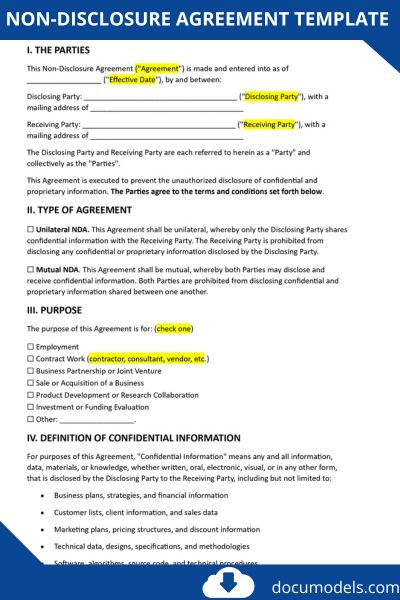
Whether you’re a startup seeking investment or an established company collaborating with partners, an NDA can be your first line of defense against potential breaches.
Non-disclosure agreement (Word)An Example of Non-Disclosure Agreement
What Is a Non-Disclosure Agreement?
A non-disclosure agreement, often referred to as an NDA or confidentiality agreement, is a legally binding contract between two or more parties that outlines the confidential information they agree not to disclose to others.
NDAs establish a framework for sharing sensitive information while ensuring it remains protected from unauthorized use or disclosure.
Key Characteristics of an NDA
- Legally Binding: NDAs are enforceable in court, provided they meet legal requirements.
- Customizable: They can be tailored to specific industries, relationships, or types of information.
- Time-Bound: Many NDAs specify a duration for confidentiality obligations.
- Mutual or Unilateral: NDAs can apply to one party or all parties involved.
Purpose of a Non-Disclosure Agreement
The primary purpose of an NDA is to protect sensitive information from being shared with unauthorized individuals or the public. By signing the agreement, the receiving party legally commits to keeping the information secret.
Key goals of an NDA include:
- Protecting Trade Secrets: This includes formulas, processes, designs, and practices that are not generally known and provide a competitive advantage. The formula for Coca-Cola is a classic example of a closely guarded trade secret.
- Safeguarding Business Plans: When pitching to investors or potential partners, you need to share your business strategy without the risk of it being copied.
- Securing Client Information: Businesses that handle sensitive client data, like financial records or personal information, use NDAs to ensure employees and contractors maintain confidentiality.
- Protecting Intellectual Property: Before a patent is filed, an NDA can protect an invention or idea during discussions with manufacturers, engineers, or marketers.
- Facilitating Due Diligence: During mergers and acquisitions, both companies share extensive financial and operational details. An NDA ensures this information remains private if the deal does not proceed.
Types of Non-Disclosure Agreements
NDAs are not one-size-fits-all. They can be structured in different ways depending on the relationship between the parties and the flow of information.
Unilateral NDA
This is the most common type of NDA. In a unilateral agreement, only one party is disclosing confidential information, and the other party (the recipient) agrees not to disclose it.
Example: An inventor shares a new product idea with a manufacturing company to see if it can be produced. The inventor provides the information, and the manufacturer agrees to keep it confidential.
Bilateral (Mutual) NDA
In a bilateral agreement, both parties are disclosing confidential information to each other. Each party agrees to protect the other’s sensitive data. This is common in joint ventures or business partnerships.
Example: Two companies decide to collaborate on a new software product. Both will share proprietary code, marketing strategies, and customer data with each other, and both agree to keep the shared information secret.
Multilateral NDA
This type of agreement involves three or more parties, where at least one party discloses confidential information to the others. It simplifies situations where multiple parties are collaborating, as it avoids the need for numerous individual unilateral or bilateral NDAs.
Example: A team of independent consultants is hired by a company to work on a sensitive project. The company can use a single multilateral NDA for all consultants, ensuring everyone is bound by the same confidentiality terms.
Common Uses of Non-Disclosure Agreements
NDAs are used in a wide variety of business scenarios. Understanding where they are most effective can help you recognize when you need one.
- Startups and Investors: Entrepreneurs often require potential investors to sign an NDA before revealing their business model, financial projections, or innovative technology.
- Employer and Employee: Companies frequently include confidentiality clauses or require separate NDAs as part of the hiring process to protect customer lists, internal processes, and financial data.
- Business Sales and Mergers: When one company considers buying another, the seller provides access to its books and operations. An NDA is crucial to protect the seller’s information if the sale falls through.
- Inventors and Service Providers: An inventor may need to discuss their creation with engineers, designers, or marketing agencies. An NDA ensures these third parties cannot steal the idea.
- Freelancers and Contractors: Companies hiring independent contractors for specific projects often use NDAs to protect any sensitive information the contractor may access, such as software code or strategic plans.
Key Components of a Non-Disclosure Agreement
While the specifics can vary, a well-drafted NDA should include several key components to be effective and enforceable.
1. Identification of Parties: The agreement must clearly state the names and addresses of the disclosing party (the one sharing information) and the receiving party (the one receiving it).
2. Definition of Confidential Information: This is the most critical section. It must clearly define what is considered confidential. It’s often better to be specific rather than overly broad.
It can include:
- Trade secrets
- Business plans and strategies
- Financial data
- Customer lists
- Technical data and source code
- Marketing plans
3. Exclusions from Confidentiality: The agreement should also specify what is not considered confidential. This typically includes information that:
- Is already publicly known.
- Was already in the recipient’s possession before the agreement.
- Is independently developed by the recipient without using the confidential information.
- Is legally required to be disclosed by a court order.
4. Obligations of the Receiving Party: This section outlines the recipient’s duties. The primary obligation is to keep the information secret and not disclose it to anyone. It may also include requirements to use the information only for the specified purpose (e.g., evaluating a business partnership).
5. Time Period: An NDA should specify how long the duty of confidentiality lasts. This can be a fixed period (e.g., 3-5 years) or continue indefinitely, especially for trade secrets. The duration should be reasonable to be enforceable.
6. Return or Destruction of Information: The agreement should state that the receiving party must return or destroy all confidential materials (including any copies) upon request or at the end of the agreement term.
7. Consequences of Breach: This clause outlines the remedies available to the disclosing party if the agreement is violated. This can include injunctive relief (a court order to stop the disclosure) and monetary damages.
8. Governing Law and Jurisdiction: The NDA should specify which state’s laws will govern the agreement and in which state or county any legal disputes will be handled.
Best Practices for Non-Disclosure Agreements
To ensure an NDA is effective and enforceable, consider the following best practices:
- Be Specific About Confidential Information: Clearly define what is protected to avoid ambiguity. Vague terms may weaken enforceability.
- Tailor the NDA to the Situation: Customize the agreement to fit the industry, relationship, and type of information involved.
- Set a Realistic Duration: Ensure the confidentiality period is reasonable based on the information’s sensitivity and industry standards.
- Use Clear and Simple Language: Avoid overly complex legal jargon to ensure all parties understand their obligations.
- Include Exceptions: Specify that information already public, independently developed, or legally required to be disclosed is not covered.
- Consult a Legal Professional: Have an attorney review the NDA to ensure compliance with local laws and industry regulations.
- Secure Signatures and Records: Ensure all parties sign the agreement and keep copies for reference.
- Regularly Review and Update: Periodically revisit NDAs to ensure they remain relevant as business relationships or information evolve.
Frequently Asked Questions (FAQ)
There are two primary types: unilateral NDAs where only one party discloses confidential information, and mutual NDAs where both parties share sensitive data with each other. The choice depends on whether information flows one-way or both ways in the relationship.
NDAs typically last between one to five years, depending on the nature of the confidential information and the agreement’s terms. Some agreements may have indefinite durations, especially concerning trade secrets.
Breaking an NDA can result in legal action, monetary damages, injunctive relief to stop further disclosure, attorney fees, and potential criminal charges in severe cases. The specific consequences depend on the agreement’s terms and the extent of the breach’s impact on the disclosing party.
Yes, NDAs are enforceable in court if they are clear, reasonable, and not contrary to public policy. Courts may invalidate NDAs that are overly broad, indefinite, or attempt to conceal illegal activities.
A unilateral NDA involves one party disclosing confidential information to another, with only the receiving party bound by confidentiality obligations. A mutual NDA involves both parties sharing confidential information and agreeing to protect each other’s data.
Yes, NDAs are commonly included in employment contracts to protect an employer’s confidential business information. However, NDAs cannot prevent employees from reporting illegal activities, such as discrimination or harassment, to authorities or legal advisors.
Format model to edit
Related Articles: