
Clear communication and well-defined expectations are essential for successful business partnerships. A Master Service Agreement (MSA) is a comprehensive contract that outlines the terms and conditions governing the relationship between a client and a service provider.
By establishing a common framework for future projects, the MSA eliminates the need to negotiate every detail for each new engagement. It specifies key provisions such as payment terms, confidentiality, intellectual property rights, and liability, providing a structured foundation for collaboration.
A properly drafted MSA protects both parties, reduces risk, and helps ensure that operations proceed smoothly and efficiently. With the right agreement in place, misunderstandings are minimized and a stable, productive partnership can thrive.
To support you in developing a robust contract, we have curated a selection of MSA templates. Explore these examples to see best practices in action and start building your own effective business agreements.
Master Service Agreement templates
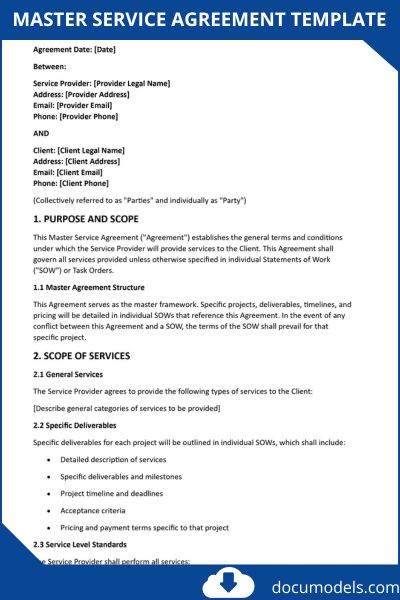
By setting a comprehensive framework at the outset, MSAs enhance efficiency and consistency, allowing businesses to focus on growth and collaboration.
Master service agreement (Template)Sample master service agreement
What Is a Master Service Agreement?
A Master Service Agreement, often abbreviated as MSA, is a comprehensive legal contract that outlines the general terms and conditions governing the relationship between two or more parties for current and future business activities.
Unlike a one-off contract, an MSA doesn’t detail specific project deliverables; instead, it sets the overarching rules, such as payment structures, confidentiality obligations, and dispute resolution processes.
Key Characteristics of an MSA
- Framework Nature: It acts as a template for future agreements, allowing parties to reference it in subsequent deals.
- Flexibility: MSAs are adaptable, often paired with addendums like SOWs that specify project details, timelines, and costs.
- Legal Binding: Once signed, it’s enforceable and helps prevent misunderstandings by clarifying expectations upfront.
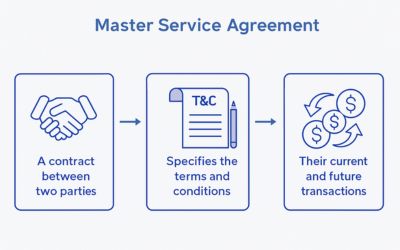
For example, if a software company provides ongoing IT support to a client, the MSA would cover broad terms like liability and intellectual property, while individual SOWs handle each upgrade or maintenance task.
Why Is Having a Master Service Agreement So Important?
Investing time to create a solid MSA upfront saves a significant amount of time, money, and potential conflict down the road. It provides a stable framework that benefits both the client and the service provider.
- Streamlines Future Contracts: The most immediate benefit is efficiency. With an MSA in place, you can start new projects quickly by simply signing a one or two-page SOW. This accelerates project kick-offs and reduces administrative delays.
- Ensures Clarity and Consistency: An MSA ensures that both parties are always on the same page regarding fundamental expectations. Key terms like payment schedules, confidentiality, and liability are standardized across all projects, preventing confusion.
- Mitigates Risk: It clearly defines responsibilities, liabilities, and procedures for handling disputes. This proactive approach helps manage potential risks by addressing issues like intellectual property rights, data security, and termination conditions before they become problems.
- Builds a Stronger Relationship: By agreeing on the foundational rules of engagement at the outset, both parties demonstrate a commitment to a long-term, transparent partnership. This fosters trust and allows the focus to remain on delivering great work.
Common Use Cases
MSAs are versatile and commonly used in scenarios involving repeated or long-term service provisions. They’re particularly prevalent in service-oriented industries where ongoing engagements are the norm.
Typical Industries and Scenarios
- Information Technology (IT) Services: For software development, cloud hosting, or cybersecurity, where clients need continuous support and updates.
- Consulting and Professional Services: Management consultants or legal firms use MSAs for multiple client projects, such as advisory services or audits.
- Marketing and Advertising: Agencies handling ongoing campaigns, social media management, or branding efforts for brands.
- Healthcare: Providers of medical equipment maintenance or IT systems for hospitals, ensuring compliance and reliability.
- Human Resources Outsourcing: For recruitment, payroll, or training services that span multiple years.
- Construction and Engineering: In large-scale projects involving subcontractors for ongoing site management or supplies.
- Oil and Gas: For drilling, exploration, or equipment leasing, where safety and regulatory compliance are critical.
Note: In each case, the MSA provides a stable foundation, while SOWs address project-specific details.
Core Components of a Master Service Agreement
A comprehensive MSA should be thorough and cover all essential aspects of the business relationship. While the specifics can vary, most effective MSAs include these core components.
1. Scope of Services
This section provides a high-level description of the types of services the provider will offer. It remains general, as the specifics will be detailed in individual SOWs.
2. Payment Terms
Here, you’ll define how and when the provider gets paid.
This includes:
- Billing rates (hourly, per project, or retainer)
- Invoice frequency (e.g., monthly, upon project completion)
- Payment due dates (e.g., Net 30, Net 60)
- Consequences for late payments
3. Term and Termination
This clause outlines the duration of the agreement and the conditions under which either party can end the relationship. It specifies notice periods and whether termination can be for cause (like a breach of contract) or for convenience.
4. Confidentiality
A critical component, this section ensures that any sensitive information shared between the parties remains private. It defines what constitutes “confidential information” and the obligations of each party to protect it.
5. Intellectual Property (IP) Rights
This defines who owns the work produced. Does the client own all deliverables upon payment? Does the provider retain rights to their underlying processes or pre-existing tools? A clear IP clause prevents future ownership disputes.
6. Warranties and Representations
The service provider “warrants” or guarantees that their work will meet certain standards. For example, they may warrant that the work will be performed in a professional manner and will not infringe on the intellectual property of a third party.
7. Limitation of Liability and Indemnification
This is a key risk-management section.
- Limitation of Liability: It caps the amount of damages one party can recover from the other in case of a breach or error. Often, this is limited to the total fees paid under a specific SOW or over a certain period.
- Indemnification: One party agrees to cover the losses of the other party if a specific issue arises. For example, a provider might indemnify a client against a lawsuit claiming the provider’s work violated a copyright.
8. Dispute Resolution
Should a disagreement arise, this clause outlines the steps to resolve it. It often requires parties to attempt mediation or arbitration before heading to court, which can be a faster and less expensive process.
9. Governing Law
This section specifies which state or country’s laws will be used to interpret the contract. This is especially important if the parties are in different locations.
Best Practices When Using a Master Service Agreement
To maximize the benefits of an MSA, follow these best practices, which emphasize clarity, foresight, and ongoing management.
Recommended Strategies:
- Involve Legal Experts Early: Consult attorneys to customize the MSA to your specific needs and ensure compliance with relevant laws.
- Use Clear, Concise Language: Avoid jargon; define all key terms to prevent ambiguity.
- Incorporate Flexibility: Include provisions for amendments, renewals, and handling changes in scope or regulations.
- Pair with Detailed SOWs: Always reference the MSA in SOWs and ensure they don’t contradict it.
- Regularly Review and Update: Schedule periodic reviews to adapt to business changes or new laws.
- Define Performance Metrics: Include SLAs (Service Level Agreements) for measurable outcomes and remedies for breaches.
- Address Exit Strategies: Clearly outline termination processes, including data return and post-termination obligations.
- Leverage Technology: Use contract management software for tracking, reminders, and e-signatures to streamline processes.
Frequently Asked Questions (FAQ)
While an MSA sets the overarching terms for the relationship, a Statement of Work (SOW) details the specific scope, deliverables, timelines, and costs for individual projects under the MSA.
Yes, once signed by both parties, an MSA is a legally binding contract. It establishes the legal framework for the relationship but doesn’t obligate either party to perform or pay for services until a specific SOW is agreed upon.
An MSA should encompass: scope of work, payment terms, confidentiality clauses, intellectual property rights, service level agreements (SLAs), liability and indemnification provisions, warranties, termination and renewal terms, and dispute resolution processes.
Yes, MSAs can be amended through a formal written process agreed upon by both parties. This allows the foundational terms to evolve with the business relationship without needing to renegotiate the entire agreement.
The validity period of an MSA can vary. It’s determined by the terms specified in the agreement. Some MSAs are valid for a year, while others may last multiple years. There are also auto-renewal clauses that can automatically extend the agreement unless either party opts out.
While it’s not mandatory, it’s highly recommended to involve legal counsel when drafting, reviewing, or negotiating an MSA. This ensures that your interests are well-protected and that the terms are legally sound.
Termination typically occurs through notice periods (e.g., 30-90 days), mutual agreement, or breach, as outlined in the MSA’s clause. Post-termination, obligations like confidentiality and IP persist.
Format model to edit
Related Articles: