
Renewing a lease might seem like a straightforward process, but in reality, it’s an important legal step that can protect both landlords and tenants while ensuring a smooth continuation of the rental agreement.
This legally binding contract provides an opportunity to review, revise, and extend the terms of an existing lease, ensuring clarity for everyone involved. For landlords, it offers a chance to protect their investment while retaining good tenants. For tenants, it provides a sense of stability and assurance in their living arrangements.
Renewing a lease isn’t just about signing on the dotted line. It’s an essential step in avoiding misunderstandings and fostering trust between property owners and renters.
In this post, we’ll break down what a lease renewal agreement is, why it’s important, and the key elements it should include. Plus, we’ll share practical, ready-to-use lease renewal agreement templates to make the process faster and easier.
Free Lease Renewal Agreement Templates
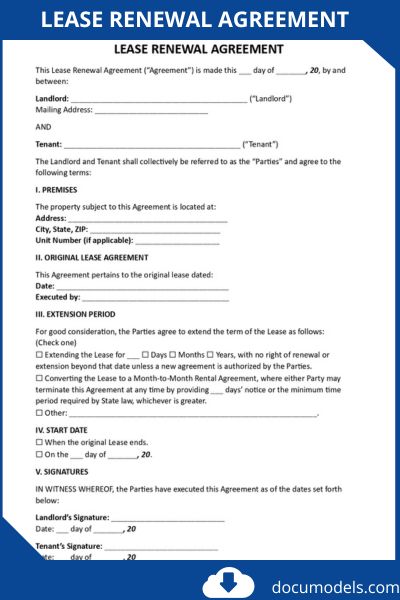
Understanding the nuances of lease renewals not only helps tenants secure their homes but also aids landlords in maintaining stable rental income.
Sample Lease Renewal AgreementLease renewal agreement template
What Is a Lease Renewal Agreement?
A lease renewal agreement is a legally binding contract that extends the term of an existing lease between a tenant and a landlord, allowing the tenant to continue occupying the property under similar or updated conditions.
It’s essentially a new agreement that replaces or builds upon the expiring one, typically for another fixed period like 6 or 12 months. Unlike simply letting a lease roll over into a month-to-month tenancy, a renewal formalizes the continuation and can include changes to rent, rules, or other terms.
Common Scenarios for Lease Renewal
Lease renewals arise in various situations, often driven by mutual benefits like tenant retention and avoiding vacancy costs.
Here are some typical scenarios where renewals are common:
- End-of-Term Continuation: As a lease approaches expiration (usually 6-12 months), a satisfied tenant and landlord opt to renew rather than end the tenancy. This is ideal for stable renters who pay on time and maintain the property well.
- Tenant Relocation Avoidance: Tenants might renew to skip moving expenses, especially in high-demand areas like New York or San Francisco, where finding affordable housing is challenging.
- Landlord Incentives: Landlords offer renewals with perks, such as a free month of rent or minor upgrades (e.g., painting an accent wall), to retain reliable tenants and reduce turnover.
- Personal or Financial Changes: A tenant facing job relocation might renew short-term, or a landlord could renew with adjusted terms if market rents have risen.
- Commercial Leases: In business rentals, renewals often include rent ceilings or floors to cap increases, common in retail spaces.
Difference Between Renewal and Extension
While often used interchangeably, lease renewals and extensions are distinct processes with different implications. A renewal creates a new lease agreement, potentially with revised terms, whereas an extension simply prolongs the existing one without major changes.
Understanding this helps avoid confusion during negotiations.
Here’s a comparison table for clarity:
| Aspect | Lease Renewal | Lease Extension |
| Definition | A new contract replacing the old lease, often with updated terms like rent increases or new rules. | An addendum to the original lease that extends the term without creating a new agreement. |
| Duration | Typically matches the original (e.g., another year), but can be renegotiated. | Short-term, like a few months, for temporary needs. |
| Changes Allowed | High flexibility; can revise rent, clauses, or responsibilities. | Minimal changes; terms remain mostly the same. |
| Legal Document | Full new lease or renewal agreement. | Simple amendment or addendum. |
| Best For | Long-term stability with updates (e.g., after market shifts). | Short-term bridging, like during renovations or moves. |
| Pros | Opportunity to negotiate better terms; resets the clock. | Quick and simple; maintains status quo. |
| Cons | More paperwork; potential disputes over changes. | No room for major updates; could lead to outdated terms. |
What Is the Process for Renewing a Lease?
Renewing a lease involves a structured process to ensure everything is legal and mutually agreed upon. Start early—ideally 60-90 days before expiration—to allow time for negotiations.
Here’s a step-by-step guide:
- Review Your Current Lease: Check for renewal clauses, notice periods (e.g., 30-60 days), automatic rollover options, and any restrictions like rent caps. Note state-specific rules; for instance, some areas require written notice.
- Communicate Intent: Tenants should inform the landlord of their desire to renew, while landlords send a renewal offer letter. This can be via email, letter, or in-person. Discuss potential changes early.
- Negotiate Terms: Bargain over rent increases, repairs, or incentives. Tenants might request lower rent if market rates dropped, or landlords could offer perks for prompt renewal.
- Draft the Renewal Agreement: Use a template or consult a lawyer to create the document. Include all updates and ensure it complies with local laws.
- Sign and Execute: Both parties review, sign, and exchange copies. Pay any fees or deposits if required.
- Handle Non-Renewal if Needed: If declining, provide notice (e.g., 30 days) to avoid automatic month-to-month conversion.
Legal Considerations and Best Practices
Lease renewals must adhere to federal, state, and local laws to avoid violations. For example, under the Fair Housing Act, discrimination based on race, religion, or disability is illegal during renewals.
State laws vary—California has strict rent control, while Texas offers more landlord flexibility.
Key Legal Considerations
- Notice Requirements: Most states mandate 30-60 days’ notice for non-renewal or changes.
- Rent Increases: Must be reasonable and notified in advance; some cities cap hikes (e.g., 3-5% annually).
- Habitability Standards: The property must remain safe and livable; renewals can’t waive these rights.
- Automatic Renewals: Some leases include evergreen clauses that auto-renew unless canceled.
- Eviction Protections: Non-renewal can’t be retaliatory (e.g., after a complaint).
Best Practices
- Start Early: Begin discussions 90 days out to allow negotiations and avoid rushed decisions.
- Document Everything: Keep records of communications, agreements, and property conditions.
- Offer Incentives: Landlords can provide discounts or upgrades to encourage renewals.
- Review Tenant History: Evaluate payment records and compliance before offering renewal.
- Consult Professionals: Use lawyers or property managers for complex cases, especially in regulated areas.
- Be Flexible: Listen to feedback—tenants might renew if minor requests (e.g., pet allowances) are met.
Format model to edit
Related Articles: