
Navigating the path to homeownership can feel challenging, especially in a competitive real estate market. Likewise, sellers often look for flexible ways to secure a committed buyer.
A lease purchase contract, also known as a rent-to-own agreement, offers a unique solution that bridges this gap, creating a win-win scenario for both parties.
Understanding the key terms, conditions, and legal implications of these contracts is essential for both parties to protect their interests and ensure a smooth transition from renter to owner.
Whether you’re a prospective buyer or a landlord, knowing how to structure a lease purchase contract properly can save you time, money, and stress.
In this article, we will explore the essentials of lease purchase contracts, including their structure, benefits, and key considerations for both buyers and sellers. Additionally, we will provide a template to help you draft your own agreement, ensuring that all necessary terms and conditions are clearly outlined.
Lease to Purchase Agreement Template
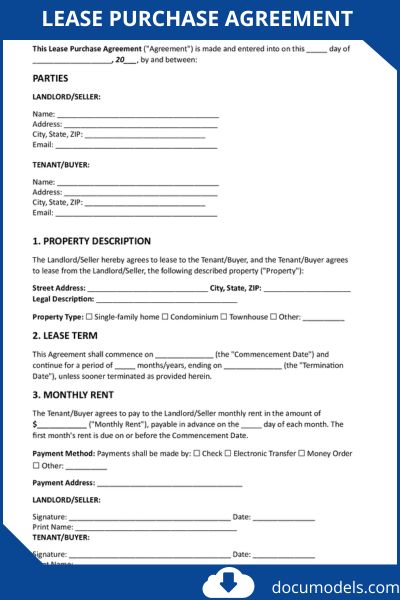
This arrangement not only provides flexibility but also helps potential buyers build equity while living in their future home.
Lease Purchase Agreement (Sample)Free Lease Purchase Agreement
What Is a Lease Purchase Agreement?
A lease purchase agreement is a legally binding contract that combines elements of a rental lease with a purchase agreement. It allows a tenant (often called the buyer or lessee) to rent a property for a specified period—typically 1 to 3 years—with the obligation to buy it at a predetermined price upon lease expiration.
Unlike a standard lease, part of the monthly rent may be credited toward the future down payment, helping build equity over time.
Key features include:
- Upfront Option Fee: A non-refundable fee (usually 1-5% of the purchase price) paid by the tenant to secure the right to buy.
- Fixed Purchase Price: Agreed upon at the start, protecting against market fluctuations.
- Rent Credits: A portion of rent (e.g., $400 of $2,000 monthly) applied to the down payment.
- Cross-Default Provisions: If the tenant defaults on the lease, it can trigger issues in the purchase agreement, and vice versa.
Distinction from Lease-Option and Rent-to-Own Agreements
While lease purchase, lease-option, and rent-to-own agreements are often confused under the “rent-to-own” umbrella, they differ significantly in obligations and risks.
Here’s a breakdown:
Lease Purchase vs. Lease-Option
- Lease Purchase: The tenant is obligated to buy the property at the end of the lease. It’s essentially a delayed sale with a binding commitment. If the buyer fails to purchase, they may face legal consequences, such as losing deposits or facing breach of contract claims.
- Lease-Option: The tenant has the option (but not the obligation) to buy. They pay an option fee for the right to purchase but can walk away at lease end, forfeiting only the fee and any credits.
Lease Purchase vs. Rent-to-Own
- Rent-to-own is a broader term often synonymous with lease-option, where the focus is on the optional path to ownership. In contrast, lease purchase mandates the sale, making it riskier for buyers but more secure for sellers.
Common Uses
Lease purchase agreements are commonly used in residential real estate but can apply to commercial properties or even durable goods like appliances.
They serve specific scenarios where traditional buying isn’t feasible:
- Credit Repair: Buyers with low credit scores rent while improving their rating to qualify for a mortgage.
- Building Down Payments: Rent credits accumulate toward the purchase, helping those short on savings.
- Market Testing: Buyers “test-drive” the property and neighborhood before committing fully.
- Seller Benefits: Sellers in slow markets secure tenants who are likely to buy, receiving higher rent and option fees.
- Relocation or Job Transitions: Ideal for those moving but not ready to buy immediately.
- Rising Markets: Locks in a price early, potentially creating equity if values rise.
In commercial contexts, businesses use them for equipment or office space to avoid large upfront costs.
Key Components of Lease Purchase Agreements
A well-drafted lease purchase agreement includes several essential elements to protect both parties.
- Parties Involved: Names, addresses, and roles of the landlord/seller and tenant/buyer.
- Property Description: Detailed address, legal description, and any inclusions (e.g., appliances).
- Lease Term: Duration (e.g., 24 months), start/end dates, and renewal options.
- Monthly Rent and Credits: Total rent amount and portion credited to purchase (e.g., 20-30% as down payment credit).
- Purchase Price: Fixed amount or formula (e.g., current value + annual increases).
- Option Fee: Upfront, non-refundable payment (1-5% of price).
- Maintenance and Repairs: Who handles what—often tenant responsibility for minor issues.
- Insurance and Taxes: Typically, seller’s duty until purchase, but tenant may contribute.
- Default Clauses: Consequences for breach, like eviction or loss of credits.
- Closing Details: Timeline, contingencies (e.g., appraisal), and financing requirements.
Legal, Regulatory, and State Considerations
Lease purchase agreements are governed by real estate laws, which vary by state.
Federally, under the Dodd-Frank Act, if credits make it a financing arrangement, buyers must qualify as with a traditional mortgage to prevent predatory lending.
Key considerations:
- State Variations: Some states (e.g., Texas) have specific disclosure requirements; others treat them as installment sales. Check local laws for limits on fees or terms.
- Recording the Agreement: Record with the county to protect against seller selling to others.
- Tax Implications: Sellers may defer capital gains; buyers can’t deduct mortgage interest until purchase.
- Consumer Protections: Agreements must avoid resembling contract deeds to prevent foreclosure risks. In Washington, for example, leases over four months must meet specific criteria.
- Regulatory Risks: If deemed financing, sellers need Mortgage Loan Originator registration.
Always consult state-specific resources or a lawyer, as non-compliance can void the agreement.
Additional Legal Provisions and Best Practices
To ensure fairness and avoid disputes, include these provisions and follow best practices:
Additional Provisions
- Contingencies: Clauses for financing approval, home inspection, or appraisal.
- Right of First Refusal: Buyer gets priority if seller receives other offers.
- Assignment Clause: Whether the agreement can be transferred.
- Dispute Resolution: Mediation or arbitration before court.
- Exit Strategies: Conditions for early termination.
Best Practices
- Consult Professionals: Work with a real estate attorney and agent to draft/review the agreement.
- Get Everything in Writing: Avoid verbal promises; document all terms clearly.
- Financial Readiness: Buyers should pre-qualify for a mortgage early and monitor credit.
- Market Research: Appraise the property to ensure fair pricing.
- Transparency: Disclose all fees, risks, and responsibilities upfront.
- For Sellers: Verify buyer’s ability to purchase; include escalation clauses for rising markets.
- For Buyers: Build in flexibility for life changes; consider shorter terms to minimize risk.
Format model to edit
Related Articles: