
Facing a legal dispute can be daunting, and the thought of a lawsuit often brings stress and uncertainty. However, before escalating to court, there is a powerful tool that can help resolve conflicts more efficiently: the letter of intent to sue.
This formal document serves as a final warning to the other party, clearly outlining your grievances and the specific actions you expect them to take to avoid a lawsuit. It demonstrates your seriousness and provides one last opportunity for negotiation and settlement.
Understanding how to structure this letter — from stating the facts clearly to specifying your demands and deadlines — can make a significant difference in how seriously your claim is taken.
In this post, we’ll guide you through the essentials of crafting an effective Letter of Intent to Sue and share powerful sample letters you can use as templates.
Free letter of intent to sue templates
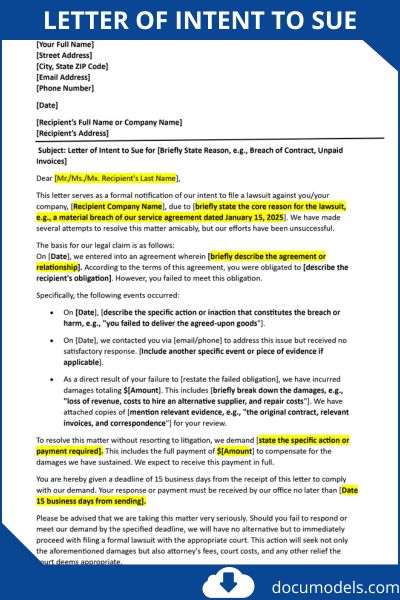
Understanding how to craft an effective letter can significantly impact the outcome of a dispute, potentially leading to resolution without the need for costly litigation.
Letter of intent to sue (Sample)Sample letter of intent to sue
[Your Full Name]
[Street Address]
[City, State ZIP Code]
[Email Address]
[Phone Number]
[Date]
[Recipient’s Full Name or Company Name]
[Recipient’s Address]
[City, State ZIP Code]
Subject: Letter of Intent to Sue for [Briefly State Reason, e.g., Breach of Contract, Unpaid Invoices]
Dear [Mr./Ms./Mx. Recipient’s Last Name],
This letter serves as a formal notification of our intent to file a lawsuit against you/your company, [Recipient Company Name], due to [briefly state the core reason for the lawsuit, e.g., a material breach of our service agreement dated January 15, 2025]. We have made several attempts to resolve this matter amicably, but our efforts have been unsuccessful.
The basis for our legal claim is as follows:
On [Date], we entered into an agreement wherein [briefly describe the agreement or relationship]. According to the terms of this agreement, you were obligated to [describe the recipient’s obligation]. However, you failed to meet this obligation.
Specifically, the following events occurred:
- On [Date], [describe the specific action or inaction that constitutes the breach or harm, e.g., “you failed to deliver the agreed-upon goods“].
- On [Date], we contacted you via [email/phone] to address this issue but received no satisfactory response. [Include another specific event or piece of evidence if applicable].
- As a direct result of your failure to [restate the failed obligation], we have incurred damages totaling $[Amount]. This includes [briefly break down the damages, e.g., “loss of revenue, costs to hire an alternative supplier, and repair costs“]. We have attached copies of [mention relevant evidence, e.g., “the original contract, relevant invoices, and correspondence“] for your review.
To resolve this matter without resorting to litigation, we demand [state the specific action or payment required]. This includes the full payment of $[Amount] to compensate for the damages we have sustained. We expect to receive this payment in full.
You are hereby given a deadline of 15 business days from the receipt of this letter to comply with our demand. Your response or payment must be received by our office no later than [Date 15 business days from sending].
Please be advised that we are taking this matter very seriously. Should you fail to respond or meet our demand by the specified deadline, we will have no alternative but to immediately proceed with filing a formal lawsuit with the appropriate court. This action will seek not only the aforementioned damages but also attorney’s fees, court costs, and any other relief the court deems appropriate.
This letter represents a final attempt to resolve this dispute before legal proceedings commence. We hope to avoid litigation but are fully prepared to pursue all available legal remedies to protect our interests.
Sincerely,
__________________________
[Your Signature (if printed)]
[Your Full Name]
Enclosures: [List any documents included, e.g., copies of contracts, receipts, correspondence, etc.]
Sample 2: Letter of intent to sue
[Your Full Name]
[Address]
[City, State, ZIP Code]
[Email Address]
[Phone Number]
[Date]
[Recipient’s Full Name or “Registered Agent”]
[Company Name, if applicable]
[Address]
Re: Notice of Intent to Sue for [Brief Description of Dispute, e.g., Breach of Contract]
Dear [Recipient’s Name or “Sir/Madam“],
I am writing to formally notify you of my intent to pursue legal action against you (or your organization) unless the matter described below is resolved promptly. This letter serves as a good-faith effort to avoid the time, expense, and uncertainty of litigation.
On [specific date(s) or period], [briefly describe the incident or facts giving rise to the dispute, e.g., “you failed to deliver goods as agreed under our contract dated [date], resulting in financial losses of approximately $X”]. Despite my previous attempts to resolve this issue through [mention any prior communications, e.g., “emails dated [dates] and a phone call on [date]”], no satisfactory resolution has been reached. This conduct constitutes [reference relevant legal basis, e.g., “a breach of contract under [applicable state] law” or “negligence causing harm”].
As a direct result of your actions (or inactions), I have suffered [describe damages, e.g., “monetary losses exceeding $X, emotional distress, and lost business opportunities“]. To mitigate further harm and avoid commencing a lawsuit, I demand the following within [specify timeframe, e.g., “14 days from the date of this letter”]:
- [Demand 1, e.g., “Full compensation in the amount of $X for all documented losses.”]
- [Demand 2, e.g., “A written apology and assurance that such conduct will cease immediately.”]
- [Any additional demands, e.g., “Return of all property or documents in your possession.”]
Should you fail to comply with these demands by [specific deadline, e.g., “October 19, 2025“], I will have no choice but to file a lawsuit in [appropriate court, e.g., “the Superior Court of [County/State]”] seeking [outline remedies sought, e.g., “compensatory damages, punitive damages, attorney’s fees, and court costs“]. This action will be taken without further notice.
I urge you to consult with legal counsel and respond in writing to the address above. I remain open to discussing a mutually agreeable settlement to resolve this matter amicably.
Sincerely,
[Your Full Name]
[Signature, if sending physically]
What Is a Letter of Intent to Sue?
A letter of intent to sue is a preliminary legal document sent by a prospective plaintiff to a potential defendant, outlining the intent to pursue a lawsuit unless the matter is settled. It serves as an official warning, detailing the grievances and giving the recipient an opportunity to address the issue before court proceedings begin.
Unlike a full complaint, this letter is not filed in court but acts as a strategic tool to encourage negotiation and potentially avoid litigation altogether.
These letters are commonly used in civil disputes and must be clear, factual, and professional to establish a serious tone. They are not legally binding agreements but can create a record of your good-faith attempt to resolve the conflict.
Purpose and Importance
The primary purpose of a letter of intent to sue is to prompt negotiation and avoid the time, expense, and stress of a lawsuit. It communicates your seriousness about the claim and gives the other party an opportunity to respond, potentially leading to a quick settlement.
Here’s why it’s important:
- Encourages Settlement: Many disputes are resolved at this stage, saving both parties from court fees and attorney costs.
- Preserves Evidence: The letter documents your claim, including facts, damages, and demands, which can be used later in court to show good faith.
- Meets Legal Requirements: In certain cases (e.g., under the Fair Debt Collection Practices Act in the U.S.), a demand letter is mandatory before suing.
- Builds Your Case: It demonstrates that you’ve given the defendant fair notice, which can strengthen your position if the case goes to trial.
- Cost-Effective: Drafting and sending the letter is relatively inexpensive compared to filing a lawsuit.
When to Use a Letter of Intent to Sue
Not every disagreement warrants a letter of intent to sue. Use it when informal attempts (like phone calls or emails) have failed, and you’re prepared to follow through with legal action if needed.
Common scenarios include:
- Personal Injury Claims: If you’ve been injured due to someone else’s negligence (e.g., a car accident or slip-and-fall), send the letter to demand compensation for medical bills, lost wages, and pain.
- Contract Breaches: When a party fails to uphold a business agreement, such as non-payment for services rendered.
- Property Disputes: Issues like property damage, boundary encroachments, or landlord-tenant conflicts (e.g., unpaid rent or unreturned security deposits).
- Debt Collection: To recover owed money, especially if you’re a creditor.
- Defamation or Libel: If false statements have harmed your reputation.
- Consumer Complaints: Against companies for faulty products, poor services, or violations of consumer protection laws.
- Employment Disputes: Such as wrongful termination or unpaid wages, though some require EEOC filings first.
Key Components of a Letter of Intent to Sue
A well-structured letter of intent is clear, professional, and contains all the necessary information for the recipient to understand and respond to your claim. While the exact details will vary, every letter should include these key components.
- Your Information: Your full name and contact information.
- Recipient’s Information: The full name and address of the person or business you intend to sue.
- Date: The date the letter is written.
- A Clear Subject Line: For example, “Final Demand for Payment” or “Notice of Intent to Pursue Legal Action.”
- A Statement of Facts: A concise, chronological account of the events that led to the dispute. Stick to the facts and avoid emotional language.
- The Legal Basis for Your Claim: Explain why the recipient is legally responsible for your damages (e.g., breach of contract, negligence).
- A Specific Demand for Action: Clearly state what you want the recipient to do. This could be a specific sum of money, the completion of a service, or the replacement of a damaged item.
- A Deadline for Response: Give the recipient a reasonable deadline to respond or comply with your demand (e.g., 14 or 30 days).
- Consequences of Non-Compliance: State explicitly that you will file a lawsuit if your demand is not met by the deadline.
- Your Signature: Sign the letter to formalize it.
How to Write an Intent to Sue Letter
Writing an effective letter requires a balance of professionalism and firmness. Follow this step-by-step guide to draft your letter.
Step 1: Gather All Relevant Documents
Before you start writing, collect all evidence related to your claim. This includes contracts, invoices, emails, photos, receipts, and witness statements. Having these documents on hand will help you state the facts accurately.
Step 2: Draft the Introduction
Start with your contact information, the date, and the recipient’s contact information. Use a clear subject line that immediately communicates the letter’s purpose.
Step 3: State the Facts Objectively
Write a clear, factual narrative of the dispute. Begin with the initial agreement or relationship and explain what went wrong.
Example for a breach of contract:
On May 15, 2025, we signed a contract for you to remodel our kitchen for a total cost of $15,000, with a completion date of July 30, 2025. You failed to complete the project by the agreed-upon date and have left the work unfinished despite our repeated attempts to contact you.
Step 4: Explain the Damages and Demand a Resolution
Quantify the damages you have suffered. If you are demanding money, explain how you calculated the amount.
Be specific about what you want.
Example:
As a result of your breach of contract, we have been forced to hire another contractor to complete the work at an additional cost of $5,000. We demand payment of $5,000 to cover this cost within 15 days of the date of this letter.
Step 5: Set a Clear Deadline and State the Consequences
Clearly state the deadline for the recipient to meet your demand. Also, state the consequence of their failure to do so.
Example:
If we do not receive payment in full by October 20, 2025, we will have no alternative but to file a lawsuit against you to recover the damages. We will also seek to recover attorney’s fees and court costs.
Step 6: Conclude Professionally
End the letter with a professional closing, such as “Sincerely,” and your signature. Keep a copy of the letter for your records.
Best Practices and Legal Advice
While you can write a letter of intent to sue on your own, following these best practices can increase its effectiveness.
- Be Professional, Not Emotional: Avoid insults, threats, or angry language. A calm, professional tone is more likely to be taken seriously and will not harm your case if the letter is presented in court.
- Be Specific and Factual: Vague claims are easy to ignore. Provide specific dates, amounts, and details of the incident. The more detailed and evidence-based your letter is, the stronger your position will be.
- Send it via Certified Mail: Send the letter via certified mail with a return receipt requested. This provides proof that the recipient received the letter and the date on which they received it. This is crucial evidence if you need to prove you gave them a chance to respond.
Legal Advice: Always consult an attorney before sending. They can review for accuracy, ensure compliance with local rules, and advise on next steps.
Format model to edit
Related Articles: