
Starting a new job is both exciting and overwhelming—for the employee stepping into a new role and for the company eager to integrate fresh talent. One of the most effective ways to make this transition smoother is through a thoughtful welcome letter to a new employee.
This simple gesture goes beyond formality; it sets the tone for the working relationship, reinforces company culture, and makes the new hire feel valued from day one.
A well-crafted welcome letter communicates warmth, professionalism, and clarity. It can highlight the company’s mission, outline the employee’s role, and provide practical information that helps them hit the ground running.
More importantly, it fosters a sense of belonging, which is crucial for long-term engagement and retention.
If you’re looking for inspiration or ready-to-use templates, keep reading—because we’re sharing practical samples of welcome letters to new employees that you can adapt for your own organization.
New Employee Welcome Letter Template
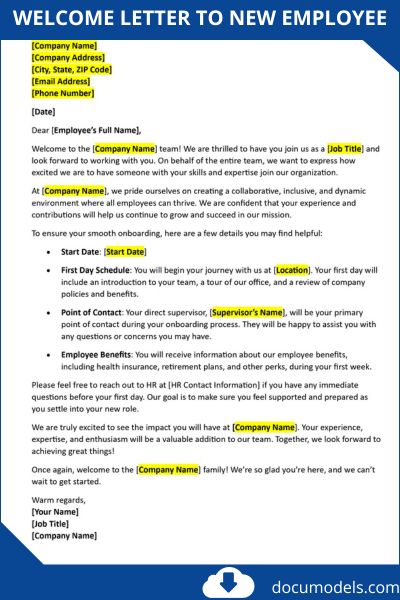
A well-crafted welcome letter not only sets the tone for their experience but also makes them feel valued from day one.
Welcome letter to new employee (Sample)Sample welcome letter to new employee
[Company Logo/Letterhead]
[Company Name]
[Address]
[Date]
[Employee Name]
[Employee Address]
Subject: Welcome to the [Company Name] Team!
Dear [Employee Name],
On behalf of the entire team, I am delighted to welcome you to [Company Name]. We are all very excited to have you join us, and we look forward to your first day on [Start Date].
We believe that our team is our greatest asset, and we are confident that your skills and experience will be a fantastic addition. Here at [Company Name], we foster a culture of collaboration, innovation, and mutual support. We encourage open communication and value the unique perspectives that each team member brings. We hope you will find your new role both rewarding and challenging.
As our new [Job Title], you will be reporting to [Manager’s Name] and working with the [Department/Team Name] team. Your primary role will involve [briefly describe 1-2 key responsibilities, e.g., “managing our key client accounts” or “developing new features for our flagship software”]. We know you will play a crucial part in our future success.
Your first few days will be focused on orientation and getting you settled in. We have planned a schedule to help you get to know the team, our systems, and our ongoing projects. Your new colleagues are eager to meet you and help you get up to speed.
Please don’t hesitate to reach out if you have any questions before your start date. We are here to support you and ensure you have a smooth and successful transition into the company.
Once again, welcome to the team! We can’t wait to see what we will accomplish together.
Warmly,
[Your Name/Hiring Manager’s Name/CEO’s Name]
[Your Title]
[Company Name]
Sample 2: New employee welcome letter to staff
[Company Name]
[Company Address]
[City, State, ZIP Code]
[Email Address]
[Phone Number]
[Date]
Dear [Employee’s Full Name],
Welcome to the [Company Name] team! We are thrilled to have you join us as a [Job Title] and look forward to working with you. On behalf of the entire team, we want to express how excited we are to have someone with your skills and expertise join our organization.
At [Company Name], we pride ourselves on creating a collaborative, inclusive, and dynamic environment where all employees can thrive. We are confident that your experience and contributions will help us continue to grow and succeed in our mission.
To ensure your smooth onboarding, here are a few details you may find helpful:
- Start Date: [Start Date]
- First Day Schedule: You will begin your journey with us at [Location]. Your first day will include an introduction to your team, a tour of our office, and a review of company policies and benefits.
- Point of Contact: Your direct supervisor, [Supervisor’s Name], will be your primary point of contact during your onboarding process. They will be happy to assist you with any questions or concerns you may have.
- Employee Benefits: You will receive information about our employee benefits, including health insurance, retirement plans, and other perks, during your first week.
Please feel free to reach out to HR at [HR Contact Information] if you have any immediate questions before your first day. Our goal is to make sure you feel supported and prepared as you settle into your new role.
We are truly excited to see the impact you will have at [Company Name]. Your experience, expertise, and enthusiasm will be a valuable addition to our team. Together, we look forward to achieving great things!
Once again, welcome to the [Company Name] family! We’re so glad you’re here, and we can’t wait to get started.
Warm regards,
[Your Name]
[Job Title]
[Company Name]
Sample 3: Welcome Letter Template from CEO to New Employee
[Date]
[Employee Name]
[Employee Address]
Subject: A Warm Welcome to the Team
Dear [Employee Name],
On behalf of the entire team, I am delighted to welcome you to [Company Name]. We are all incredibly excited to have you join us and are confident that your skills and experience will be a fantastic addition to our company.
We chose you because we believe you share our passion and commitment. Our mission at [Company Name] is to [briefly and inspiringly state the company’s mission, e.g., “innovate the future of sustainable energy” or “create meaningful connections through technology“]. We achieve this by staying true to our core values of [mention 2-3 key company values, e.g., integrity, collaboration, and customer focus]. We believe you will play a crucial role in helping us uphold these values and drive our mission forward.
Your first few weeks will be a time of learning, meeting new people, and understanding how we operate. We encourage you to ask questions, share your ideas, and immerse yourself in our culture. Your perspective is valuable, and we hired you because we want to hear it. Open communication is something we champion here, and my door is always open should you ever wish to share your thoughts.
We are not just a company; we are a community. We are committed to creating an environment where you feel supported, valued, and empowered to do your best work. Your success is our success, and we are dedicated to helping you grow both professionally and personally during your time with us.
Welcome aboard. We are thrilled to begin this journey with you and look forward to the great things we will accomplish together.
Warmly,
[CEO Name]
Chief Executive Officer
[Company Name]
Purpose and Importance of a Welcome Letter
The primary purpose of a welcome letter is to make the new employee feel valued, informed, and excited about their role. It goes beyond a mere “hello” by outlining what to expect, reinforcing the company’s culture, and providing logistical details.
Here’s why welcome letters are important:
- Builds Excitement and Reduces Anxiety: Starting a new job can be overwhelming. A warm welcome reassures the employee that they’ve made the right choice.
- Sets Expectations: It clarifies the first day’s agenda, company policies, and key contacts, helping the new hire prepare mentally and practically.
- Enhances Company Branding: It showcases your organization’s professionalism, inclusivity, and values, which can improve employer branding.
- Improves Retention and Productivity: Employees who feel welcomed are more likely to engage quickly, leading to higher job satisfaction and lower turnover rates.
Without a welcome letter, new employees might feel overlooked, which could result in disengagement or early resignation. Studies from HR organizations like SHRM indicate that effective onboarding, starting with such letters, can improve retention by up to 82%.
Key Elements of an Effective Welcome Letter
A welcome letter should be concise (1-2 pages or a short email), personalized, and informative. Avoid overwhelming the reader with too much detail—save that for the employee handbook.
Essential key elements include:
- Header and Greeting: Use company letterhead with the date, employee’s name, and a warm salutation like “Dear [First Name],”.
- Introduction and Welcome: Express genuine excitement about their joining. Mention their role and start date.
- Company Overview: Briefly highlight the company’s mission, values, and culture.
- First-Day Logistics: Include details like arrival time, dress code, parking info, and who to meet.
- Next Steps: Outline any pre-start tasks, such as completing paperwork or setting up accounts.
- Contact Information: Provide HR or manager’s details for questions.
- Closing: End with encouragement and a sign-off from the sender.
Who Should Send the Welcome Letter and When
The sender of the welcome letter depends on the company’s size and structure:
- HR Department: Ideal for larger organizations to handle standardization and compliance.
- Direct Manager or Team Lead: Adds a personal touch, especially in smaller teams, fostering immediate rapport.
- CEO or Executive: For high-level roles or small companies, to emphasize importance.
- Combination: Sometimes co-signed by HR and the manager for a balanced approach.
As for timing:
- Send it 1-2 weeks before the start date to give the employee time to prepare without overwhelming them too early.
- If the hire is immediate, send it within 24-48 hours of acceptance.
- For remote workers, email is preferred; for in-office, consider a printed version delivered with onboarding swag.
Pro Tip: Automate sending via HR software like BambooHR or Workday to ensure consistency.
How to Write a New Employee Welcome Letter
Crafting a welcome letter doesn’t have to be complicated. By following a clear structure and including key pieces of information, you can create a message that is both professional and personal.
Step 1: Start with a Warm and Personal Greeting
Begin your letter with a genuine and enthusiastic tone. Address the new employee by their first name to make the message feel personal and direct.
Examples:
- “Dear [New Employee Name],”
- “Hi [New Employee Name],”
- “Welcome to the team, [New Employee Name]!”
Step 2: Express Your Excitement
Immediately follow the greeting by expressing how happy you and the team are to have them join. This simple statement can make a huge difference in how a new hire feels.
Examples:
- “We are all so excited to welcome you to the [Company Name] team.”
- “On behalf of the entire [Department Name] department, I want to extend our warmest welcome.”
- “The whole team was thrilled to hear you’d be joining us as our new [Job Title].”
Step 3: Provide Essential First-Day Information
This is the most practical part of the letter. Clearly outline the details they need for a smooth first day. Use a bulleted or numbered list to make this information easy to scan.
Key details to include:
- Start Date and Time: “Your first day is Monday, October 6th. Please plan to arrive by 9:00 AM.”
- Location and Directions: “Our office is located at [Full Address]. You can find parking in the lot on the west side of the building. Please come to the front reception on the 3rd floor.”
- Who to Ask For: “When you arrive, please ask for me, [Your Name], or our office manager, [Office Manager’s Name].”
- First-Day Schedule: Give a brief overview of what to expect. “Your morning will be dedicated to HR orientation and getting your equipment set up. We have a team lunch planned at noon to introduce you to everyone.”
- Dress Code: Briefly mention the company’s dress code. “Our office dress code is business casual.”
Step 4: Outline What to Bring
Help them prepare by listing any necessary documents or items they need to bring on their first day.
Common items to list:
- Identification for I-9 verification (e.g., passport, driver’s license, Social Security card)
- Bank account details for direct deposit setup
- Any completed new-hire paperwork, if sent in advance
Step 5: Introduce the Team and Their Role
Briefly mention the team they will be working with and who their primary point of contact will be. This helps them understand the team structure and where they fit in.
Example:
“You’ll be joining our Marketing team, working closely with Sarah, our Content Lead, and Tom, our Digital Ads Specialist. I will be your direct manager, and we’ll have a one-on-one meeting on your first afternoon to discuss your role and initial projects in more detail.”
Step 6: End with a Welcoming Closing
Conclude the letter on a positive and encouraging note. Reiterate your excitement and provide your contact information in case they have any questions before their start date.
Examples:
- “We are all looking forward to seeing you on Monday. If you have any questions before then, please don’t hesitate to reach out to me directly at [Your Phone Number] or [Your Email Address].”
- “Again, welcome to the team! We can’t wait for you to get started.”
Sign off with a professional closing.
Examples:
- “Best regards,”
- “Sincerely,”
- “Warmly,”
Tailoring Welcome Letters for Different Roles
Customizing the letter based on the employee’s role ensures relevance and engagement. Avoid a one-size-fits-all approach to make the new hire feel specifically valued.
- Entry-Level Positions: Focus on training opportunities, mentorship programs, and growth paths to excite and reassure.
- Mid-Level Roles: Emphasize team dynamics, project overviews, and how their expertise fits into ongoing initiatives.
- Executive Positions: Highlight strategic impacts, company vision, and access to leadership resources like board meetings.
- Remote or Hybrid Workers: Include details on virtual tools, communication protocols, and virtual team-building events.
- Industry-Specific Adjustments: For tech roles, mention software stacks; for creative fields, discuss innovation processes.
Use the job description as a base to personalize, and consider cultural or demographic factors for inclusivity, such as accommodating diverse backgrounds.
Best Practices for Writing a Welcome Letter
To ensure your letter hits the mark, keep these best practices in mind.
Do:
- Keep it Concise: Aim for a letter that can be read in a few minutes.
- Proofread Carefully: Typos and grammatical errors look unprofessional.
- Be Enthusiastic: Your genuine excitement is contagious.
- Personalize It: Use their name and reference their specific role.
- Send It from the Manager: This builds a direct and meaningful connection.
Don’t:
- Overwhelm with Information: Avoid sending lengthy documents or complex policy details. Save that for the official onboarding process.
- Use Vague Language: Be specific about times, locations, and expectations.
- Wait Until the Last Minute: Sending it the day before their start date can feel rushed and disorganized.
- Forget to Include Contact Info: Always give them a point of contact for questions.
- Sound Like a Robot: Avoid overly formal or generic template language. Inject some personality.
Format model to edit
Related Articles: