
Crafting a compelling teacher cover letter is a crucial step in landing your dream teaching position.
Whether you’re a seasoned educator or just starting your career, your cover letter is your first opportunity to make a lasting impression on hiring managers.
It’s more than just a summary of your resume—it’s your chance to showcase your passion for teaching, highlight your unique skills, and explain why you’re the perfect fit for the school and its students.
A well-written cover letter can set you apart from other candidates by demonstrating your dedication, classroom philosophy, and ability to contribute positively to the school community.
However, writing one that strikes the right tone and effectively communicates your strengths can be challenging. That’s why we’ve gathered a collection of exceptional teacher cover letter examples to inspire and guide you through the process.
Cover Letter Templates and Examples
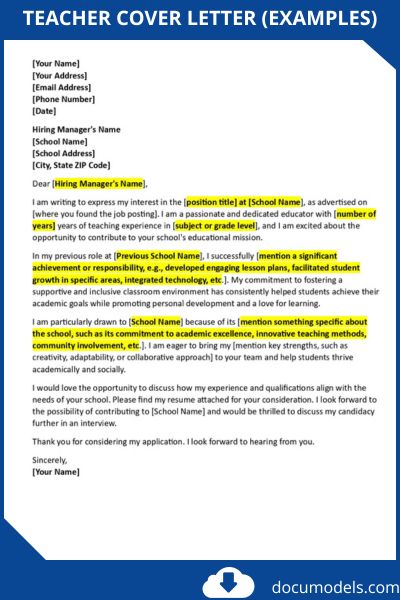
A well-written cover letter can make a lasting impression on hiring committees and set you apart from other candidates.
Teaching cover letter (sample)Teacher cover letter template
[Your Name]
[Your Address]
[Email Address]
[Phone Number]
[Date]
Hiring Manager’s Name
[School Name]
[School Address]
[City, State ZIP Code]
Dear [Hiring Manager’s Name],
I am writing to express my interest in the [position title] at [School Name], as advertised on [where you found the job posting]. I am a passionate and dedicated educator with [number of years] years of teaching experience in [subject or grade level], and I am excited about the opportunity to contribute to your school’s educational mission.
In my previous role at [Previous School Name], I successfully [mention a significant achievement or responsibility, e.g., developed engaging lesson plans, facilitated student growth in specific areas, integrated technology, etc.]. My commitment to fostering a supportive and inclusive classroom environment has consistently helped students achieve their academic goals while promoting personal development and a love for learning.
I am particularly drawn to [School Name] because of its [mention something specific about the school, such as its commitment to academic excellence, innovative teaching methods, community involvement, etc.]. I am eager to bring my [mention key strengths, such as creativity, adaptability, or collaborative approach] to your team and help students thrive academically and socially.
I would love the opportunity to discuss how my experience and qualifications align with the needs of your school. Please find my resume attached for your consideration. I look forward to the possibility of contributing to [School Name] and would be thrilled to discuss my candidacy further in an interview.
Thank you for considering my application. I look forward to hearing from you.
Sincerely,
[Your Name]
Sample substitute teacher cover letter
[Your Name]
[Your Address]
[City, State, ZIP Code]
[Your Email Address]
[Date]
[Principal’s Name]
[School Name]
[School Address]
[City, State, ZIP Code]
Dear [Principal’s Name],
I am writing to express my interest in the Substitute Teacher position at [School Name]. With a strong passion for education and experience working with diverse student populations, I am confident in my ability to provide a positive and productive learning environment in your school.
I hold [your degree or certification], and I have previously worked as a substitute teacher at [previous school or district], where I successfully managed classrooms across multiple grade levels and subjects. My approach focuses on maintaining continuity in the classroom, following lesson plans carefully, and engaging students with clear communication and patience.
I am adaptable, reliable, and committed to supporting students’ academic and social development during their regular teacher’s absence. I am confident that my skills and enthusiasm make me a strong candidate for this role.
Thank you for considering my application. I look forward to the opportunity to contribute to [School Name] and support its educational mission. Please feel free to contact me at [your phone number] or [your email] to discuss how I can be an asset to your team.
Sincerely,
[Your Name]
Sample elementary teacher cover letter
[Your Name]
[Your Address]
[Phone Number]
[Email Address]
[Date]
[Principal’s Name]
[School’s Name]
[School’s Address]
[City, State ZIP Code]
Dear [Principal’s Name],
I am writing to express my interest in the elementary teacher position at [School’s Name], as advertised on [where you found the job posting]. I am passionate about fostering a nurturing and engaging learning environment where students can grow academically, socially, and emotionally. With [X] years of experience in teaching, as well as a strong commitment to helping children reach their full potential, I believe I would be a great addition to your team.
In my previous role as an elementary school teacher at [Previous School’s Name], I successfully created lesson plans that were both educational and engaging, tailored to meet the diverse learning styles of my students. I employed a variety of teaching strategies, including cooperative learning, differentiated instruction, and hands-on activities, to ensure that all students were able to grasp the material effectively.
In addition to my teaching experience, I hold a [Degree] in [Subject or Field] from [University Name], and I am certified in [Certification(s)] in [State/Country]. I also actively seek professional development opportunities to stay current with best practices and innovations in education. I am particularly interested in [mention a specific aspect of the school or district’s curriculum or approach], and I would love to contribute to the continued success of your students.
I would be thrilled to further discuss how my skills and experiences align with the needs of your school. Thank you for considering my application. I look forward to the possibility of meeting with you to talk more about how I can contribute to the positive learning environment at [School’s Name].
Sincerely,
[Your Name]
Special Education Teacher Cover Letter
[Your Name]
[Your Address]
[Phone Number]
[Email Address]
[Date]
Hiring Manager
[School District/Organization Name]
[School Name]
[School Address]
Dear Hiring Manager,
I am excited to apply for the Special Education Teacher position at [School Name]. With [X years] of experience in special education, I have developed a strong ability to design and implement individualized education programs (IEPs) that support diverse learners. My background includes working with students with [specific disabilities], adapting curricula, and utilizing assistive technologies to ensure every student’s success.
I am passionate about creating inclusive and engaging learning environments where all students can thrive. I believe in fostering a collaborative classroom, working closely with other teachers, support staff, and families to ensure each student’s needs are met and their progress is celebrated. My experience has honed my ability to build meaningful relationships with students, helping them gain both academic and social skills that lead to greater independence.
I hold a [Degree] in [Special Education or Related Field] from [University Name], and I am certified by [Certifying Body or State] to teach Special Education in [State]. I am committed to continuous professional development and am eager to contribute my skills and dedication to the [School Name] team.
Thank you for your time and consideration. I look forward to the opportunity to discuss how my experience and enthusiasm for special education can benefit your students. Please feel free to contact me at [Phone Number] or [Email Address] to schedule an interview.
Sincerely,
[Your Name]
What Is a Teacher Cover Letter and Its Purpose?
A teacher cover letter is a formal document submitted alongside your resume when applying for a teaching position. Its purpose is to provide additional details about your skills, experiences, and motivations that your resume may not fully convey. It allows you to connect your qualifications directly to the job posting and express your enthusiasm for the role.
Think of your cover letter as a bridge between your resume and the job you’re seeking—one that gives hiring managers insight into your personality and dedication to education.
Why Is a Teacher Cover Letter Important?
- Personalization: It adds a personal touch to your application, something a list of qualifications on a resume cannot accomplish.
- Demonstrates Communication Skills: Teachers need strong communication skills, and your ability to craft a thoughtful cover letter will showcase this skill.
- Highlights Unique Qualifications: It’s where you can elaborate on specific experiences or achievements that make you stand out, such as developing creative lesson plans or leading extracurricular activities.
- Shows Interest in the Institution: Hiring managers appreciate candidates who’ve taken the time to learn about their school and explain why it’s a good match.
What to Include in Your Teacher Cover Letter
A strong teacher cover letter should be concise (typically one page), professional, and structured to address the specific needs of the role.
Below are the key components to include:
1. Header and Salutation
- Contact Information: Include your name, address, phone number, and email at the top.
- Date: Add the date of submission.
- Recipient’s Details: Address the letter to a specific person (e.g., the principal or hiring manager). Avoid generic salutations like “To Whom It May Concern.” If the name isn’t listed in the job posting, research the school’s website or call to find out.
- Professional Salutation: Use “Dear [Recipient’s Name]” for a formal tone.
2. Introduction
- Hook: Start with a compelling opening that grabs attention. For example, mention a unique achievement or your passion for teaching.
- Position and Source: Clearly state the position you’re applying for and where you found the job listing.
- Brief Overview: Provide a snapshot of your qualifications or teaching philosophy to set the tone.
Example:
“As a dedicated elementary educator with five years of experience fostering inclusive classrooms, I was thrilled to see the opening for a 3rd-grade teacher at [School Name] on [Job Board]. My commitment to student-centered learning and innovative teaching methods aligns with your school’s mission to inspire lifelong learners.”
3. Body Paragraphs
The body of your cover letter should consist of 1–2 paragraphs that highlight your qualifications and fit for the role.
Paragraph 1: Relevant Experience and Skills
- Teaching Experience: Highlight specific teaching roles, grade levels, or subjects you’ve taught.
- Achievements: Share measurable accomplishments, such as improved student test scores or successful classroom initiatives.
- Skills: Emphasize skills like classroom management, lesson planning, or integrating technology into lessons.
- Alignment with School: Connect your experience to the school’s values, curriculum, or teaching philosophy.
Example:
“At [Previous School], I successfully implemented differentiated instruction strategies, resulting in a 15% increase in student engagement as measured by classroom participation metrics. My ability to integrate STEM activities into the curriculum aligns with [School Name]’s focus on innovative, hands-on learning.”
Paragraph 2: Personal Fit and Passion
- Why This School?: Show you’ve researched the school by referencing its mission, programs, or community involvement.
- Teaching Philosophy: Share your approach to education and how it benefits students.
- Soft Skills: Highlight qualities like empathy, adaptability, or collaboration that make you a great fit.
Example:
“I am particularly drawn to [School Name]’s commitment to fostering a diverse and inclusive learning environment. My teaching philosophy emphasizes building strong relationships with students to create a safe space for learning, which I believe complements your school’s values.”
4. Closing
- Call to Action: Politely express your enthusiasm for an interview and your willingness to discuss your qualifications further.
- Gratitude: Thank the reader for considering your application.
- Professional Sign-Off: Use “Sincerely” or “Best regards,” followed by your full name.
Example:
“I am excited about the opportunity to contribute to [School Name]’s vibrant community and would welcome the chance to discuss how my skills can support your students’ success. Thank you for considering my application. I look forward to the possibility of an interview.
Sincerely,
[Your Full Name]”
Optional: Enclosures
If submitting a physical copy, include “Enclosures: Resume, [Other Documents]” to indicate additional materials.
How to Tailor Your Teacher Cover Letter
Tailoring your cover letter to each teaching position is crucial to demonstrate your genuine interest and suitability. A generic cover letter risks being overlooked, as hiring managers can spot a lack of effort.
Here’s how to customize your cover letter effectively:
1. Research the School
- Visit the school’s website to understand its mission, values, and programs.
- Look for specific initiatives, such as STEM programs, extracurricular activities, or diversity efforts, that you can reference.
- Check recent news or social media posts to identify achievements or priorities (e.g., a new reading program or community outreach).
Example:
If applying to a school with a strong arts program, mention your experience integrating art into lessons or leading extracurricular art clubs.
2. Analyze the Job Description
- Identify key requirements, such as specific subjects, grade levels, or skills (e.g., experience with special education or bilingual instruction).
- Use keywords from the job posting to align your skills with their needs.
- Address any preferred qualifications, like familiarity with a particular curriculum or technology.
Example:
If the job requires “proficiency in data-driven instruction,” highlight your experience using student performance data to inform lesson plans.
3. Showcase Relevant Achievements
- Choose accomplishments that directly relate to the role. For example, if applying for a high school math position, focus on your success teaching algebra rather than unrelated subjects.
- Use metrics when possible (e.g., “increased student reading proficiency by 20%”).
- Tailor examples to match the school’s priorities, such as improving test scores or fostering inclusivity.
4. Reflect the School’s Culture
- Mirror the tone and values of the school. For example, a progressive school may value creativity, while a traditional school may prioritize structure.
- Mention specific programs or initiatives that resonate with you, such as a focus on social-emotional learning or extracurricular involvement.
Example:
“[School Name]’s emphasis on social-emotional learning resonates with my approach to fostering student well-being through mindfulness activities in the classroom.”
Visual Aid: Tailoring Checklist
| Step | Action |
| Research the School | Visit website, check social media, and note mission/values. |
| Analyze Job Description | Identify key skills, qualifications, and keywords. |
| Highlight Relevant Experience | Use specific examples and metrics that match the role. |
| Reflect School Culture | Align your tone and examples with the school’s priorities and values. |
| Proofread | Ensure no generic references (e.g., wrong school name) remain. |
Adapting Cover Letters for Different Teaching Roles
Teaching roles vary widely, from early childhood education to high school special education. Adapting your cover letter to reflect the specific demands of each role is essential.
1. Early Childhood Education (Pre-K to Grade 2)
Focus: Emphasize nurturing, play-based learning, and foundational skills (e.g., literacy, social development).
Skills to Highlight: Patience, creativity, classroom management for young learners, and parent communication.
Example Language:
“My experience designing play-based learning activities has helped my preschool students develop early literacy skills while fostering a love for learning.”
2. Elementary Education (Grades 3–5)
Focus: Highlight your ability to teach multiple subjects and foster critical thinking.
Skills to Highlight: Curriculum development, differentiated instruction, and student engagement.
Example Language:
“By integrating project-based learning into my 4th-grade classroom, I increased student participation by 25% and improved collaborative skills.”
3. Middle School (Grades 6–8)
Focus: Address the unique needs of adolescents, including social-emotional learning and subject-specific expertise.
Skills to Highlight: Classroom management, interdisciplinary teaching, and mentoring.
Example Language:
“As a 7th-grade science teacher, I developed hands-on experiments that boosted student curiosity and aligned with NGSS standards.”
4. High School (Grades 9–12)
Focus: Emphasize subject expertise, college/career readiness, and advanced instructional strategies.
Skills to Highlight: Content mastery, data-driven instruction, and preparing students for standardized tests.
Example Language:
“My experience teaching AP Calculus has equipped me to guide students toward academic excellence and college readiness.”
5. Special Education
Focus: Highlight your ability to support diverse learners and implement individualized education plans (IEPs).
Skills to Highlight: Knowledge of IEPs, collaboration with support staff, and inclusive teaching strategies.
Example Language:
“I have successfully collaborated with IEP teams to create tailored interventions, resulting in measurable progress for students with diverse learning needs.”
6. Subject-Specific Roles (e.g., Art, Music, PE)
Focus: Showcase your expertise in the subject and its impact on student development.
Skills to Highlight: Creative instruction, cross-curricular connections, and extracurricular involvement.
Example Language:
“As an art teacher, I’ve led after-school programs that increased student participation in creative projects by 30%.”
Visual table: Adapting for Teaching Roles
| Teaching Role | Key Focus | Skills to Emphasize |
| Early Childhood | Nurturing, play-based learning | Creativity, patience, parent communication |
| Elementary | Multi-subject teaching, engagement | Differentiated instruction, curriculum design |
| Middle School | Adolescent development, subject expertise | Classroom management, mentoring |
| High School | College readiness, content mastery | Data-driven instruction, subject expertise |
| Special Education | Inclusive teaching, IEPs | Collaboration, tailored interventions |
| Subject-Specific | Creative instruction, student development | Subject expertise, extracurricular leadership |
Quick Tips for Writing a Strong Cover Letter
- Keep it concise (one page).
- Use clear, professional language.
- Proofread for grammar and spelling errors.
- Show your personality and passion for teaching.
- Always tailor each letter to the specific job and school.
Format model to edit
Related Articles: