
Applying to graduate school is an exciting step toward your academic and professional goals, but the process can feel overwhelming. Among the many components of your application, a strong letter of recommendation plays an essential role in showcasing your potential.
These letters provide admissions committees with insights into your abilities, work ethic, and character, often tipping the scales in your favor if written effectively. But what makes a letter truly stand out?
A great letter of recommendation doesn’t just list achievements—it tells a story. It highlights your unique qualities in a way that feels personal and impactful, painting a vivid picture of why you’re an excellent candidate. Whether it’s a glowing account of your teamwork skills or an example of your academic perseverance, a compelling letter can make a world of difference.
In this post, discuss the do’s and don’ts, and provide valuable examples to guide you in crafting a recommendation that resonates with admissions boards.
What is a Graduate School Recommendation Letter?
A graduate school recommendation letter is a formal document written by a person who can attest to an applicant’s qualifications and capabilities for graduate study. This letter provides an assessment of the applicant’s academic performance, research abilities, and potential for success in a graduate program.
It is an essential component of the application process, offering admissions committees a more comprehensive view of the candidate beyond grades and test scores.
Who Should Write a Recommendation Letter for Graduate School?
Choosing the right individuals to write your recommendation letters is crucial. The ideal recommenders are those who can provide meaningful insights into your academic and professional capabilities.
Here are some key points to consider:
Ideal Recommenders
- Professors and Academic Advisors: They can speak to your academic performance, intellectual abilities, and potential for research.
- Research Supervisors: If you have participated in research projects, supervisors can provide detailed accounts of your contributions and skills.
- Professional Mentors: For programs that value professional experience, a mentor or supervisor from your workplace can highlight your practical skills and achievements.
Tips for Choosing Recommenders
- Relevance: Select individuals who are familiar with your work in areas relevant to the graduate program.
- Relationship: Choose those who know you well and can provide a personalized and detailed recommendation.
- Reputation: Recommendations from well-respected professionals in your field can carry significant weight.
How to Request a Letter of Recommendation for Graduate School
Requesting a letter of recommendation can be a daunting task, but with proper preparation and communication, you can ensure a strong and supportive letter.
Steps to Request a Recommendation Letter
- Start Early: Give your recommenders plenty of time to write the letter. Aim to ask at least a month before the application deadline.
- Choose Wisely: Select recommenders who know you well and can provide specific examples of your strengths and achievements.
- Provide Necessary Information: Supply your recommenders with your resume, personal statement, and details about the graduate program. This will help them tailor the letter to highlight relevant aspects of your background.
- Make a Formal Request: Approach your recommenders in person if possible, or via a well-crafted email. Be polite and explain why you are asking them specifically.
- Follow Up and Thank Them: After they agree, send a reminder as the deadline approaches. Once the letter is submitted, send a thank-you note to express your gratitude.
Types of Recommendation Letters
There are predominantly two types of recommendation letters:
- Academic Recommendation Letters: These are typically written by professors who can attest to a student’s academic performance and potential. They place emphasis on scholarly contributions and engagement.
- Professional Recommendation Letters: Often authored by employers or supervisors, these letters vouch for the student’s professional experience and skills relevant to graduate studies.
Key Elements of a Graduate School Recommendation Letter
- Introduction and Statement of Recommendation: This section should clearly state the recommender’s relationship to the applicant and the purpose of the letter.
- Qualifications and Achievements: Highlight specific academic achievements, research experiences, and relevant skills.
- Personal Anecdotes: Provide examples that illustrate the applicant’s strengths and character.
- Conclusion: Summarize the applicant’s potential and express a strong endorsement for their admission to the graduate program.
How to write a letter of recommendation for graduate school
Writing a letter of recommendation for graduate school can seem daunting, especially if it’s your first time. However, with the right structure and information, you can create a compelling letter that highlights the applicant’s strengths and qualifications.
Here’s a step-by-step guide to help you through the process.
1. Understand the Purpose of the Letter
Before you start writing, ask yourself:
- Why is the applicant asking you to write this letter?
- What program are they applying to?
- What qualities and skills should you highlight to support their application?
Clarify any doubts by asking the applicant for specifics about the program, deadlines, and guidelines. Reviewing the program’s requirements or mission statement can help you tailor the letter.
2. Request Key Information from the Applicant
Ask the applicant to provide the following:
- A copy of their resume or CV
- A list of their achievements and experiences relevant to the program
- A personal statement or a brief note on why they’re applying
- Details about the submission process (online upload, email, or physical copy)
3. Follow a Strong Structure
A professional recommendation letter typically has the following format:
Opening Paragraph
Introduce yourself and explain your relationship with the applicant.
Include:
- Your name, job title, and institution (if relevant)
- How you know the applicant (e.g., professor, manager, advisor)
- The duration and context of your relationship
For example: “It is my pleasure to recommend [Applicant’s Full Name] for admission to [Program Name] at [University Name]. I have worked as an Associate Professor in the Department of Biology at XYZ University for the past ten years, and I had the privilege of mentoring [Applicant] during her undergraduate research project.”
Middle Paragraphs
This is the core of your letter. Focus on their qualifications, achievements, and personal qualities:
- Highlight specific examples of their skills in action, such as completing a complex project, conducting impressive research, or overcoming challenges.
- Mention qualities that align with the program’s focus, such as leadership, collaboration, critical thinking, or creativity.
- Provide metrics, if possible, to quantify their impact. (e.g., “Under her leadership, the team increased efficiency by 20%.”)
For example: “During our research collaboration on genetic sequencing, [Applicant] demonstrated exceptional critical thinking and technical skills. She devised a novel approach to analyze DNA samples, which improved our results’ accuracy by 15%. Her ability to tackle challenges with perseverance and innovation was truly inspiring.”
Closing Paragraph
Wrap up the letter by:
- Reiterating your strong support for the applicant.
- Offering your contact information for follow-up questions.
For example: “I am confident that [Applicant’s Name] will be an excellent addition to your graduate program. Please do not hesitate to contact me at [email] or [phone number] if you require additional information.”
End with a formal sign-off, such as:
“Sincerely,
[Your Full Name]
[Your Position/Title and Institution]”
4. Keep the Tone Enthusiastic Yet Professional
Admissions committees value letters that are authentic and enthusiastic without sounding overly exaggerated. Write confidently, avoiding clichéd phrases like “one of the best students I’ve known,” unless you provide evidence to back it up.
5. Format the Letter Properly
- Font & Size: Use a professional font like Times New Roman or Arial in 11-12 point size.
- Length: Aim for 1-2 pages. Admissions teams prioritize concise and relevant letters.
- Margins: Keep standard 1-inch margins.
6. Proofread Thoroughly
Errors can reflect poorly on both you and the applicant.
Check for:
- Typos, grammar issues, and awkward phrasing.
- Facts or metrics that are inaccurately stated.
- Proper spelling of the applicant’s and program’s name.
Graduate School Letter of Recommendation Examples
Example 1
[Your Name]
[Title/Position]
[Email Address]
[Phone Number]
[Date]
Admissions Committee
[Name of Graduate Program or University]
[University Address]
Dear Members of the Admissions Committee,
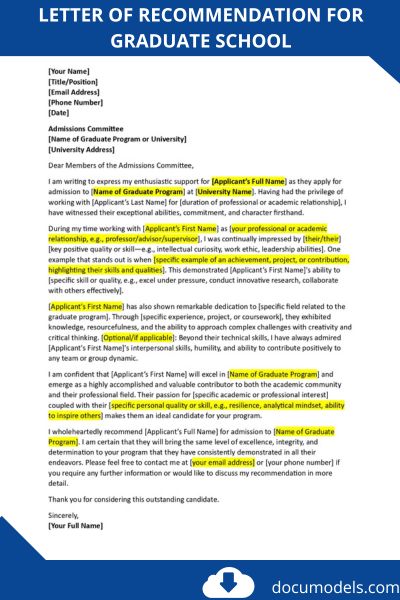
I am writing to express my enthusiastic support for [Applicant’s Full Name] as they apply for admission to [Name of Graduate Program] at [University Name]. Having had the privilege of working with [Applicant’s Last Name] for [duration of professional or academic relationship], I have witnessed their exceptional abilities, commitment, and character firsthand.
During my time working with [Applicant’s First Name] as [your professional or academic relationship, e.g., professor/advisor/supervisor], I was continually impressed by [their/their] [key positive quality or skill—e.g., intellectual curiosity, work ethic, leadership abilities]. One example that stands out is when [specific example of an achievement, project, or contribution, highlighting their skills and qualities]. This demonstrated [Applicant’s First Name]’s ability to [specific skill or quality, e.g., excel under pressure, conduct innovative research, collaborate with others effectively].
[Applicant’s First Name] has also shown remarkable dedication to [specific field related to the graduate program]. Through [specific experience, project, or coursework], they exhibited knowledge, resourcefulness, and the ability to approach complex challenges with creativity and critical thinking. [Optional/if applicable]: Beyond their technical skills, I have always admired [Applicant’s First Name]’s interpersonal skills, humility, and ability to contribute positively to any team or group dynamic.
I am confident that [Applicant’s First Name] will excel in [Name of Graduate Program] and emerge as a highly accomplished and valuable contributor to both the academic community and their professional field. Their passion for [specific academic or professional interest] coupled with their [specific personal quality or skill, e.g., resilience, analytical mindset, ability to inspire others] makes them an ideal candidate for your program.
I wholeheartedly recommend [Applicant’s Full Name] for admission to [Name of Graduate Program]. I am certain that they will bring the same level of excellence, integrity, and determination to your program that they have consistently demonstrated in all their endeavors. Please feel free to contact me at [your email address] or [your phone number] if you require any further information or would like to discuss my recommendation in more detail.
Thank you for considering this outstanding candidate.
Sincerely,
[Your Full Name]
Example 2
Admissions Committee
[Name of Graduate Program or University]
[University Address]
[Date]
Subject: Recommendation for [Applicant’s Full Name]
Dear Members of the Admissions Committee,
It is my pleasure to write in support of [Applicant’s Full Name], who is applying to [Name of Graduate Program] at [University Name]. I have had the privilege of [working with/teaching/supervising] [Applicant’s First Name] for [length of relationship] in my role as [your position]. Over this time, I have come to know [Applicant’s First Name] as a highly impressive individual, both in terms of their intellectual capabilities and the personal qualities that make them such a unique and promising candidate.
From our very first [class/project/interaction], it was clear that [Applicant’s First Name] offered something exceptional. They impressed me with their [specific skill or trait, e.g., sharp analytical mind, ability to think critically, creativity], particularly during [specific example, e.g., a challenging project, a pivotal presentation, demanding research]. [He/She/They] demonstrated not only technical proficiency but also the ability to approach complex problems with resourcefulness and a fresh perspective.
Equally noteworthy is [Applicant’s First Name]’s character. [He/She/They] consistently approached challenges with perseverance, balanced determination, and an eagerness to learn, encouraging others in the process. For instance, [specific anecdote illustrating their leadership, teamwork, or personal values]. This experience, among many others, showcased [his/her/their] ability to bring out the best in both themselves and those around them, whether working collaboratively or independently.
Beyond this, [Applicant’s First Name] has demonstrated a sincere passion for [academic field or professional field]. Their drive to pursue deeper understanding in [specific area or project] is evident in [key accomplishment, e.g., their research, community involvement, internship experience]. These attributes combined with their [specific positive quality, e.g., dedication, thoughtful approach, vision for the future] assure me that [he/she/they] is prepared not only to excel in graduate-level study but also to make meaningful contributions to the [academic/professional discipline].
I am confident that [Applicant’s First Name] will thrive at [University Name] and bring energy, insight, and dedication to your program. [He/She/They] has my unequivocal recommendation, and I am excited about the impact [he/she/they] will undoubtedly make in their future endeavors. Should you need further information or details, please do not hesitate to reach out to me at [your email address] or [your phone number].
Thank you for considering [Applicant’s Full Name]’s application.
Sincerely,
[Your Full Name]
[Title/Position]
[Your Institution/Organization]
Tips for Writing an Effective Letter of Recommendation
- Be Honest: Only agree to write the letter if you can genuinely support the applicant.
- Focus on Unique Strengths: What sets the candidate apart from others? Avoid generic statements.
- Tailor Each Letter: If the applicant is applying to multiple programs, customize each letter for relevance.
- Avoid Overloading with Praise: While positivity is key, an overly enthusiastic tone without evidence may come across as insincere.
Format model to edit
Related Articles: